
Short Questions:
The primary purpose of reproduction in living organisms is to ensure the continuation and survival of a species. Through reproduction, organisms pass on their genetic material to the next generation, allowing for the maintenance of population numbers, adaptation to changing environments through genetic variation (especially in sexual reproduction), and the overall persistence of life over time.
The two main types of reproduction are:
- Asexual Reproduction
- Sexual Reproduction
The human reproductive system becomes functional at puberty, when hormonal changes trigger the ability to reproduce—typically between ages 8–13 in girls and 9–14 in boys.
The hormone primarily responsible for the development of male secondary sexual characteristics is testosterone.
It is produced mainly by the testes and leads to changes such as a deeper voice, facial and body hair growth, and increased muscle mass during puberty.
Sertoli cells support and nourish developing sperm in the testes, form the blood-testis barrier, and help regulate sperm production through hormone secretion.
The hormone essential for spermatogenesis that acts on Sertoli cells is follicle-stimulating hormone (FSH).
FSH stimulates Sertoli cells to support sperm development and produce androgen-binding protein, which helps maintain high testosterone levels in the testes.
The hormone primarily responsible for the development of female secondary sexual characteristics is estrogen.
Estrogen promotes changes such as the development of breasts, widening of the hips, and the regulation of the menstrual cycle during puberty.
Ovulation in the female reproductive cycle is triggered by a surge in luteinizing hormone (LH).
This surge occurs around the middle of the menstrual cycle, following a rise in follicle-stimulating hormone (FSH). The LH surge causes the mature follicle to release an egg from the ovary, a process known as ovulation.
After ovulation, progesterone is produced by the corpus luteum, which forms from the ruptured follicle in the ovary.
Progesterone helps prepare the uterine lining for possible implantation of a fertilized egg. If pregnancy does not occur, the corpus luteum degenerates, leading to a drop in progesterone and the onset of menstruation.
The process of sperm cell production is called spermatogenesis.
It occurs in the seminiferous tubules of the testes and involves the development of spermatogonia into mature sperm cells (spermatozoa).
Spermatogenesis occurs in the seminiferous tubules of the testes. These tubules are where sperm cells are produced and matured before being transported through the male reproductive system.
Fertilization typically occurs in the fallopian tubes (also known as uterine tubes) of the female reproductive system.
The sperm meets the egg in the ampulla region of the fallopian tube, where fertilization usually takes place.
The genetic outcome of offspring produced through asexual reproduction is that the offspring are genetically identical to the parent.
This is because asexual reproduction involves only one parent, and the offspring inherit the same genetic material (DNA) as the parent, resulting in clones.
The scrotum in a male rabbit plays a crucial role in regulating the temperature of the testes.
It holds the testes outside the body cavity, providing a cooler environment that is essential for spermatogenesis (sperm production). The scrotum helps maintain the optimal temperature for sperm development, typically a few degrees cooler than the body temperature.
In female rabbits, fertilization typically occurs in the oviducts (fallopian tubes). Specifically, it happens in the ampulla, which is the wider section of the oviduct where the egg meets the sperm after ovulation.
Long Questions:
In male sexual development, hormones play a critical role in regulating various physiological changes and the process of spermatogenesis. The primary hormones involved are testosterone and follicle-stimulating hormone (FSH).
Here's how each hormone functions and how they interact:
Testosterone:
Production: Testosterone is produced by the Leydig cells in the testes, primarily in response to luteinizing hormone (LH) from the pituitary gland.
Functions:
- Development of male secondary sexual characteristics: Testosterone is responsible for the development of characteristics like a deeper voice, facial and body hair, muscle growth, and increased bone density.
- Spermatogenesis: Testosterone acts on the Sertoli cells in the seminiferous tubules to support and nourish developing sperm cells. It helps maintain the environment necessary for sperm production.
- Regulation of the male reproductive system: Testosterone also helps regulate the function of the hypothalamic-pituitary-gonadal axis, influencing the secretion of other hormones.
Follicle-Stimulating Hormone (FSH):
Production: FSH is produced by the anterior pituitary gland in response to signals from the hypothalamus (specifically gonadotropin-releasing hormone (GnRH)).
Functions:
- Stimulating Sertoli cells: FSH primarily acts on Sertoli cells in the seminiferous tubules, where it helps support spermatogenesis by promoting the maturation of sperm cells.
- Production of androgen-binding protein (ABP): FSH stimulates Sertoli cells to produce ABP, which binds to testosterone in the seminiferous tubules, ensuring that a high concentration of testosterone is maintained, which is essential for sperm development.
Interaction between Testosterone and FSH in Spermatogenesis:
- FSH and Sertoli cells: FSH stimulates Sertoli cells, which in turn support and nourish developing sperm. Sertoli cells also produce ABP, which keeps testosterone levels high in the seminiferous tubules.
- Testosterone's role: Testosterone, produced by Leydig cells in response to LH, binds to androgen receptors on Sertoli cells, further supporting the development of sperm.
- Coordination: The interaction between FSH and testosterone ensures the proper functioning of spermatogenesis. FSH promotes the early stages of sperm development, while testosterone maintains the environment necessary for the final stages of sperm maturation.
- Negative feedback: Both testosterone and inhibin (produced by Sertoli cells) provide negative feedback to the hypothalamus and pituitary gland to regulate the levels of LH and FSH, maintaining hormonal balance and ensuring proper sperm production.
Comparision and contrast the processes of spermatogenesis and oogenesis:
| Feature | Spermatogenesis | Oogenesis |
|---|---|---|
| Location | Seminiferous tubules of the testes | Ovaries |
| Begins | At puberty, continues throughout life | Begins during fetal development, resumes at puberty |
| Gamete Produced | Four functional sperm cells per precursor cell | One functional egg (ovum) and three polar bodies |
| Duration | 64–72 days for sperm maturation | Takes years for the process to complete; eggs mature monthly |
| Number of Gametes | Four sperm per primary spermatocyte | One egg per primary oocyte, three polar bodies |
| Meiotic Divisions | Two meiotic divisions (Meiosis I and II) | Two meiotic divisions, with unequal cytokinesis |
| Cytokinesis | Equal cytokinesis, dividing cytoplasm equally | Unequal cytokinesis, most cytoplasm goes to the egg |
| Timing of Release | Continuous sperm production | One egg is released per menstrual cycle |
| Completion of Meiosis | Completes after two meiotic divisions | Meiosis II completes only after fertilization |
Fertilization in Humans:
Fertilization in humans is the process by which a sperm cell from a male merges with an egg (ovum) from a female, resulting in the formation of a zygote. This process typically occurs in the fallopian tube (oviduct), following ovulation, when a mature egg is released from the ovary.
Steps of Fertilization:
- Sperm Transport: After ejaculation, sperm travel through the female reproductive tract, navigating the cervix, uterus and into the fallopian tubes.
- Egg Release: The egg, released from the ovary during ovulation, enters the fallopian tube.
- Sperm Penetration: Multiple sperm attempt to penetrate the zona pellucida (protective layer around the egg). The first sperm to penetrate triggers a reaction that prevents other sperm from entering (known as block to polyspermy).
Fusion of Gametes:
The nucleus of the sperm fuses with the nucleus of the egg, combining their genetic material to form a zygote.
Formation of Zygote:
The sperm and egg's chromosomes combine, restoring the diploid number of chromosomes (46 in humans), with 23 chromosomes from the sperm and 23 chromosomes from the egg.
Significance of Internal vs. External Fertilization:
- Internal Fertilization in humans ensures that fertilization occurs in a protected environment within the female's body, which increases the chances of successful fertilization and embryo development. The female reproductive system provides a controlled and supportive environment, including protection from environmental factors and a more directed transfer of sperm to egg.
- External Fertilization, while more common in aquatic organisms, can be less reliable due to the exposure of gametes to the external environment. However, species that employ external fertilization often compensate by producing large numbers of eggs and sperm to increase the chances of fertilization.
Restoration of the Diploid Chromosome Number:
Fertilization is essential for restoring the diploid number of chromosomes in the zygote, ensuring that the offspring has two complete sets of chromosomes (one set from the mother and one set from the father).
- Sperm Cell: Contains 23 chromosomes (haploid, n).
- Egg Cell: Contains 23 chromosomes (haploid, n).
When the sperm and egg fuse, their haploid sets of chromosomes combine to form a diploid zygote with 46 chromosomes (2n), half from the father and half from the mother. This process restores the diploid chromosome number, which is characteristic of human cells, ensuring that the organism has a complete set of chromosomes for normal development.
Key Steps in Sexual Reproduction:
Sexual reproduction in rabbits, like in most mammals, involves the fusion of male and female gametes (sperm and egg) to produce a fertilized zygote. The key steps in this process are outlined below, with specific details for rabbits:
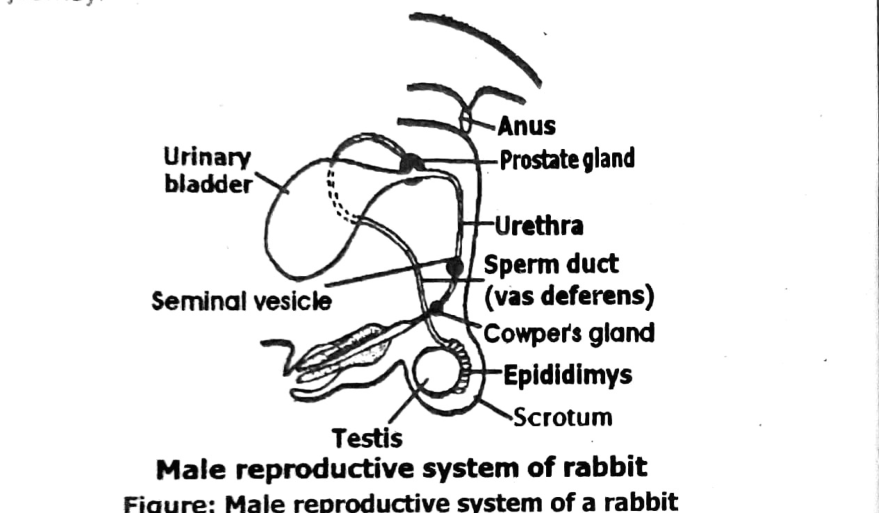
Male Reproductive System (Rabbit):
The male reproductive system in rabbits includes organs that produce sperm and facilitate its delivery to the female reproductive system.
- Testes: The testes produce sperm and the hormone testosterone. In rabbits, the testes are located in the scrotum, which regulates the temperature for sperm production.
- Epididymis: Sperm mature and are stored here.
- Vas Deferens: Sperm travel from the epididymis to the urethra.
- Penis: The penis delivers sperm into the female's reproductive tract during mating.
- Seminal Vesicles & Prostate Gland: These produce seminal fluid that nourishes and protects the sperm during its journey.
Female Reproductive System (Rabbit):
The female reproductive system is responsible for egg production, fertilization, and the development of offspring.
- Ovaries: The ovaries produce eggs (ova) and secrete hormones like estrogen and progesterone.
Fallopian Tubes (Oviducts): The site where fertilization usually occurs. The egg is released from the ovary and travels through the fallopian tube.
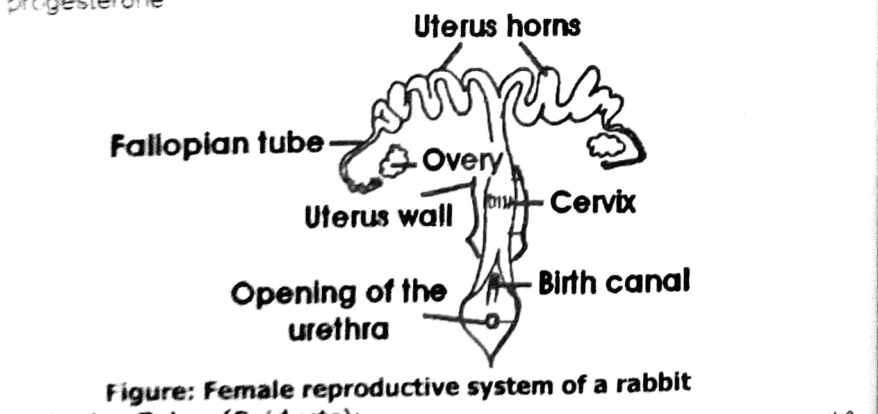
- Uterus: After fertilization, the zygote implants in the uterine lining for further development.
- Vagina: The passage through which sperm enters during mating and where the offspring exits during birth.
Mating and Fertilization:
Mating: During mating, the male rabbit introduces sperm into the female's vagina using his penis. The sperm then travels through the cervix and into the uterus, eventually reaching the fallopian tubes where an egg may be waiting for fertilization.
Ovulation: Female rabbits have induced ovulation, meaning ovulation occurs after mating. The release of the egg from the ovary is triggered by the act of mating.
Fertilization: If sperm successfully meets an egg in the fallopian tube, fertilization occurs. The sperm's genetic material combines with the egg's genetic material, restoring the diploid chromosome number (46 chromosomes in total in rabbits). The fertilized egg becomes a zygote.
Early Development:
Zygote Development: The zygote undergoes cell divisions (cleavage) as it moves down the fallopian tube toward the uterus. As it divides, it forms a blastocyst.
Implantation: The blastocyst implants in the lining of the uterus, where it will continue to develop.
Pregnancy and Fetal Development:
Embryo to Fetus: After implantation, the developing organism is called an embryo. As it grows, it becomes a fetus. During pregnancy, the female rabbit's body supports the developing fetus through the placenta, which provides nutrients and oxygen.
Gestation Period: The gestation period for rabbits is typically 28–31 days (relatively short compared to humans). During this time, the fetus undergoes rapid development.
Birth: After the gestation period, the female rabbit gives birth to live offspring. A typical litter consists of several kits (baby rabbits). The birth process occurs through the vagina, and the mother immediately begins to care for the young.
Post-Birth Care and Development:
Nursing: Newborn rabbits (kits) are born blind, hairless, and helpless. They rely on the mother's milk for nourishment and development. The mother provides nursing and protection to the kits.
Weaning and Maturity: Kits grow quickly and are weaned off the mother's milk at around 4–6 weeks of age. They reach sexual maturity at around 5–8 months and can begin the reproductive cycle, continuing the cycle of reproduction.
Mechanisms of asexual reproduction in animals:
Binary Fission:
Mechanism: The parent organism divides into two identical offspring. The parent's genetic material is replicated, and then the cell divides into two daughter cells, each with an identical copy of the genetic material.
Example: Bacteria and Amoebas are classic examples of organisms that reproduce through binary fission. In bacteria, the single cell replicates its DNA and splits into two genetically identical cells. This process is rapid and efficient.
Budding:
Mechanism: A new organism grows as a small bud on the parent's body, and when it becomes large enough, it detaches to live independently. The genetic material of the bud is identical to that of the parent.
Example: Hydra (a freshwater invertebrate) and yeast (a type of fungus) reproduce by budding. In Hydra, a small bud forms on the body of the parent, and after developing, it breaks off to become a new individual.
Fragmentation:
Mechanism: The body of the parent organism breaks into pieces, and each fragment has the ability to grow into a new organism. This usually happens when the organism is physically damaged or intentionally divides.
Example: Starfish and planarians (flatworms) are capable of fragmentation. For instance, a starfish can regenerate a whole new individual from just a part of its body, such as an arm. Similarly, planarians can regenerate from a single piece of their body.
Regeneration:
Mechanism: An organism can regrow lost body parts or even create a whole new individual from a fragment of its body. This involves cellular differentiation, where cells develop into specific types of tissues to form new structures.
Example: Flatworms and sea stars are well-known for their regenerative abilities. A sea star, if it loses a limb, can regenerate an entirely new limb (or even an entire organism from a single limb).
Parthenogenesis:
Mechanism: Offspring develop from an unfertilized egg, and they are genetically identical to the mother, since no sperm is involved in fertilization. Parthenogenesis is often seen in certain environmental conditions where sexual reproduction is not possible or efficient.
Example: Bees, aphids, and certain lizards (like the whiptail lizard) reproduce through parthenogenesis. In bees, female workers can reproduce asexually and produce offspring without mating, which ensures colony growth in certain conditions.
Contributions to Reproduction:
- Asexual reproduction allows organisms to rapidly reproduce and populate environments, especially in stable, favorable conditions where genetic variation may not be essential.
- These methods are highly efficient because they do not require mating and can lead to quick population growth.
- However, because offspring are genetically identical to the parent (except in rare cases like mutations), this can limit the ability to adapt to changing environments over time.
Sex Determination in Humans:
In humans, sex determination is based on the combination of sex chromosomes inherited from the parents. The primary mechanism is governed by the X and Y chromosomes, which are part of the 23 pairs of chromosomes in human cells.
Chromosomal Basis of Sex Determination:
- Humans have 46 chromosomes in total, divided into 23 pairs. Of these, 22 pairs are autosomes (non-sex chromosomes), and the 23rd pair consists of sex chromosomes (XX or XY).
- The X chromosome is larger and carries many essential genes, while the Y chromosome is smaller and carries fewer genes.
Males:
- XY chromosome combination: A male has one X chromosome from the mother and one Y chromosome from the father.
Females:
- XX chromosome combination: A female has two X chromosomes, one inherited from each parent.
How Sperm and Eggs Contribute:
- Eggs (female gametes): Females produce eggs that contain only one X chromosome (because they have two X chromosomes, they pass one of them on to the offspring).
- Sperm (male gametes): Males produce sperm that can carry either an X chromosome or a Y chromosome (since males have one X and one Y chromosome, the sperm can carry either the X or Y).
The Role of Sperm in Determining Sex:
- The sex of the offspring is determined by the sperm because it is the sperm that carries either an X or a Y chromosome.
- If the sperm carrying an X chromosome fertilizes the egg, the resulting offspring will be XX (female).
- If the sperm carrying a Y chromosome fertilizes the egg, the resulting offspring will be XY (male).
Thus, it is the male's sperm that determines the biological sex of the offspring.
The SRY Gene and Male Sex Development:
The SRY gene (Sex-determining Region Y gene) is located on the Y chromosome and plays a critical role in male sex differentiation:
SRY Gene Function:
The SRY gene triggers the development of male sex organs by initiating a cascade of events that lead to the formation of testes. The gene is responsible for the formation of testis-determining factor (TDF), a protein that drives the development of the testes from the undifferentiated gonads during early embryonic development.
Testes Formation:
The presence of the SRY gene activates a pathway that causes the gonads to become testes. This is a pivotal event because the testes will produce testosterone and other male sex hormones (androgens), which drive the development of male secondary sexual characteristics, such as the growth of the penis, scrotum, and other male traits during puberty.
Absence of SRY:
If the SRY gene is absent (as occurs in individuals with XX chromosomes), the gonads will develop into ovaries, and the individual will develop female sex organs.
The terms viviparous, oviparous, and ovoviviparous refer to different methods of reproduction in animals, each with distinct strategies for nurturing offspring. These reproductive strategies are adapted to the environments and lifestyles of the animals.
Viviparous Animals:
Viviparous reproduction refers to animals that give birth to live young that have developed inside the mother's body. In these animals, the embryo receives nourishment from the mother through a placenta or similar structure.
Characteristics:
- Internal fertilization: Sperm fertilizes the egg inside the female's body.
- Development inside the mother: The embryo develops within the mother's body, where it is nourished via a placenta (in mammals) or other structures.
- Live birth: The offspring are born alive, fully formed or nearly developed.
Examples:
Humans, mammals (e.g., dogs, elephants), and some reptiles (e.g., certain species of lizards and snakes).
Adaptation to Environment:
Viviparous reproduction is advantageous in environments where survival rates of embryos are low outside the mother’s body (e.g., harsh climates, predation pressure). The internal development allows for better protection and a stable environment for the developing young. This method also enables the mother to provide a constant supply of nutrients and protection from external threats.
Oviparous Animals:
Oviparous animals lay eggs that develop and hatch outside the mother’s body. The embryo receives nourishment from the yolk within the egg.
Characteristics:
- External fertilization (in many species): Eggs are fertilized outside the female’s body, or fertilization occurs just before the eggs are laid.
- Egg-laying: Females lay eggs in a safe environment, where the embryos develop externally, often with a protective shell.
- Nourishment from yolk: The embryo receives nutrients from the yolk inside the egg during development.
Examples:
Birds (e.g., chickens, eagles), reptiles (e.g., turtles, lizards), and amphibians (e.g., frogs).
Adaptation to Environment:
Oviparous reproduction is advantageous in environments where the mother may not be able to care for offspring long-term or where laying many eggs can increase reproductive success. This strategy allows for the dispersal of offspring in different environments (such as water or land). Additionally, the protective shell or coating of the egg protects the developing embryo from desiccation, predation, and environmental stress.
Ovoviviparous Animals:
Ovoviviparous animals produce eggs that develop inside the mother’s body, but the embryos are nourished by the yolk inside the egg, not directly from the mother. The eggs hatch internally, and the mother gives birth to live young.
Characteristics:
- Internal fertilization: Fertilization occurs inside the female’s body.
- Egg development inside the mother: The embryo develops within an egg, but the egg is retained inside the mother’s body until it hatches.
- No placenta: The developing embryos are not nourished directly by the mother, but by the egg’s yolk.
Examples:
Sharks (e.g., great white shark, hammerhead shark), some reptiles (e.g., some species of snakes), and some amphibians (e.g., certain species of frogs).
Adaptation to Environment:
Ovoviviparous reproduction allows for offspring to develop in a protected environment (inside the mother’s body) without relying on a placenta for nourishment. This strategy is advantageous in environments where external eggs may be vulnerable to predation or environmental hazards. By retaining the eggs internally, the mother can better protect the developing embryos while still allowing them to obtain nourishment from the yolk.
Significance of Gametogenesis in Sexual Reproduction:
Gametogenesis refers to the process of producing gametes (sperm and eggs) through meiosis. This process is essential for sexual reproduction because it ensures the formation of haploid cells (with half the normal number of chromosomes), which are required for fertilization. In sexual reproduction, two gametes (one from the male and one from the female) fuse during fertilization to restore the diploid chromosome number of the species.
Points in Gametogenesis:
- In males, gametogenesis results in the production of sperm through a process called spermatogenesis.
- In females, gametogenesis results in the production of eggs (ova) through oogenesis.
Role of Meiosis in Genetic Variation:
Meiosis is the process by which a diploid cell divides to produce four non-identical haploid gametes. The key mechanisms in meiosis that contribute to genetic variation include:
- Independent Assortment:
- During metaphase I of meiosis, homologous chromosomes (one from each parent) are randomly distributed into different gametes. This means that the combination of chromosomes inherited from each parent is random, increasing genetic diversity in the offspring.
- Example: If a parent has two pairs of chromosomes (AB and ab), during meiosis, they could pass on either combination of alleles: AB, Ab, aB, or ab.
Crossing Over (Genetic Recombination):
- During prophase I, homologous chromosomes pair up, and genetic material is exchanged between chromatids at chiasmata. This results in recombination, where portions of chromosomes from both parents are swapped.
- This increases genetic diversity by producing new combinations of alleles that were not present in either parent, ensuring offspring are genetically unique.
- Example: If two chromosomes have alleles for different traits, crossing over can result in new allele combinations in the resulting gametes, like a combination of genes from both parents that didn’t exist in either one.
Random Fertilization:
- Even after meiosis, the union of sperm and egg during fertilization is a random event. Since there is genetic variation in the gametes, the random pairing of sperm and egg further increases genetic diversity.
- Example: If each parent produces 8 million possible gametes, the union of one sperm and one egg leads to a vast number of potential combinations of alleles in the offspring (around 64 trillion possibilities in humans).
Importance of Genetic Variation for Survival and Evolution:
Genetic variation is crucial for the survival and evolution of species for several reasons:
Adaptation to Changing Environments:
- Genetic variation enables populations to adapt to new or changing environments. If all individuals in a population were genetically identical, the entire population could be wiped out by a single environmental change or disease.
- Example: A population of organisms with genetic diversity might have some individuals with traits that allow them to survive in a drought, while others might have traits that help them resist disease. These variations allow some individuals to survive and reproduce, even if others do not.
Natural Selection:
- Natural selection acts on genetic variation within a population. Organisms with beneficial traits (due to genetic variation) are more likely to survive and reproduce, passing those traits on to the next generation.
- Over time, this process drives the evolution of species, leading to the development of adaptations that improve survival and reproduction.
- Example: A population of animals with genetic diversity may include some individuals with a natural resistance to a predator. These individuals will survive and reproduce more successfully, leading to the gradual increase of resistance traits in the population.
Increased Disease Resistance:
- Genetic variation provides the foundation for disease resistance. If a population has a variety of genetic makeup, it is less likely that a single disease will wipe out the entire population.
- Example: In humans, genetic variation in the immune system (such as different alleles for certain genes) helps ensure that some individuals can resist diseases that others cannot.
Avoidance of Inbreeding:
Inbreeding (mating between close relatives) can lead to an increase in the expression of harmful recessive traits, which may reduce the health and fitness of offspring. Genetic variation minimizes the risks associated with inbreeding by ensuring that individuals are not too genetically similar to one another.