Agriculture: Agriculture is the cultivation of land for the production of crops and the raising of animals. It is a primary industry, meaning that it extracts raw materials from the earth. Agricultural raw materials can be processed in industry or consumed directly.
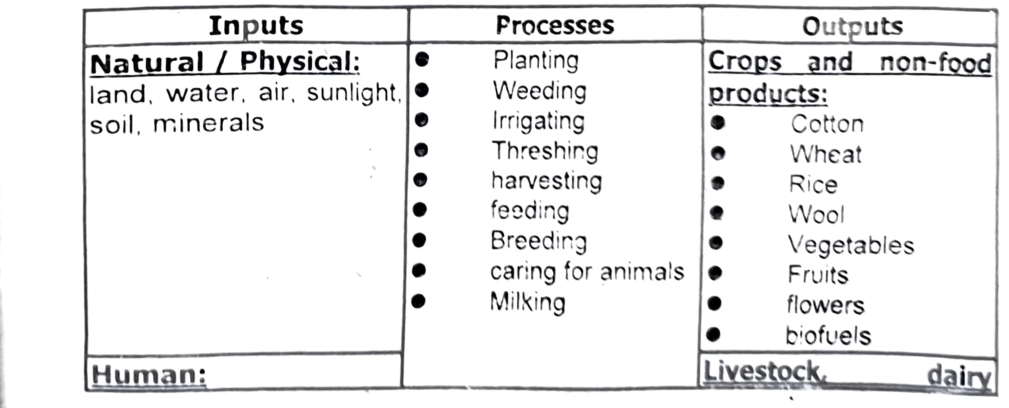
Agriculture can be viewed as a system of inputs, processes, and outputs. The inputs are the resources that are used to produce agricultural products.
i. Inputs
The inputs can be divided into two main categories:
Natural (Physical)
Land and other abiotic elements including soil, water and climate are is essential for agriculture, as it is used to grow crops and raise livestock.
Human (Economic)
Human resources include skilled and semi-skilled labour, machinery, investment, seeds, fertilizers, pesticides, machinery etc. These inputs are used to improve the productivity and efficiency of agricultural production.
ii. Processes
The inputs regulate the type of processes required on the farm. The Processes are the activities to convert inputs into outputs. These processes can be divided into two main categories:
- Crop production: Crop production processes include planting, weeding, irrigating, and harvesting.
- Livestock production: Livestock production processes feeding, breeding, and caring for animals.
iii. Outputs
Outputs are the products that are produced by the agricultural system. The outputs of livestock production (livestock and dairy products) can be used as inputs to the food system or to other industries, such as the leather industry. These outputs can be divided into two main categories food products and non-food products.
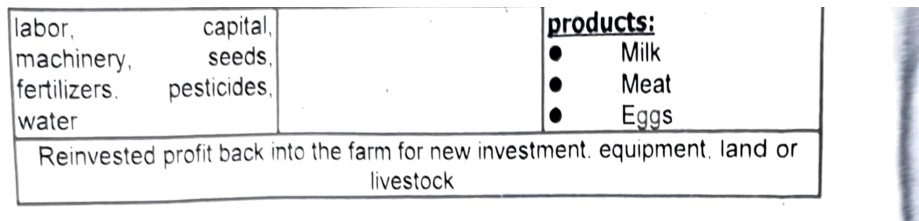
The diagram shows agriculture as system in Pakistan
| Inputs | Processes | Outputs |
|---|---|---|
| Natural / Physical: land, water, air, sunlight, soil, minerals |
| Crops and non-food products:
|
| Human: | Livestock; dairy |
Categories of Agriculture as a Complex System:
Agriculture is a complex system in which various inputs are used through different processes to produce useful outputs. The type of agriculture depends on climate, land, water, technology, labour, and market conditions.
- Subsistence Agriculture:
Subsistence agriculture is mainly practiced to meet the food needs of the farmer and their family. Farmers usually use small areas of land and traditional methods.
Examples: Wheat, maize, vegetables, and livestock for household consumption.
- Commercial Agriculture:
Commercial agriculture is carried out mainly to sell agricultural products and earn profit. It usually involves larger farms, modern machinery, fertilizers, irrigation, and improved seeds.
Examples: Cotton, sugarcane, rice, and wheat grown for markets and industries.
- Intensive Agriculture:
Intensive agriculture involves using large amounts of labour, fertilizers, irrigation, and other inputs on relatively small areas of land to obtain high yields.
Example: Intensive farming in the fertile Indus Plain.
- Extensive Agriculture:
Extensive agriculture uses large areas of land with relatively fewer inputs per unit of land. Mechanization is often used to reduce labour requirements.
Example: Large-scale farming in areas with abundant land.
- Mixed Farming:
Mixed farming combines crop cultivation and livestock rearing on the same farm. Crops provide food and animal feed, while livestock provides milk, meat, manure, and income.
- Plantation Agriculture:
Plantation agriculture involves growing a single major cash crop on large farms, usually for commercial purposes.
Examples: Tea, rubber, coffee, and sugarcane.
Agriculture as a System:
- Inputs:
Inputs are the resources required for farming, such as:
- Land
- Seeds
- Labour
- Capital
- Water and irrigation
- Fertilizers and pesticides
- Machinery
- Technology
- Processes:
Processes are the activities carried out to produce agricultural goods:
Land preparation → Sowing → Irrigation → Fertilizing → Weeding → Pest control → Harvesting → Processing
- Outputs:
Outputs are the products obtained from agriculture, including:
- Food crops such as wheat, rice, and maize
- Cash crops such as cotton and sugarcane
- Livestock products such as milk, meat, and wool
- Raw materials for industries
- Income and employment
There are three main types of farming practiced in Pakistan.
- Small-scale subsistence farming
- Cash crop farming
- Livestock farming
Small-Scale Subsistence Farming:
- Definition:
Subsistence farming involves growing crops and rearing animals mainly to meet the farmer's own needs. Any surplus produce may be sold for profit.
- Small Land Holdings:
Small-scale subsistence farmers generally own less than 12.5 acres of land.
- Contribution to Food Security:
Subsistence farmers produce important basic food crops such as wheat, rice and maize, contributing to Pakistan's food security.
- Use of Traditional Methods:
Farmers mainly use traditional methods of cultivation and rely on manual labour for sowing, weeding, harvesting and threshing.
- Use of Animals:
Animals are often used instead of modern machinery for pulling wooden ploughs and carts and for threshing.
- Labour-Intensive Activity:
Small-scale subsistence farming is labour-intensive, requiring considerable human effort throughout the farming process.
- Involvement of Women and Children: Women and children also participate in farming activities, including caring for animals, preparing animal feed, milking livestock, collecting eggs and helping with harvesting.
Major and Minor Food and Cash Crops of Pakistan:
Pakistan has a largely agricultural economy, and crops provide food, employment, export earnings, and raw materials for industries. Crops can be divided into food crops and cash crops according to their main purpose and economic importance.
i. Major Food Crops:
Food crops are mainly grown to provide food for the population.
- Wheat:
- Importance: Pakistan’s most important food crop and a major source of flour.
- Growing Areas: Mainly Punjab and Sindh, with cultivation also in Khyber Pakhtunkhwa and Balochistan.
- Season: Mainly a Rabi crop.
- Rice:
- Importance: An important food and export crop.
- Growing Areas: Mainly Punjab and Sindh, particularly areas with suitable irrigation.
- Season: Mainly a Kharif crop.
- Maize:
- Importance: Used as food, animal feed, and an industrial raw material.
- Growing Areas: Mainly Punjab and Khyber Pakhtunkhwa.
- Season: Grown in both seasons in different areas.
Minor Food Crops:
Other food crops include millets, sorghum (jowar), barley, pulses, and potatoes. These are important for local food supplies and livestock feed.
ii. Major Cash Crops:
Cash crops are mainly produced for sale, export, and use as industrial raw materials.
- Cotton:
- Importance: One of Pakistan’s most important cash crops and the main raw material for the textile industry.
- Growing Areas: Mainly southern and central Punjab and Sindh.
- Economic Role: Supports textile manufacturing, exports, and employment.
- Sugarcane:
- Importance: Major cash crop used mainly by the sugar industry.
- Growing Areas: Mainly Punjab, Sindh, and Khyber Pakhtunkhwa.
- Economic Role: Provides raw material for sugar mills and related industries.
- Tobacco:
- An important commercial crop and industrial raw material.
- Growing Areas: Mainly Khyber Pakhtunkhwa, particularly suitable irrigated areas.
iii. Minor Cash Crops
Minor cash crops include oilseeds, chillies, tobacco, and some fruits. Their importance varies according to region and market demand.
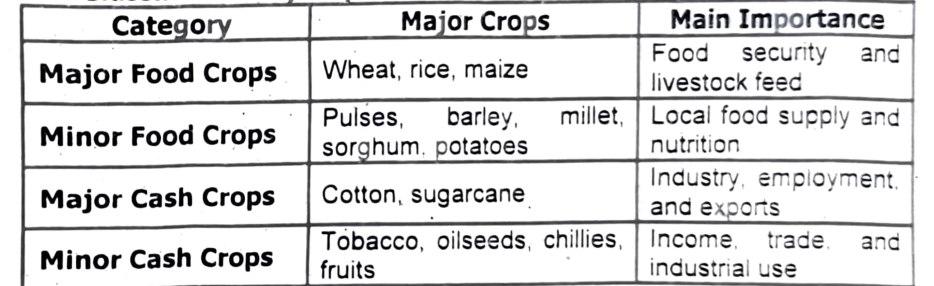
iv. Classification by Importance:
| Category | Major Crops | Main Importance |
|---|---|---|
| Major Food Crops | Wheat, rice, maize | Food security and livestock feed |
| Minor Food Crops | Pulses, barley, millet, sorghum, potatoes | Local food supply and nutrition |
| Major Cash Crops | Cotton, sugarcane | Industry, employment, and exports |
| Minor Cash Crops | Tobacco, oilseeds, chillies, fruits | Income, trade, and industrial use |
v. Economic Significance:
Agricultural crops contribute to Pakistan’s economy by providing food, employment, export earnings, and raw materials for industries. Wheat and rice are particularly important for food security, while cotton and sugarcane support major industries.
Cash crop farming:
Purpose of cultivation:
It is commercial farming in which the farm output is sold to make a profit including crops and animals. Cash crop farming is the cultivation of crops that are grown primarily for sale and profit, rather than for consumption by the farmer or their family.
Cash crops are typically grown on a large scale and are often exported to other countries. Some examples of cash crops include cotton, sugarcane, wheat, rice, corn, coffee, tobacco, cocoa, soybeans, oilseeds, fruits and vegetables.
Source of implement:
Cash crop farms typically employ a mix of skilled and unskilled labor. Skilled labor is often needed for operating machinery, applying pesticides and herbicides, and maintaining the farm's infrastructure. Unskilled labor is often used for tasks such as planting, weeding, and harvesting.
Main Cash crops in different season:
Kharif (summer April to October) and rabi (winter October-April).
Winters in the lowlands are warm enough for temperate crops to grow, such as wheat and rapeseed, which are summer crops in the UK and other northwestern European countries.
Pakistan's summer crops, such as cotton and rice, require high temperatures, like those in the tropics.
Problems for Cash crops forming:
Water supply is a bigger problem for cash crop farming in Pakistan. Farmers can only grow crops in both seasons if they have enough irrigation water.
Numerous dams (large and small) and barrages have been built to divert and store water from rivers that originate in the Himalayas.
The two largest storage dams are Tarbela on the Indus and Mangla on the Jhelum. These dams supply water to large link canals, which in turn feed water into the many smaller canals that crisscross the Punjab and Sindh plains.
Large barrages across the Indus in the south, such as Sukkur, are supplied with water from the Tarbela Dam in winter when river flow is low.
Tube wells are also used to pump water from the ground for irrigation, especially in areas where canal irrigation is not available or adequate.
The map show some details about dams barrages and link canals in Pakistan.
Cotton:
Economic Importance of Cotton:
- Contribution to GDP:
Cotton contributes around 0.6% of Pakistan’s GDP.
- Contribution to Agriculture:
It contributes about 3.1% of the value added in agriculture.
- Raw Material for Textile Industry:
Cotton is an important raw material for Pakistan’s textile industry.
- Cash Crop:
Cotton is one of Pakistan’s most important cash crops.
- Foreign Exchange Earnings:
Cotton products contribute significantly to Pakistan’s foreign exchange earnings.
- Export Crop:
Cotton is an important export-oriented crop, supporting Pakistan’s international trade.
Cotton Growing Areas:
The main areas for cotton cultivation in Pakistan are the provinces of Punjab and Sindh:
- Punjab: The leading cotton-producing province in Pakistan, accounting for around 65% of the country's cotton. The core cotton-producing districts in Punjab include Muzaffargarh, Multan, Bahawalnagar, Bahawalpur, Vehari, Rahim Yar Khan, Dera Ghazi Khan, Layyah, and Sahiwal.
- Sindh: Accounts for around 35% of Pakistan's cotton.
Geographical Requirement:
Rainfall:
Cotton requires moderate rainfall. However, cotton can be grown in areas with less rainfall if irrigation is available.
Temperature:
Cotton is a warm-season crop and requires temperatures between 25°C and 35°C for optimal growth. Temperatures below 20°C can stunt plant growth, and temperatures above 40°C can reduce yields.
Irrigation:
Cotton is a drought-tolerant crop, but irrigation is often necessary to achieve high yields. Irrigation is especially important in areas with low rainfall or during droughts.
Soil Type:
Soil type for cotton is a well-drained, loamy soil with a pH between 6.0 and 7.5.
Problems of Cotton Crop:
Pakistan, a major cotton producer, is experiencing a significant decline in production due to multiple challenges, including:
- Economic:
Cotton is no longer as profitable as other crops such as maize, paddy, and sugarcane.
- Biotic stresses:
White fly and pink bollworm infestations are damaging crops. Leave curl virus also attacks the crop with irreversible effects.
- Abiotic stresses:
Climate change, heat stress, and extreme rainfalls are also impacting production.
- Poor agricultural practices:
Unsustainable farming practices and excessive pesticide use are also contributing to the decline.
- High input costs:
Fertilizers, pesticides, and seeds are expensive, making it difficult for farmers to turn a profit.
- Limited research and development:
There is a shortage of early generation seeds, and research on new varieties that can withstand pests, diseases, and climatic stresses is inadequate.
Revival of Cotton Production:
To revive cotton production in Pakistan, the following measures are essential:
- Set a minimum indicative or intervention price for cotton. This will ensure that farmers receive a fair price for their crops, even when market prices are low.
- Issue subsidies to farmers in a timely manner. This will help to reduce the cost of inputs such as seeds, fertilizers, and pesticides.
- Improve extension services to educate farmers about best practices. This will help farmers to improve their yields and reduce their costs.
- Develop and distribute genetically modified (GM) cotton seeds that are resistant to pests and diseases. This will help to reduce crop losses and improve yields.
- Issue subsidies for pesticides, seeds, and fertilizers through Kissan cards. This will make it easier for farmers to access the inputs they need at an affordable price.
Economic importance of wheat:
- Food Security:
Wheat is a major food crop and provides a significant part of the population's daily food.
- Large Cultivated Area:
About 8.9 million hectares are used for wheat cultivation.
- Economic Contribution:
Wheat makes an important contribution to Pakistan's economy.
- Employment:
It provides employment to farmers and workers.
- Income:
Wheat production generates income for farmers and related businesses.
Wheat Growing areas:
During 2020-21, area under wheat cultivation increased by 4.2 percent to 9,178 thousand hectares over last year's sown area of 8,805 thousand hectares. Wheat is Pakistan's main staple crop, and it is essential for the country's food security.
Punjab is the largest wheat producing province in Pakistan, accounting for over 70% of the country's total wheat production. Other major wheat producing provinces include Sindh, Khyber Pakhtunkhwa, and Baluchistan. Major Wheat growing areas include:
- Punjab: Faisalabad, Toba Tek Singh, Jhang, and Chakwal
- Sindh: Jacobabad, Larkana, and Shikarpur
- Khyber Pakhtunkhwa: Mardan, Nowshera, and Swabi
- Balochistan: Quetta, Pishin, and Zhob
Geographical Requirements:
Wheat is a relatively adaptable crop and can be grown in a variety of geographical conditions.
Soil type:
Wheat prefers well-drained, loamy soils with a pH between 6.0 and 7.5.
Rainfall:
Wheat requires moderate rainfall, ranging from 50 to 100 centimeters per year. However, wheat can be grown in areas with less rainfall if irrigation is available.
Temperature:
Wheat is a cool-season crop and requires temperatures between 10 and 20 degrees Celsius for optimal growth. Temperatures above 30 degrees Celsius can stress the crop and reduce yields.
Irrigation:
Wheat can be grown in rainfed conditions, but irrigation is often necessary to achieve high yields. Irrigation is especially important in areas with low rainfall or during droughts.
Sugar Cane:
Economic Importance of Sugar Cane:
- Sugar Industry:
Sugarcane is the main raw material for the sugar industry. Pakistan's second-largest agriculture-based industry.
- Employment:
The sugar industry provides employment to about one million people.
- Government Revenue:
The sugar industry contributes significantly to government revenue.
- Bioenergy:
Sugarcane can be used to produce bioethanol, a renewable source of energy.
- Livestock Feed:
Sugarcane tops provide valuable fodder for livestock, especially during winter.
- Raw Material for Industries:
Sugarcane provides raw materials for the chemical and paper industries.
- Suitable Climate:
The tropical and subtropical climate of Punjab and Sindh is suitable for sugarcane cultivation.
Geographical Requirements:
Temperature:
Sugarcane requires a temperature range of 20°C to 30°C for optimal growth. Temperatures below 20°C can stunt plant growth, and temperatures above 40°C can reduce yields.
Rainfall:
Sugarcane requires moderate rainfall, ranging from 100 to 1520 mm. However, sugarcane can be grown in areas with less rainfall if irrigation is available.
Soil type:
Sugarcane prefers well-drained, loamy soils with a pH of 6.5 to 7.5. Clay soils can be too heavy and poorly draining for sugarcane, while sandy soils may not retain enough moisture.
Method of Cultivation:
To cultivate sugarcane, the soil is prepared by tilling it to a depth of at least 30 cm. Organic matter should then be added to the soil to improve drainage and fertility. Sugarcane stalk is cut to 30–45 cm long and the cuttings are planted in furrows that are 10–15 cm deep and 75–100 cm apart. Sugarcane requires regular irrigation and regular fertilization, especially potash. It is important to keep the sugarcane field free of weeds, as they compete with the sugarcane for water and nutrients.
Main Sugarcane Growing Regions in Pakistan:
- Punjab:
Punjab is the largest sugarcane-producing province of Pakistan. Important sugarcane-growing districts include:
- Faisalabad
- Toba Tek Singh
- Jhang
- Sindh:
Sindh is the second-largest sugarcane-producing province. Major growing districts include:
- Jacobabad
- Larkana
- Shikarpur
- Khyber Pakhtunkhwa:
Khyber Pakhtunkhwa is the third-largest sugarcane-producing province. Important districts include:
- Mardan
- Nowshera
- Swabi
Sugarcane is mainly grown in Punjab, Sindh, and Khyber Pakhtunkhwa because these regions have suitable fertile soils, warm temperatures, and irrigation facilities.
Rice:
Importance:
Rice is a major food and cash crop in Pakistan. It is the second most important staple food crop after wheat and the second most exported commodity after cotton. Rice contributes 3.5% of value added in agriculture and 0.7% of GDP.
Categories:
Rice production is divided into two categories:
- Basmati (fine)
- Coarse
The production of coarse types has been increasing in recent years. In 2020–21, rice was cultivated on 3,335 thousand hectares, up 9.9% from the previous year.
Geographical Requirements:
Temperature:
Rice requires a temperature range of 20°C to 35°C for optimal growth. Temperatures below 20°C can stunt plant growth, and temperatures above 40°C can reduce yields.
Rainfall:
Rice requires moderate to high rainfall, ranging from 100 to 250 cm per year. However, rice can be grown in areas with less rainfall if irrigation is available.
Soil type:
Rice prefers well-drained, loamy soils with a pH of 6.5 to 7.5. Clay soils can be too heavy and poorly draining for rice, while sandy soils may not retain enough moisture.
Economic Importance of Rice:
- Major Food Crop:
Rice is the second most important food crop after wheat and is a staple food for millions of Pakistanis.
- Employment:
The rice industry provides employment opportunities, especially to rural populations in Punjab and Sindh.
- Foreign Exchange Earnings:
Pakistan earns significant foreign exchange through rice exports. In 2022–23, rice exports exceeded US$2.5 billion.
- Major Rice Producer:
Pakistan is the 11th largest rice producer in the world.
- Contribution to World Trade:
Pakistan contributes about 8% of the world's total rice trade.
Method of Cultivation:
The soil is tilled and levelled to prepare the seedbed. Rice seeds are sown in the seedbed. Seedlings are transplanted to the main field when they are 3–4 weeks old. Rice requires regular irrigation, especially during the first few months after transplanting. A balanced fertilizer should be applied every 4–6 weeks. It is also important to keep the rice field free of weeds. Weeds compete with the rice for water and nutrients, and they can also harbor pests and diseases. Rice is typically harvested 3–4 months after transplanting. The crop is harvested by hand or by machine. The harvested rice is then threshed to remove the grains from the stalks.
Main Areas of Rice Cultivation in Pakistan:
- Punjab:
Punjab is the largest rice-producing province of Pakistan. Major rice-growing districts include:
- Faisalabad
- Gujranwala
- Sialkot
- Sheikhupura
- Hafizabad
- Narowal
- Sindh:
Sindh is the second-largest rice-producing province. Important rice-growing districts include:
- Jacobabad
- Shikarpur
- Larkana
- Khyber Pakhtunkhwa:
Khyber Pakhtunkhwa is the third-largest rice-producing province. Major growing areas include:
- Mardan
- Swabi
- Nowshera
- Balochistan
A small quantity of rice is cultivated in suitable areas of Balochistan because of limited water availability.
Rice is mainly cultivated in Punjab, Sindh, and Khyber Pakhtunkhwa, where suitable temperature, fertile soils, and irrigation water are available.
Problems of Rice Crop:
- Rice is susceptible to a number of pests and diseases, such as rice stem borers, brown plant hoppers, and blast disease.
- Rice is also susceptible to abiotic stresses, such as drought, salinity, and flooding.
- Weeds compete with rice for water and nutrients, and they can also harbor pests and diseases.
- Rice is a heavy feeder and requires regular fertilization. Nutrient deficiencies can lead to reduced yields and poor grain quality.
Management Strategies:
Pests and diseases control:
Pests and diseases can be managed through a combination of cultural practices, biological control, and chemical pesticides. Cultural practices, such as crop rotation can help to maintain soil fertility. Biological control involves the use of various biological organisms to control pests. Chemical pesticides should only be used as a last resort.
Laser leveling:
Laser leveling is a land preparation technique that uses lasers to create a level surface. This can help to improve water distribution and reduce water waste.
Alternate wetting and drying (AWD):
AWD is a water management practice in which rice fields are alternately flooded and drained. This can help to reduce water consumption without sacrificing yield.
Nutrient deficiencies:
Nutrient deficiencies can be managed through regular fertilization. A balanced fertilizer should be applied every 4–6 weeks.
Economic Importance and Growing Regions of Maize in Pakistan:
Economic Importance of Maize:
- Important Cereal Crop:
Maize is the third most important cereal crop of Pakistan after wheat and rice.
- Contribution to Economy:
Maize contributes about 0.7% to GDP and 2.9% to agricultural value addition.
- Food Uses:
Maize is used as food, particularly for making corn flour and other food products.
- Animal and Poultry Feed:
It is widely used as poultry feed and livestock fodder.
- Industrial Uses:
Maize is used in the feed and wet-milling industries and other industrial processes.
- Food Security:
Maize contributes to Pakistan’s food security and supports the agricultural economy.
Growing Regions of Maize:
- Punjab:
Punjab is the leading maize-producing province of Pakistan.
- Khyber Pakhtunkhwa:
Khyber Pakhtunkhwa (KPK) is another major maize-producing region.
- Cultivated Area:
In 2020–21, maize was cultivated on about 1.118 million hectares.
- Improved Seed Varieties:
The availability of improved varieties of seeds has helped increase maize production.
- Better Economic Returns:
Better economic returns have encouraged farmers to increase maize cultivation.
Growing Regions and Economic Importance of Tobacco in Pakistan:
Regions of Cultivation:
- Major Growing Province:
Tobacco is mainly grown in Khyber Pakhtunkhwa (KPK).
- Major Tobacco-Growing Districts:
The major growing districts are Swabi, Mardan, Nowshera and Charsadda.
- Flue Cured Virginia Tobacco:
These districts produce over 90% of Pakistan’s Flue Cured Virginia (FCV) tobacco.
- Irrigated Land:
Tobacco is grown on approximately 0.25% of Pakistan’s irrigated land.
Economic Importance of Tobacco:
- Employment:
The tobacco industry provides employment to around 75,000 people in cultivation, distribution and retail.
- Contribution to Economy:
The industry contributes nearly US$1 billion to Pakistan’s national economy.
- Tax Revenue:
It generates significant government revenue, with tax collections reaching PKR 122 billion from July 2023 to January 2024.
- Support to Farmers:
Tobacco cultivation provides income and employment opportunities to farming communities.
Tobacco is a ratoon crop. Ratoon crop is a second crop that is grown from the roots of the previous crop.
Minor Crops:
- Decline in Gram, Bajra and Jowar Production:
Production of Gram, Bajra and Jowar decreased in 2020–21 due to reduced cultivated areas and unfavourable weather conditions.
- Barley, Rapeseed and Mustard:
Production of Barley, Rapeseed and Mustard remained almost unchanged but stayed at a low level.
- Tobacco Production:
Tobacco production remained the same as the previous year and continued to be at a low level.
- Increase in Pulses and Potato:
Production of Moong, Mash and Potato increased significantly in 2020–21.
- Decrease in Chillies and Onion:
Production of Chillies and Onion decreased slightly.
- Masoor Production:
Masoor production remained unchanged compared with the previous year.
- Edible Oil:
Pakistan imported 2.917 million tonnes of edible oil in 2021, while local production was only 0.374 million tonnes.
Fruit Farming in Pakistan:
Importance of Fruit Farming:
Fruit farming is an important part of Pakistan’s economy. It provides employment, income, food, and foreign exchange earnings. Pakistan produces a wide variety of fruits, including mangoes, apples, citrus, bananas, grapes, guavas, dates, and peaches.
Fruit Farming in Punjab:
Punjab is the largest fruit-producing province. Major fruit-growing districts include:
- Multan
- Toba Tek Singh
- Faisalabad
- Sargodha
Punjab is particularly famous for mangoes and citrus fruits.
Fruit Farming in Sindh:
Sindh is the second-largest fruit-producing province. Important fruit-growing districts include:
- Jacobabad
- Larkana
- Shikarpur
The province is well known for dates, bananas, and mangoes.
Fruit Farming in Khyber Pakhtunkhwa:
Khyber Pakhtunkhwa is the third-largest fruit-producing province. Important areas include:
- Mardan
- Nowshera
- Swat
Swat is particularly known for apples and apricots.
Fruit Farming in Balochistan:
Balochistan produces apples, dates, apricots, and grapes. The province’s highland areas provide suitable conditions for several temperate fruits.
Fruit Farming in Northern Areas:
Hunza and Swat are well known for the production of apples and apricots. The cooler climate of these areas is suitable for temperate fruits.
Dry Fruits:
Pakistan also produces important dry fruits, including almonds, walnuts, and raisins, particularly in mountainous and cooler regions.
Economic Importance:
Fruit farming supports farmers, labourers, transporters, traders, and processing industries. Exporting fresh and processed fruits also earns foreign exchange for Pakistan.
Government Support Schemes for Fruit Farmers:
- The government is providing subsidies to farmers for purchasing fruit plants and fertilizers.
- The government is also providing training to farmers on modern fruit farming practices.
- National Program for the Development of Horticulture (NPDH):
The NPDH provides subsidies to farmers for the purchase of fruit plants and other agricultural inputs.
It also provides training to farmers on modern fruit farming practices such as, cold storage for fruits protection and preventing harvest loss, pest and disease management, irrigation, fertilization, and harvesting.
Contribution of Agriculture to Pakistan’s Economy:
Agriculture is a major sector of Pakistan’s economy. It provides employment, raw materials for industries, food, and export earnings. Its development can therefore contribute significantly to economic growth.
- Contribution to Employment:
Agriculture provides employment to a large proportion of Pakistan’s population, particularly in rural areas. Farmers, livestock keepers, farm labourers, transporters, and traders all depend on agricultural activities for their livelihoods.
- Support for Processing Industries:
Agriculture provides raw materials to many industries.
- Cotton → textile and clothing industries
- Sugarcane → sugar industry
- Wheat → flour and food-processing industries
- Rice → rice-processing and packaging industries
- Milk and livestock → dairy and meat industries
Thus, agricultural production encourages the growth of agro-based industries and employment.
- Contribution to Exports:
Agricultural products contribute to Pakistan’s export earnings. Important agricultural exports include rice, cotton-based textiles, fruits, vegetables, and other processed food products. Increasing quality and processing can improve Pakistan’s competitiveness in international markets.
- Food Security:
Agriculture provides essential food such as wheat, rice, maize, pulses, fruits, vegetables, milk, and meat. Higher domestic production reduces dependence on food imports and helps maintain food security.
- Organic Farming:
Organic farming reduces the use of synthetic fertilizers and pesticides and uses natural methods such as compost, crop rotation, biological pest control, and organic manure. It can improve soil health and reduce environmental pollution.
- Efficient Irrigation:
Farmers should adopt drip irrigation, sprinkler systems, and improved water channels to reduce water wastage and cope with water shortages.
- Soil Conservation:
Practices such as crop rotation, conservation tillage, composting, and planting trees can reduce soil erosion and maintain soil fertility.
- Modern Technology:
Using drought-resistant seeds, weather forecasting, modern machinery, GIS, and precision farming can increase productivity while reducing the unnecessary use of water and chemicals.
- Better Storage and Processing:
Improved storage, refrigeration, transportation, and food-processing facilities can reduce post-harvest losses and increase the value of agricultural products.
Contribution of Agriculture to the Employment Sector:
- Major Source of Employment:
Agriculture is one of the largest sources of employment in Pakistan. It employs around 38.5% of the labour force and provides livelihoods to a large proportion of the rural population.
- Direct Employment:
Agriculture provides direct jobs to farmers, farm labourers, livestock keepers, fishermen, and agricultural workers involved in crop production and animal husbandry.
- Indirect Employment:
Agriculture also creates employment in related sectors such as food processing, transport, storage, marketing, textile industries, and agricultural machinery.
- Rural Livelihoods:
A large proportion of Pakistan’s population depends on agriculture for income, food, and employment. It is therefore particularly important for rural communities.
- Contribution to the Economy:
Agriculture contributes about 19.2% to Pakistan’s GDP and provides raw materials for important industries such as textiles, sugar, food processing, and leather.
- Challenges:
Agricultural employment is affected by shrinking arable land, climate change, water shortages, rural-to-urban migration, and rising input costs. These factors can reduce productivity and employment opportunities.
- Future Potential:
The employment potential of agriculture can be increased through modern farming techniques, efficient irrigation, mechanization, climate-smart agriculture, agro-based industries, and better training for farmers.
Livestock farming:
Livestock farming is the raising and management of domesticated animals for the production of meat, milk, eggs, and other animal products. It is one of the oldest and most important forms of agriculture, and it is a significant contributor to the country's economy, accounting for around 11% of GDP.
The sector also plays an important role in food security, providing the Pakistani people with a source of high-quality protein. Livestock farming can be divided into three main types: nomadic, settled, and transhumance. The details of each type will be discussed next.
Nomadic:
Nomadic livestock farming is a traditional form of livestock farming in which herders move their animals from place to place in search of pasture and water. Nomadic livestock farming is typically practiced in arid and semi-arid regions, where there is limited availability of resources.
Nomadic livestock farming is practiced by the Baloch and Pashtun tribes in the Balochistan and Khyber Pakhtunkhwa provinces of Pakistan. The main types of livestock raised by nomadic farmers are sheep and goats.
Settled:
Settled livestock farming is a type of livestock farming in which animals are kept in permanent enclosures. Settled livestock farming is typically practiced in areas with more abundant resources, such as arable land and water.
Settled livestock farming is practiced throughout Pakistan, but it is particularly concentrated in the Punjab and Sindh provinces. The main types of livestock raised by settled farmers are cattle, buffaloes, goats, and poultry.
| Type of Livestock | Areas | Cities |
|---|---|---|
| Cattle, Buffaloes | Punjab, Sindh | Lahore, Karachi, Faisalabad |
| Sheep | Balochistan, Khyber Pakhtunkhwa, Kashmir | Quetta, Peshawar, Muzaffarabad |
| Goats | Balochistan, Khyber Pakhtunkhwa, Kashmir, Punjab, Sindh | Quetta, Peshawar, Muzaffarabad, Lahore, Karachi |
| Poultry | Punjab, Sindh | Lahore, Karachi, Faisalabad |
Main Features of Transhumance Livestock Farming in Pakistan:
- Seasonal Movement:
Transhumance is a type of livestock farming in which herders move their animals between different pastures according to the season.
- Mountainous Regions:
It is mainly practiced in mountainous areas, where the availability of pasture changes with the seasons.
- Gujjar and Bakarwal Tribes:
In Pakistan, transhumance is practiced by the Gujjar and Bakarwal tribes, particularly in the Kashmir region.
- Main Livestock:
The main animals raised by transhumant farmers are sheep and goats.
- Seasonal Availability of Pasture:
Herders move their livestock to areas where fresh and suitable grazing pastures are available during different seasons.
Challenges Facing the Agriculture Sector and Sustainable Strategies:
- Conversion of Agricultural Land into Housing Societies:
Fertile agricultural land is increasingly being converted into housing societies and urban settlements, reducing the area available for crop production.
- Water Shortage:
Water scarcity, inefficient irrigation and declining groundwater levels create difficulties for farmers and reduce agricultural productivity.
- Climate Change:
Rising temperatures, irregular rainfall, floods and droughts negatively affect crops and livestock.
- Outdated Farming Methods:
Many farmers still use traditional farming techniques and outdated machinery, resulting in low productivity.
- High Cost of Inputs:
The increasing prices of fertilizers, seeds, pesticides, fuel and machinery raise production costs and reduce farmers' profits.
- Soil Degradation:
Water logging, salinity, soil erosion and excessive use of chemicals reduce soil fertility and agricultural output.
- Lack of Modern Technology:
Limited access to modern machinery, improved seeds, agricultural technology and research prevents farmers from achieving higher yields.
Sustainable Strategies:
- Protection of Agricultural Land:
Strict land-use planning and zoning laws should prevent the unnecessary conversion of fertile agricultural land into housing societies.
- Efficient Irrigation:
Drip irrigation, sprinkler systems and improved canal management should be promoted to conserve water.
- Modern Farming Techniques:
Farmers should be encouraged to adopt mechanization, improved seeds, precision farming and modern cultivation methods.
- Climate-Smart Agriculture:
Drought-resistant and heat-tolerant crops, crop diversification and better weather forecasting can reduce the effects of climate change.
- Soil Conservation:
Proper drainage, crop rotation, balanced fertilizer use and soil conservation practices should be adopted to maintain soil fertility.
- Government Support:
The government should provide affordable agricultural credit, quality seeds, fertilizers, machinery and technical training to farmers.
- Better Storage and Marketing:
Improved storage facilities, cold chains, transport and market access can reduce post-harvest losses and ensure better prices for farmers.
- Increase in Agricultural Output:
Combining land protection, efficient water use, modern technology and farmer support can increase crop yields, strengthen food security, create employment and contribute to Pakistan’s economic growth.
Challenges Faced by the Agriculture Sector in Pakistan:
Pakistan’s agriculture sector, a cornerstone of its economy, faces numerous challenges that hinder its potential. These challenges include limited irrigation facilities, inadequate post-harvest infrastructure, unreliable electricity supply, and soil degradation.
- Lack of Irrigation Facilities:
Only 28% of cultivable land in Pakistan is irrigated. This limitation, coupled with inefficient water management, results in significant water loss. This results in food shortages and the government has to import wheat and sugar from other countries.
- Inadequate Post-Harvest Infrastructure:
The absence of proper storage facilities leads to post-harvest losses, forcing farmers to sell their produce at lower prices. This, in turn, affects their income and discourages investment in agriculture.
- Unreliable Electricity Supply:
Farmers often rely on diesel-powered pumps for irrigation, which is both costly and environmentally damaging. The lack of a reliable electricity supply further exacerbates this issue.
- Soil Erosion:
Soil erosion is reducing the amount of land available for agriculture, and declining biodiversity affects the pollination of crops. At the same time, farmers are under pressure to conserve water and use fewer agricultural inputs.
- Water logging and Salinity:
Water logging and salinity are major problems affecting Pakistan’s agriculture. About 6.3 million hectares of land are threatened by salinity, especially irrigated areas.
- Inadequate Supply of Agricultural Input:
High-yielding variety (HYV) seeds, chemical fertilizers, herbicides, mechanized machinery, etc. are examples of contemporary inputs that are not only expensive but also insufficient and inconsistently available in Pakistan. There are just 10 fertilizer production units in Pakistan.
- Improper Crop Rotation and Low Cropping Intensity:
To restore the soil’s fertility, crops must be properly rotated. The fertility of the soil is depleted by the continuous cultivation of one or two crops. Crop rotation should be done properly to restore fertility. The quantity of crops grown on a plot of land in a given year is referred to as cropping intensity. In Pakistan, the amount of arable land used for double or multiple crops is insufficient.
- Underutilization of Land and Lack of High-Yielding Varieties:
A significant portion of Pakistan’s agricultural land remains underutilized or misutilized. Many farmers, particularly small-scale farmers, continue to rely on traditional and outdated farming practices. This lack of adoption of modern agricultural techniques, including the use of high-yielding variety (HYV) seeds, limits agricultural productivity. Furthermore, the limited availability of high-quality seeds, coupled with financial constraints, forces farmers to use inferior seed varieties. This, in turn, results in lower crop yields and reduced agricultural output.
- Lack of Credit and Agricultural Finance:
Farmers in Pakistan face significant challenges in accessing affordable credit. High-interest rates charged by non-institutional lenders limit their ability to invest in agricultural inputs, machinery, and technology. This, in turn, restricts their capacity to adopt modern farming practices and improve productivity.
- Lack of Agricultural Education and Farmer Training:
A lack of agricultural education and training programs hinders farmers’ ability to adopt modern farming techniques and make informed decisions. Limited access to extension services and agricultural research institutions further exacerbates this issue.
Solutions to Agricultural Problems:
Water Management and Soil Health:
Challenges Faced by the Agriculture Sector in Pakistan:
Pakistan’s agriculture sector, a cornerstone of its economy, faces numerous challenges that hinder its potential. These challenges include limited irrigation facilities, inadequate post-harvest infrastructure, unreliable electricity supply, and soil degradation.
- Lack of Irrigation Facilities:
Only 28% of cultivable land in Pakistan is irrigated. This limitation, coupled with inefficient water management, results in significant water loss. This results in food shortages and the government has to import wheat and sugar from other countries.
- Inadequate Post-Harvest Infrastructure:
The absence of proper storage facilities leads to post-harvest losses, forcing farmers to sell their produce at lower prices. This, in turn, affects their income and discourages investment in agriculture.
- Unreliable Electricity Supply:
Farmers often rely on diesel-powered pumps for irrigation, which is both costly and environmentally damaging. The lack of a reliable electricity supply further exacerbates this issue.
- Soil Erosion:
Soil erosion is reducing the amount of land available for agriculture, and declining biodiversity affects the pollination of crops. At the same time, farmers are under pressure to conserve water and use fewer agricultural inputs.
- Water logging and Salinity:
Water logging and salinity are major problems affecting Pakistan’s agriculture. About 6.3 million hectares of land are threatened by salinity, especially irrigated areas.
- Inadequate Supply of Agricultural Input:
High-yielding variety (HYV) seeds, chemical fertilizers, herbicides, mechanized machinery, etc. are examples of contemporary inputs that are not only expensive but also insufficient and inconsistently available in Pakistan. There are just 10 fertilizer production units in Pakistan.
- Improper Crop Rotation and Low Cropping Intensity:
To restore the soil’s fertility, crops must be properly rotated. The fertility of the soil is depleted by the continuous cultivation of one or two crops. Crop rotation should be done properly to restore fertility. The quantity of crops grown on a plot of land in a given year is referred to as cropping intensity. In Pakistan, the amount of arable land used for double or multiple crops is insufficient.
- Underutilization of Land and Lack of High-Yielding Varieties:
A significant portion of Pakistan’s agricultural land remains underutilized or misutilized. Many farmers, particularly small-scale farmers, continue to rely on traditional and outdated farming practices. This lack of adoption of modern agricultural techniques, including the use of high-yielding variety (HYV) seeds, limits agricultural productivity. Furthermore, the limited availability of high-quality seeds, coupled with financial constraints, forces farmers to use inferior seed varieties. This, in turn, results in lower crop yields and reduced agricultural output.
- Lack of Credit and Agricultural Finance:
Farmers in Pakistan face significant challenges in accessing affordable credit. High-interest rates charged by non-institutional lenders limit their ability to invest in agricultural inputs, machinery, and technology. This, in turn, restricts their capacity to adopt modern farming practices and improve productivity.
- Lack of Agricultural Education and Farmer Training:
A lack of agricultural education and training programs hinders farmers’ ability to adopt modern farming techniques and make informed decisions. Limited access to extension services and agricultural research institutions further exacerbates this issue.
- Addressing Water logging and Salinity: Implementing effective drainage systems, promoting efficient irrigation practices, and using saline-tolerant crop varieties can help mitigate the negative impacts of water logging and salinity.
- Enhancing Soil Health: Promoting sustainable agricultural practices, such as crop rotation, cover cropping, and organic farming, can improve soil fertility and reduce the need for chemical fertilizers.
Agricultural Credit and Financial Support:
- Expanding Access to Credit: Providing easy access to affordable credit can empower farmers to invest in modern agricultural technologies and inputs.
- Subsidized Loans: Government-subsidized loans can help farmers overcome financial constraints and adopt innovative farming practices.
Promotion of High-Yielding Varieties:
- Encouraging Seed Research: Investing in research and development to develop high-yielding, climate-resilient crop varieties can boost agricultural productivity.
- Seed Grants: Providing subsidies on high-quality seeds can encourage farmers to adopt improved seed varieties.
Agricultural Extension Services:
- Knowledge Dissemination: Strengthening extension services can help farmers acquire knowledge about modern agricultural techniques, pest and disease management, and market trends.
- Training Programs: Organizing training programs can empower farmers to make informed decisions and adopt best practices.
Infrastructure Development:
- Irrigation Infrastructure: Investing in irrigation infrastructure, such as dams, canals, and tube wells, can ensure adequate water supply for agriculture.
- Rural Infrastructure: Improving rural roads, transportation networks, and storage facilities can facilitate the movement of agricultural products to markets.
By addressing these challenges and implementing appropriate solutions, Pakistan can unlock the full potential of its agriculture sector, ensuring food security and economic growth for its people.
Organic Farming:
Organic farming is an integrated agricultural approach that uses natural, non-synthetic inputs such as compost manure, green manure and bone meal. It promotes soil fertility, biodiversity and sustainable agriculture. In Pakistan, it is mainly practiced by small-scale farmers.
Organic farming, also referred to as organic agriculture, ecological farming, or biological farming, is an integrated agricultural approach. This method utilizes naturally occurring, non-synthetic inputs, such as compost manure, green manure, and bone meal. Organic farming also emphasizes techniques which promote soil fertility, biodiversity, and sustainability. This approach emerged in the early 20th century as a response to mechanised modern farming practices.
There are a number of different organic farming methods that can be used as sustainable approaches to agriculture in Pakistan. Some of the most common methods include:
- Crop rotation: Planting different crops in the same field in sequence. This helps to improve soil fertility and reduce the risk of pests and diseases. One patch of land is left to rest called fallow land.
- Intercropping: Planting two or more different crops in the same field at the same time to improve soil fertility and reduce weed competition.
- Cover cropping: Planting crops that cover the soil surface. This prevents soil erosion.
- Composting: Composting is making of compost from a variety of materials, such as plant residues, manure, and food scraps.
- Biological pest control: It is the use of natural predators and parasites to control pests. For example, ladybugs can be used to control aphids, and lacewings can be used to control whiteflies.
- Farmland must not be converted into housing schemes. More water schemes may be helpful in sustaining agricultural activities.
Organic farming can be practiced on a variety of scales, from small backyard gardens to large commercial farms. In Pakistan, organic farming is most commonly practiced by small-scale farmers.
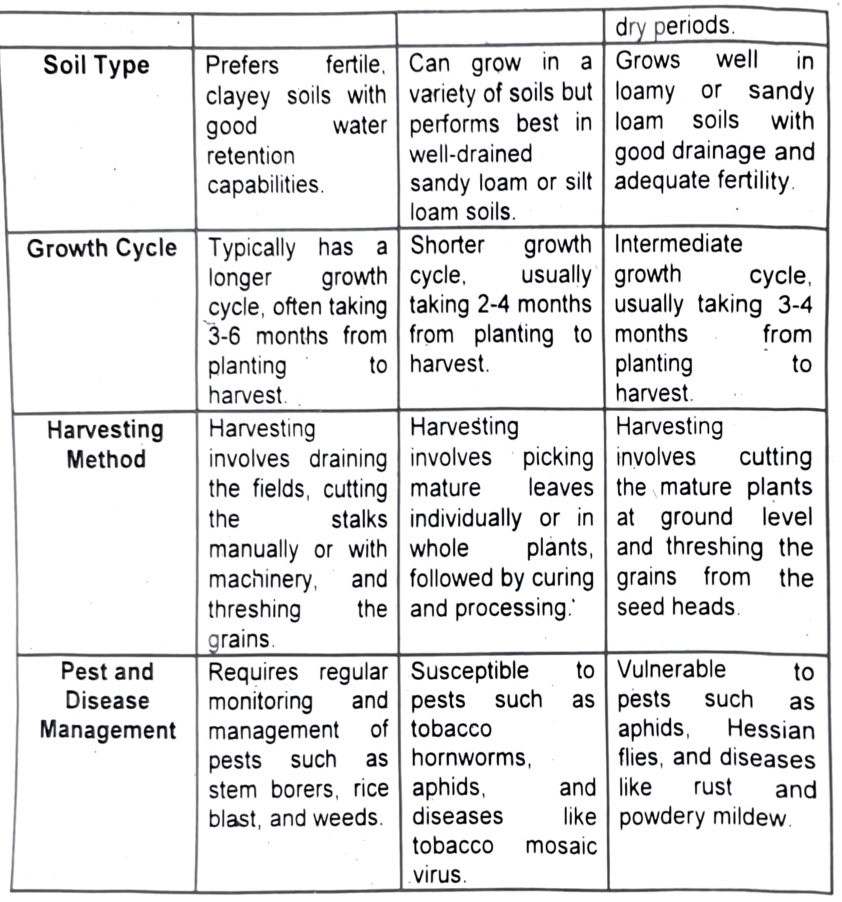
Difference between method of rice, tobacco and wheat cultivation:
| Aspect | Rice Cultivation | Tobacco Cultivation | Wheat Cultivation |
|---|---|---|---|
| Planting Method | Transplanting: Seedlings are grown in nurseries and then transplanted into flooded fields. | Direct Seeding: Seeds are sown directly into prepared seedbeds or fields. | Direct Seeding: Seeds are sown directly into tilled soil using seed drills or broadcasting. |
| Growing Conditions | Requires standing water of flooded fields for a significant portion of the growing season. | Grows well in warm climates with ample sunlight and well-drained soil. | Thrives in cooler climates with moderate temperatures and well-drained soil. |
| Water Requirements | High water requirement; typically requires continuous flooding or periodic irrigation. | Moderate water requirement; requires regular irrigation but can tolerate some drought stress. | Moderate water requirement; usually relies on rainfall or supplementary irrigation during |
| Soil Type | Prefers fertile, clayey soils with good water retention capabilities. | Can grow in a variety of soils but performs best in well-drained sandy loam or silt loam soils. | Grows well in loamy or sandy loam soils with good drainage and adequate fertility. |
|---|---|---|---|
| Growth Cycle | Typically has a longer growth cycle, often taking 3–6 months from planting to harvest. | Shorter growth cycle, usually taking 2–4 months from planting to harvest. | Intermediate growth cycle, usually taking 3–4 months from planting to harvest. |
| Harvesting Method | Harvesting involves draining the fields, cutting the stalks manually or with machinery, and threshing the grains. | Harvesting involves picking mature leaves individually or in whole plants, followed by curing and processing. | Harvesting involves cutting the mature plants at ground level and threshing the grains from the seed heads. |
| Pest and Disease Management | Requires regular monitoring and management of pests such as stem borers, rice blast, and weeds. | Susceptible to pests such as tobacco hornworms, aphids, and diseases like tobacco mosaic virus. | Vulnerable to pests such as aphids, Hessian flies, and diseases like rust and powdery mildew. |