
Oxford Reference:
Oxford Reference: “Foreign policy is a government's plan for interacting with the other nations of the world, typically involving diplomacy, military strategy, trade policies, and cultural exchanges”.
Britannica:
Britannica defines foreign policy as “general objectives that guide the activities and relationships of one state in its interactions with other states”.
Policy:
Policy is a guide to an action or a set of actions intended for the realization of the goals of an organization. It is a set of guiding principles, rules, or courses of action adopted and implemented by an organization, government, or institution to achieve specific objectives and address issues or problems. It represents a relatively stable and purposive course of action that reflects the values, priorities, and goals of the entity, guiding decision-making and ensuring consistency in actions and responses.
The Strategic Importance of Foreign Policy and an Evaluation of Pakistan's National Objectives and Guiding Principles:
- Protection of National Interests:
Foreign policy helps a country protect its security, sovereignty, economic interests, and national goals.
- Maintaining International Relations:
It enables Pakistan to develop friendly and peaceful relations with other countries and international organizations.
- Economic Development:
Foreign policy promotes trade, investment, foreign aid, and economic cooperation, contributing to national development.
- National Security:
It helps Pakistan address external threats, regional conflicts, and security challenges through diplomacy and cooperation.
- Guiding Principles of Pakistan's Foreign Policy:
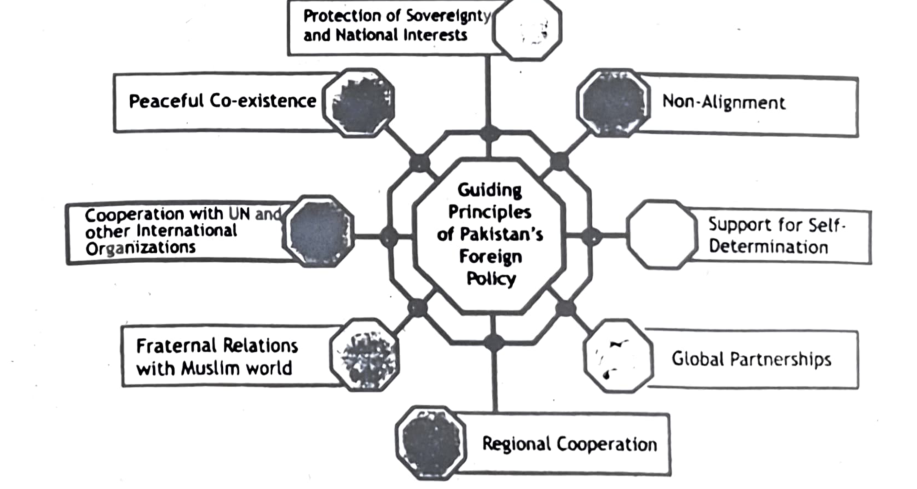
Pakistan's foreign policy is based on principles such as peaceful coexistence, respect for sovereignty, non-interference, international cooperation, and support for the right of self-determination.
- Relations with Muslim Countries:
Pakistan seeks strong relations with Muslim countries and supports cooperation among Islamic nations.
- Role in International Organizations:
Pakistan participates in organizations such as the United Nations to promote peace, cooperation, and the peaceful settlement of disputes.
- Evaluation:
Pakistan's foreign policy has generally focused on national security, economic development, regional peace, and maintaining international relations. However, changing regional conditions and economic challenges require Pakistan to follow a balanced, independent, and pragmatic foreign policy.
Importance of Foreign Policy:
Foreign policy plays a crucial role in shaping a nation's interactions and relationships with the rest of the world. It serves as a strategic tool for countries to navigate the complexities of international relations, addressing global challenges and seizing opportunities. Through well-crafted foreign policies, nations can protect their interests, promote prosperity, and contribute to global stability and peace.
Let's outline the main points regarding the importance of foreign policy.
- National Security and Defense:
Foreign policy helps countries build strong alliances, enhance military capabilities, and engage diplomatically to safeguard borders and maintain peace. It ensures national security through strategic partnerships and defense strategies.
- Economic Prosperity and Trade Relations:
Countries use foreign policy to negotiate trade agreements, attract investments, and open markets abroad. This boosts their economy, creates jobs, and improves living standards for citizens.
- Diplomacy and International Relations:
Through foreign policy, nations build diplomatic ties, resolve conflicts peacefully, and represent their interests globally. Effective diplomacy promotes stability and cooperation among countries.
- Cultural and Soft Power Influence:
Foreign policy promotes cultural exchanges, educational programs, and humanitarian aid initiatives. This helps nations build positive relationships and influence global perceptions.
- Global Governance and Multilateralism:
Foreign policy guides participation in international organizations to address global issues like climate change and human rights. Collaborating with other countries sets standards for peace and development.
- Humanitarian and Development Aid:
Foreign policy supports humanitarian efforts, sustainable development projects, and aid for vulnerable populations worldwide. It shows compassion and strengthens global partnerships for a more stable world.
Foreign policy supports humanitarian missions, development projects, and disaster relief efforts worldwide. It demonstrates solidarity, compassion, and global citizenship, fostering stronger international partnerships for sustainable development.
- Peacekeeping and Conflict Resolution:
Nations use foreign policy to participate in peacekeeping missions, mediate conflicts, and promote peaceful resolutions to disputes. Diplomatic efforts and international interventions help prevent conflicts and maintain peace in volatile regions.
- Global Influence and Status:
Effective foreign policy enhances a country's global influence and status. By engaging diplomatically, forming alliances, and promoting national values, nations gain respect and leadership opportunities in international organizations. This strengthens their ability to shape global policies and contribute to international peace and stability.
Diplomacy:
Diplomacy is the practice of managing relationships between countries through peaceful dialogue and negotiation. It helps nations protect their interests, resolve conflicts, and promote cooperation in areas like politics, trade, and culture, all while maintaining peaceful and respectful interactions.
Diplomacy is a key tool of foreign policy, as it allows countries to achieve their international goals through peaceful negotiation and dialogue, helping to resolve conflicts, build alliances, and promote cooperation without resorting to force.
Diplomacy is carried out by diplomats, who represent their country abroad and engage in negotiations to advance national interests. A good diplomat helps resolve conflicts, foster cooperation, and promote foreign policy goals effectively.
Determinants of Foreign Policy of Pakistan:
Foreign policy is shaped by a multitude of factors that influence how a nation engages with the international community. These determinants, ranging from internal socio-economic conditions to external geopolitical pressures, collectively define a country's strategic approach on the global stage.
Following are the determinants of Pakistan's foreign policy.
- Geography:
Pakistan's foreign policy is significantly influenced by its geographical features. Its location at the crossroads of South Asia, Central Asia, and the Middle East shapes its strategic outlook. The proximity to conflict zones like Afghanistan and the Arabian Sea affects security policies and economic strategies.
- History and Culture:
Pakistan’s historical experiences, including the partition from India and subsequent conflicts, shape its foreign policy objectives. Cultural ties and historical grievances influence diplomatic relations and strategic alliances.
- National Capacity:
The economic strength, military capabilities, and technological advancements of Pakistan determine its ability to pursue independent foreign policy goals. Economic development impacts its bargaining power and influence in international affairs.
- Public Opinion:
In Pakistan’s democratic framework, public sentiment plays a crucial role in shaping foreign policy decisions. Media, telecommunications, and public discourse influence government policies, particularly on issues like regional stability and international engagements.
- Ideology:
Pakistan’s ideological principles, rooted in Islamic identity and national sovereignty, guide its foreign policy stance. Ideological considerations influence alliances, international engagements, and responses to global issues.
Social and Political Structures: The nature of Pakistan’s political system and societal dynamics impact its foreign policy. Changes in government leadership and societal cohesion influence diplomatic strategies and regional interactions.
- National Interest:
The primary driver of Pakistan’s foreign policy is the protection and promotion of its national interests. Security concerns, economic prosperity, and regional stability are central to decision-making processes.
- External Factors:
International laws, treaties, and global organizations such as the United Nations (UN) shape Pakistan’s foreign policy landscape. Relations with neighboring countries, global powers, and regional alliances affect diplomatic maneuvers and strategic alignments.
- Policy-Making Factors:
The leadership qualities, personal ideologies, and bureaucratic influences within Pakistan’s government structure determine the formulation and execution of foreign policy strategies.
Evaluation of Pakistan’s Foreign Policy:
Evaluating Pakistan’s foreign policy involves looking at its history, geography, and political choices. Pakistan inherited many factors from its past, like its colonial legacy and partition with India. These factors shaped how it interacts with other countries. By studying these influences, we can see how Pakistan works to keep peace, grow its economy, and solve global issues. Pakistan’s foreign policy has the following phases as it is evaluated.
Era of Neutrality (1947-1953):
After gaining independence in 1947, Pakistan chose to remain neutral in the Cold War. Both the USA and USSR wanted Pakistan’s support, but Pakistan decided not to align with either. Internally, Pakistan faced economic and political challenges. It also had security threats from India and Afghanistan. This period set the foundation for Pakistan’s foreign policy.
Alliance with the West (1954-1962):
In the mid-1950s, Pakistan joined Western alliances, such as SEATO and CENTO. This alliance aimed to counter the Communist threat in the region. Pakistan received military and economic aid from the USA. This period strengthened Pakistan’s defense but also increased dependence on Western powers.
Era of Bilateralism (1962-1971):
During this time, Pakistan tried to improve relations with neighboring countries. It also sought stronger ties with China and other Asian nations. The focus was on solving regional issues through bilateral agreements. This period included the 1965 war with India over Kashmir, which strained relations further.
Non-Aligned Movement (1972-1979):
After the 1971 war with India and the creation of Bangladesh, Pakistan adopted a non-aligned policy. It joined the Non-Aligned Movement, which aimed to stay neutral in the Cold War. Pakistan also strengthened its ties with Muslim countries. This period emphasized economic cooperation and regional stability.
Islamic Solidarity and Regional Focus (1979-1988):
In the late 1970s, Pakistan shifted its focus to the Muslim world. It played a key role in the Afghan conflict, supporting Afghan Mujahideen against Soviet invasion. Pakistan also sought closer ties with Middle Eastern countries. This period highlighted Islamic solidarity and regional cooperation.
Post-Cold War Adjustments (1989-2001):
After the Cold War, Pakistan had to adjust its foreign policy. The collapse of the Soviet Union changed global dynamics. Pakistan faced new challenges, such as nuclear proliferation and regional instability. It sought to maintain good relations with the USA while also addressing regional issues.
War on Terror and Strategic Realignments (2001-Present):
After the 9/11 attacks, Pakistan became a key ally of the USA in the War on Terror. It faced challenges like terrorism and regional conflicts. During this time, Pakistan also built a strong partnership with China. The China-Pakistan Economic Corridor (CPEC) is a major part of this relationship. CPEC helps with economic growth and infrastructure development. In this phase, Pakistan balances relations with big powers, deals with security issues at home, and works closely with China to boost development and regional stability.
OR
What are three main objectives of Pakistan’s foreign policy?
Objectives of Pakistan’s Foreign Policy:
Preservation of National Independence and Security:
The primary objective of Pakistan’s foreign policy is to ensure national independence and security. This includes protecting the country from external threats, maintaining territorial integrity, and safeguarding the ideological foundations of the state. To achieve this, Pakistan focuses on strengthening its defense capabilities and building strategic alliances.
Economic Development:
Economic development is crucial for a nation’s independence and security. A strong economy provides the resources needed to defend national interests and maintain sovereignty. By focusing on trade, investment, and infrastructure,
Pakistan aims to enhance its economic stability, which in turn supports its security and independence.Unity of the Muslim World:
The unity of the Muslim world is a key objective of Pakistan's foreign policy, reflected in Quaid-e-Azam Muhammad Ali Jinnah's vision and the 1973 Constitution. Pakistan is a strong proponent of Muslim unity and works to strengthen ties with Muslim-majority countries through diplomacy, economic cooperation, and cultural exchanges. By advocating for common causes and supporting Muslim communities globally, Pakistan seeks to foster unity and collaboration within the Muslim Ummah.
Regional and Global Peace and Stability:
Pakistan strives to resolve conflicts through diplomatic means and supports international efforts to maintain peace. By participating in peacekeeping missions, engaging in dialogue, and cooperating with global organizations including UNO, Pakistan aims to contribute to a stable and secure international environment. This commitment helps address regional tensions and supports global peace initiatives.
Guiding Principles of Pakistan Foreign Policy:
Pakistan's foreign policy is shaped by its historical legacy, geographical position, and constitutional directives. Guided by vision of Quaid-i-Azam Muhammad Ali Jinnah it emphasizes Pakistan's commitment to peace, justice, and friendly relations among nations. The policy aims to protect national sovereignty, promote regional stability, and strengthen global partnerships.
Pakistan’s Geopolitical Importance at the Crossroads of Asia:
- Strategic Location:
Pakistan has a highly important geographical location because it lies at the crossroads of South Asia, Central Asia, and the Middle East.
- Importance of China:
Pakistan shares a close strategic relationship with China. The China-Pakistan Economic Corridor (CPEC) connects Pakistan with China's western region and provides important trade and transport opportunities.
- Importance of India:
Pakistan shares a long border with India, making its relationship with India important for regional security, peace, trade, and stability.
- Importance of Afghanistan:
Pakistan shares a long border with Afghanistan. Its location provides a link between South Asia and Central Asia, making Pakistan important for regional trade and connectivity.
- Importance of Iran:
Pakistan’s western border with Iran provides opportunities for trade, energy cooperation, and regional connectivity.
- Access to the Arabian Sea:
Pakistan has a strategic coastline along the Arabian Sea, with Gwadar Port offering opportunities for international trade and connecting landlocked regions to the sea.
- Regional Connectivity:
Pakistan’s location allows it to serve as a trade and transportation link between China, Central Asia, South Asia, and the Middle East.
Pakistan's location and its borders with China, India, Afghanistan, and Iran, along with its access to the Arabian Sea, give it significant geo-political and economic importance in the region.
Geopolitics is crucial for Pakistan's global position and relations with neighboring countries. Located in South Asia, at the crossroads of Central Asia and the Middle East, Pakistan's strategic location shapes its foreign policy and economic interests. Factors like geography, trade routes, natural resources, and security concerns heavily influence Pakistan's interactions with neighbors and international partners, affecting regional stability. Understanding these dynamics is key to grasping Pakistan's role in the global geopolitical landscape.
- Strategic Location:
Pakistan's strategic location at the crossroads of South Asia, Central Asia, and the Middle East enhances its geopolitical importance. Pakistan serves as a critical link in regional connectivity and trade routes, facilitating the movement of goods and energy resources.
- Bridge between South Asia and Central Asia:
Pakistan's geographical position acts as a bridge connecting the South Asian subcontinent with Central Asia. This geographical linkage plays a crucial role in facilitating trade, energy transport, and connectivity routes. The China-Pakistan Economic Corridor (CPEC) exemplifies this importance, linking China's Kashgar to Pakistan's Gwadar Port, providing China access to the Arabian Sea and beyond.
- Balancing Power Dynamics:
Pakistan's location serves as a balancing factor in the region's power dynamics. Sharing borders with China, Afghanistan, India, and Iran underscores its strategic importance. Major world powers, such as the United States, Russia and China have engaged with Pakistan to advance their interests in South and Central Asia.
- Economic Significance:
Pakistan's economic significance in geostrategy is substantial. It serves as a vital transit route for trade and energy corridors. The CPEC, part of China's Belt and Road Initiative, enhances Pakistan's geostrategic importance by boosting connectivity and economic integration with China.
- Security Significance:
Pakistan holds significant security importance due to its location at the confluence of South Asia, Central Asia, and the Middle East. Its border with Afghanistan has positioned it centrally in the Afghan conflict, influencing regional stability. Pakistan's role in counterterrorism efforts and its nuclear capabilities further impact regional and global security dynamics.
- Regional Dynamics:
Pakistan's regional dynamics are pivotal in geostrategic terms. Its relationships with neighboring countries like India, Afghanistan, and Iran are marked by historical tensions and strategic interests. These dynamics influence stability, security, and economic cooperation in a geopolitically volatile region.
Geopolitics:
“Geo” comes from Greek meaning “earth” or “land,” and “politics” refers to the activities related to governance and power. Geopolitics is a branch of political science which studies how geography affects the way countries interact and make decisions. The term emerged in the late 19th century to describe how geographical factors like location, resources, and terrain shape global affairs.
Historically, Gulf countries had strong ties with Pakistan due to shared religion, military cooperation, and cultural links. However, recent years have seen a shift toward India. Key reasons include:
- Economic Interests:
- India is a major energy importer and trade partner.
- Gulf countries see India’s large market and growing economy as more beneficial.
- Millions of Indian expatriates contribute to Gulf economies.
- Strategic Diversification:
- Gulf states are diversifying partnerships beyond traditional allies like Pakistan.
- India offers political stability and global influence.
- Pakistan's Foreign Policy Shortcomings:
- Over-reliance on religious solidarity.
- Limited economic engagement with Gulf states.
- Inconsistent stance on regional conflicts (e.g., Yemen) strained ties.
Impact:
- Gulf investments and diplomatic attention are increasingly directed toward India.
- Pakistan's influence in the region has diminished, though ties remain cordial, especially in defense and labor export.
Strategic Significance and Challenges for Pakistan:
- Strategic Location:
Pakistan's location at the crossroads of South Asia, Central Asia, and the Middle East gives it great strategic importance.
- Strong Partnership with China:
Pakistan has developed a strong strategic and economic partnership with China, particularly through CPEC.
- Access to the Arabian Sea:
Pakistan's coastline and ports provide important opportunities for international trade, transportation, and regional connectivity.
- Security Concerns:
Pakistan faces challenges such as terrorism, extremism, border security, and regional conflicts, which affect national stability.
- Situation in Afghanistan:
Instability in Afghanistan creates security challenges for Pakistan, including concerns about cross-border terrorism and refugee pressures.
Pakistan's Commitment to Supporting Less Privileged Nations:
The history of Pakistan is rooted in the struggle of Muslims in the Indian subcontinent. Before partition, they faced social, economic, and political challenges. This history of overcoming adversity has instilled a strong sense of solidarity in Pakistan. It has also created a sense of responsibility towards supporting less privileged people and nations.
Aid in Disasters:
Reflecting on its own historical experiences, Pakistan has sent medical teams, relief supplies, and financial aid to countries affected by natural disasters, such as earthquakes and floods. For instance, Pakistan provided significant support to Turkey after the devastating earthquake in 1999. Pakistan also helped Indonesia after the 2004 tsunami and provided relief to Haiti after the 2010 earthquake. It sent aid to Nepal following the 2015 earthquake. Additionally, Pakistan supported Bosnian Muslims during the Bosnian War in the 1990s. These efforts highlight Pakistan's commitment to aiding those in need worldwide.
Diplomatic support:
Pakistan advocates for the rights and development of less privileged nations in international forums. Pakistan champions the rights of oppressed communities, such as Palestinians, Kashmiris, Rohingya Muslims in Myanmar, and Eritrean Muslims, providing non-material aid through diplomatic advocacy and support.
Peacekeeping Missions:
Pakistan has become one of the largest contributors to United Nations peacekeeping missions. Pakistani peacekeepers have served in conflict zones around the world, including Africa and the Middle East, helping to stabilize regions, protect civilians, and support post-conflict recovery efforts. Pakistani forces have been deployed in many countries and regions including Balkan, Somalia, Congo, Sudan, Sierra Leone, Kuwait, Haiti, East Timor, and Liberia to help stabilize regions, protect civilians, and supporting post-conflict recovery efforts. These deployments showcase Pakistan's commitment to global peace and security.
Pakistan’s Diplomatic Ties: Challenges, Strategic Impacts, and Future Prospects:
- Relations with China:
Pakistan enjoys a strong strategic and economic relationship with China. Cooperation through CPEC has increased opportunities for infrastructure, trade, and investment.
- Relations with India:
Relations with India have often been affected by political tensions, security concerns, and the Kashmir dispute. Improved dialogue and peaceful cooperation could benefit both countries and promote regional stability.
- Relations with Afghanistan:
Pakistan shares important historical, cultural, and geographical links with Afghanistan. However, border security, terrorism, and political instability remain major challenges. Greater cooperation could improve peace and regional connectivity.
- Relations with Iran:
Pakistan and Iran have opportunities for cooperation in trade, energy, border security, and regional development. Better economic and diplomatic coordination can strengthen these ties.
- Regional Impact:
Pakistan's relations with its neighbors directly affect national security, economic development, trade, regional peace, and connectivity.
- Future Prospects:
Pakistan can improve regional relations through dialogue, peaceful conflict resolution, increased trade, economic cooperation, and stronger border management.
Pakistan-India Relations:
Pakistan and India share a long, complex history. Geographically, both countries share a border that stretches over 3,323 kilometers, including Indian occupied Kashmir. The two nations were part of British India until 1947, when they got independence and were partitioned into two separate countries. This division led to large-scale migration and communal violence, impacting their relations from the beginning. The partition and subsequent conflicts, particularly over Kashmir, have been central to their relationship. Despite periods of tension and conflict, both nations have also engaged in peace talks and confidence-building measures to improve bilateral relations.
Pakistan and China maintain an "All-Weather Strategic Cooperative Partnership" rooted in deep geopolitical trust, military collaboration, and comprehensive economic integration through the China-Pakistan Economic Corridor (CPEC).
Mutual Cooperation:
- Diplomatic Alignment: Both nations consistently support each other's core regional and international interests, including the Kashmir issue and the One-China policy.
- Defense and Security: Bilateral military ties feature joint exercises, co-production of defense equipment (such as the JF-17 Thunder), and institutionalized counter-terrorism coordination.
- Multilateral Engagement: Islamabad and Beijing coordinate closely within global forums like the Shanghai Cooperation Organisation (SCO) and the United Nations to promote regional stability.
Outcomes of CPEC:
- Phase I (Infrastructure & Energy): Completed foundational projects delivered thousands of megawatts of electricity to the national grid and built major highways and transport links, easing Pakistan's chronic energy deficits and improving connectivity. Phase II (CPEC 2.0 - Industrial and Agricultural
Modernization): Current frameworks shift focus toward Special Economic Zones (SEZs), information technology, green energy, agricultural technology, and joint business ventures to boost Pakistan's export capacity.
- Strategic Access: The development of the Gwadar Port provides China with an alternative, shorter trade route to the Arabian Sea, bypassing the Malacca Strait.
- Challenges: Progress faces hurdles, notably security threats to Chinese personnel working on projects, debt sustainability concerns, and the need for greater regulatory and governance consistency.
Pak- Afghan Relations:
Pakistan and Afghanistan share a long border of about 2,640 kilometers, known as the Durand Line, established in 1893. Both nations have deep cultural, ethnic, and linguistic ties, especially through the Pashtun ethnic group, which lives in both countries. Being Muslim countries, both share cultural traditions. Trade across the border has been vital for both. Historically, political relations have been shaped by regional and global politics, including the Great Game, the Cold War, and the War on Terror. Both countries face challenges like political instability and militancy, influencing their bilateral relations.
Political Relations:
Political relations between Pakistan and Afghanistan have been complex and often strained. After Pakistan's independence in 1947, Afghanistan was the only country to oppose Pakistan's admission to the United Nations. The Durand Line border has been a source of tension. Relations worsened after the 9/11 attacks.
Soviet Invasion (1979-1989):
In 1979, the Soviet Union invaded Afghanistan. Pakistan supported Afghan mujahideen against the Soviet forces. Millions of Afghan refugees fled to Pakistan during this time. This period strengthened Pakistan-Afghanistan ties against a common enemy. However, it also led to the rise of militant groups in the region.
Taliban in Government (1996-2001):
The Taliban came to power in Afghanistan in 1996. Pakistan was one of the few countries to recognize the Taliban government. Pakistan hoped that the Taliban would bring stability to Afghanistan. However, the Taliban's strict rule and human rights abuses drew international criticism. Relations between Pakistan and Afghanistan were relatively stable but complicated by regional and global politics.
War on Terror (2001-Present):
After the 9/11 attacks in 2001, the United States invaded Afghanistan to remove the Taliban and fight Al-Qaeda. Pakistan became a key ally of the US in the War on Terror. Pakistan provided support for US military operations and faced backlash from militant groups. Relations between Pakistan and Afghanistan were tense and marked by mutual distrust.
Return of the Taliban (2021-Present):
In 2021, the Taliban returned to power in Afghanistan. Pakistan aims to maintain stable relations with the new Taliban government. Both countries are working on improving ties but face challenges. Border security, refugee management, and counter-terrorism cooperation are important issues. Pakistan supports international efforts to provide humanitarian aid to Afghanistan.
Economic Relations:
Trade between Pakistan and Afghanistan is important for both countries. Pakistan provides access to international markets through its ports. The Afghanistan-Pakistan Transit Trade Agreement (APTTA) aims to formalize trade. However, border closures and security issues often disrupt trade. Despite challenges, both countries benefit from cross-border trade.
Future Prospects:
The future of Pakistan-Afghanistan relations depends on regional stability and cooperation. Improved diplomatic efforts, increased economic cooperation, and enhanced security measures are crucial. Both countries can benefit from peaceful relations and mutual cooperation in addressing common challenges such as terrorism, poverty, and development.
Importance of a Peaceful Afghanistan for Pakistan:
- National Security:
A peaceful Afghanistan can help reduce cross-border terrorism, militancy, and security threats for Pakistan.
- Border Stability:
Peace in Afghanistan can contribute to better border management and stability along the Pakistan-Afghanistan border.
- Economic Development:
A stable Afghanistan can increase bilateral trade, investment, and economic cooperation between the two countries.
- Regional Connectivity:
Peaceful conditions can allow Pakistan to strengthen its role as a trade and transportation route connecting Central Asia with the Arabian Sea.
- Reduction in Refugee Pressure:
Stability in Afghanistan can reduce the need for Afghans to leave their country, helping Pakistan manage refugee-related economic and social pressures.
- Energy and Trade Opportunities:
Peace can support regional projects involving trade, transportation, and energy, benefiting Pakistan's economy.
Durand line:
The international boundary between Pakistan and Afghanistan is called the Durand Line. It was established in 1893 to separate British India from Afghanistan. The line is named after Sir Mortimer Durand, a British diplomat who negotiated the boundary agreement with the Afghan ruler, Amir Abdur Rahman Khan.
Pakistan Iran Relationships:
Pakistan and Iran share a 959-kilometer border and have historical and cultural ties. Since Pakistan's independence in 1947, their relationship has been a mix of cooperation and complexity due to geographical proximity and shared interests.
Economic Cooperation:
Economically, Pakistan and Iran trade in natural gas and agricultural products. Projects like the Iran-Pakistan Gas Pipeline aim to enhance energy security. However, international sanctions on Iran have posed challenges to expanding economic relations.
Cultural and People-to-People Relations:
Culturally, Pakistan and Iran share deep-rooted ties, including linguistic and historical connections. Urdu and Persian literature have influenced each other over the centuries, and cultural exchanges through music, art, and literature continue to foster mutual understanding. People-to-people contacts are facilitated through religious pilgrimages, educational exchanges, and tourism.
Geopolitical Dynamics:
Geopolitically, Pakistan and Iran navigate complex regional dynamics, including relations with neighboring countries like Afghanistan and Saudi Arabia. Differences in their strategic alignments and regional policies occasionally impact bilateral relations.
Chabahar and Gwadar Port:
The Chabahar and Gwadar ports represent strategic assets for Iran and Pakistan, respectively, and serve different geopolitical interests. Gwadar, a key component of the China-Pakistan Economic Corridor (CPEC), aims to enhance trade and infrastructure connectivity. On the other hand, Chabahar, developed with India's assistance, seeks to bolster India's access to Afghanistan and Central Asia, balancing the influence of CPEC in the region.
Balochistan's Impact on Pakistan-Iran Relations:
Balochistan's strategic position affects Pakistan-Iran relations. Militant groups and separatist activities pose security risks along the shared border. Both nations cooperate in military operations and intelligence-sharing to address these challenges and protect their sovereignty.
Pakistan's Relations with Saudi Arabia:
There is a history of strong relations between Saudi Arabia and the Muslims of the Indian subcontinent before partition. After the creation of Pakistan, King Saud of Saudi Arabia visited Pakistan in 1953. King Faisal's visit in 1966 further strengthened the ties. The Faisal Mosque in Islamabad was built as a symbol of their strong bond.
Defense Cooperation:
Saudi Arabia generously supported Pakistan during the 1965 and 1971 wars with India, providing financial and diplomatic assistance. In 1979, when extremists attacked the Holy Kaaba, Pakistan's armed forces played a key role in restoring security at the sacred site. Additionally, Pakistani forces have trained Saudi military personnel and assisted in defense operations. This mutual support has significantly strengthened the defense ties between the two countries.
Economic Cooperation:
Saudi Arabia has invested in various sectors in Pakistan, including energy, agriculture, and infrastructure. In recent years, it has provided significant financial support through aid, loans, and investments to help Pakistan overcome economic crises. When Pakistan became a nuclear power in 1998, Saudi Arabia embraced this development and supported Pakistan in addressing international pressure. Saudi Arabia's backing helped Pakistan manage the diplomatic and economic challenges following its nuclear tests.
Diplomatic Collaboration:
In 1974, Saudi Arabia backed Pakistan during the OIC Summit in Lahore. It has also supported Pakistan's position on Kashmir and assisted with FATF challenges. Pakistan has supported Saudi Arabia's stance on regional issues and provided diplomatic support in international settings.
Humanitarian Support During Disasters:
Saudi Arabia has provided significant aid to Pakistan during natural disasters. After the 2005 earthquake, Saudi Arabia quickly sent financial support, relief materials, and medical help. The kingdom also assisted during severe floods by offering funds and resources for rescue and rebuilding efforts.
Pakistani Workforce:
Saudi Arabia hosts a large number of Pakistani workers. These workers are employed in various sectors, including construction, healthcare, and domestic services. Pakistani manpower plays a crucial role in Saudi Arabia's economy. The remittances sent by these workers significantly support Pakistan's economy. The presence of Pakistani workers in Saudi Arabia strengthens the bilateral ties between the two countries.
Pak-US Relations:
The US, as one of the world's leading military powers and a highly developed, economically strong nation, plays a significant role in global affairs. Shortly after its independence in 1947, Pakistan sought an alliance with the US. This relationship included cooperation in defense, economy, and education. However, the relations have also faced challenges. This relationship has evolved over the decades, influenced by global and regional events. The ties between Pakistan and the US are important for both nations and the wider world.
Pak US Relations before 9/11:
Pakistan and the US established diplomatic relations in 1947. In the 1950s, Pakistan joined US-led alliances like SEATO and CENTO. These alliances aimed to contain Soviet influence in the region. The US provided military and economic aid to Pakistan. This support strengthened Pakistan's defense capabilities.
In the 1960s and 1970s, relations faced ups and downs. The US cut off military aid during the India-Pakistan wars of 1965 and 1971. However, in the 1980s, relations improved again. Pakistan became a key ally in the US-led effort to support Afghan mujahideen against the Soviet invasion of Afghanistan. This period saw increased military and economic assistance to Pakistan.
Pak US Relations after 9/11:
After 9/11, Pakistan became a non NATO ally in the US-led War on Terror. The US provided significant military and economic aid to Pakistan. This support aimed to help Pakistan combat terrorism and stabilize the region. Pakistan's role was vital in fighting Al-Qaeda and Taliban forces.
However, the relationship faced challenges. The US often expressed concerns over Pakistan's efforts against terrorism. Incidents like the 2011 raid that