
Density of Population:
Density of population is the number of people living per square kilometer unit of an area.
Calculation of population density:
$$\text{Density of population} = \frac{\text{Total population of the country}}{\text{Total area of the country}}$$
Population Indicators:
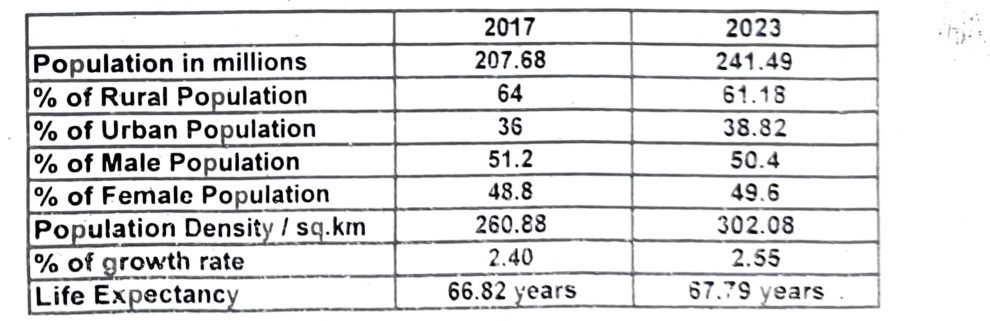
| 2017 | 2023 | |
|---|---|---|
| Population in millions | 207.68 | 241.49 |
| % of Rural Population | 64 | 61.18 |
| % of Urban Population | 36 | 38.82 |
| % of Male Population | 51.2 | 50.4 |
| % of Female Population | 48.8 | 49.6 |
| Population Density / sq.km | 260.88 | 302.08 |
| % of growth rate | 2.40 | 2.55 |
| Life Expectancy | 66.82 years | 67.79 years |
Reasons for High Density of Population:
- High Birth Rate and Low Death Rate:
The increase in density is not only because of high birth rate or low death rate but also because of increasing life expectancy of the people. - Increasing Life Expectancy:
This increasing trend is due to better hygiene, better healthcare and awareness of better lifestyle. - Improved Hygiene and Healthcare:
Life expectancy means an expected average age of a person of a country for a particular period of time.
- Population Growth:
The life expectancy of Pakistan in year 2017 was 66.82 years which has increased to 67.79 years in 2023. - Natural Factors and Availability of Resources:
Density of a country is directly related to population growth. - Subsistence Agriculture and Nomadic Herding:
Natural factors play an important role in this issue. For example, lofty mountains in the north, lack of water and rugged terrain of Balochistan and desert areas of Sindh have low density of population due to lack of basic resources. - Agricultural Economy:
People practice subsistence agriculture or nomadic herding prefer to have large families, increasing the density of population of these areas. - Preference for Large Families:
Pakistan is an agricultural country; people mostly ignore the benefits of small families. - Traditional Way of Life:
They follow their traditional way of life increasing the population as well the density of population of the country.
Population Pyramid:
- Population structure is the percentage of male and female and different age groups shown by a population pyramid.
- As indicated in the figure, it represents Birth rate, Death rate, different age groups of male and female population and migration.
- It also represents dependent population from early years to 10 years, Active group from 14 years to 60 years also known as labour force, above 60 years is known as old age and dependent group.
Population trends shown by the Population Pyramid:
Below 14 years:
- Birth rate of Population of Pakistan has declined from 2.6% in 1998 to 2.4% in 2017, indicating less dependency ratio in the early group.
- 14-60 years is a large group of active labour force; Government can easily plan for its positive work plan for development of the country. Better technical education can be designed to improve ratio between primary, secondary and tertiary activities.
- According to year 2017-18, 44% people were in Primary sector, employed in agriculture, fishing and mining, 25% in Secondary sector were employed including industry and manufacturing of machine-made quality products for domestic and foreign markets. For example, textiles, cement, sugar and many more. 37% in tertiary sector including services. Like, banking, insurance, health care and teaching etc.
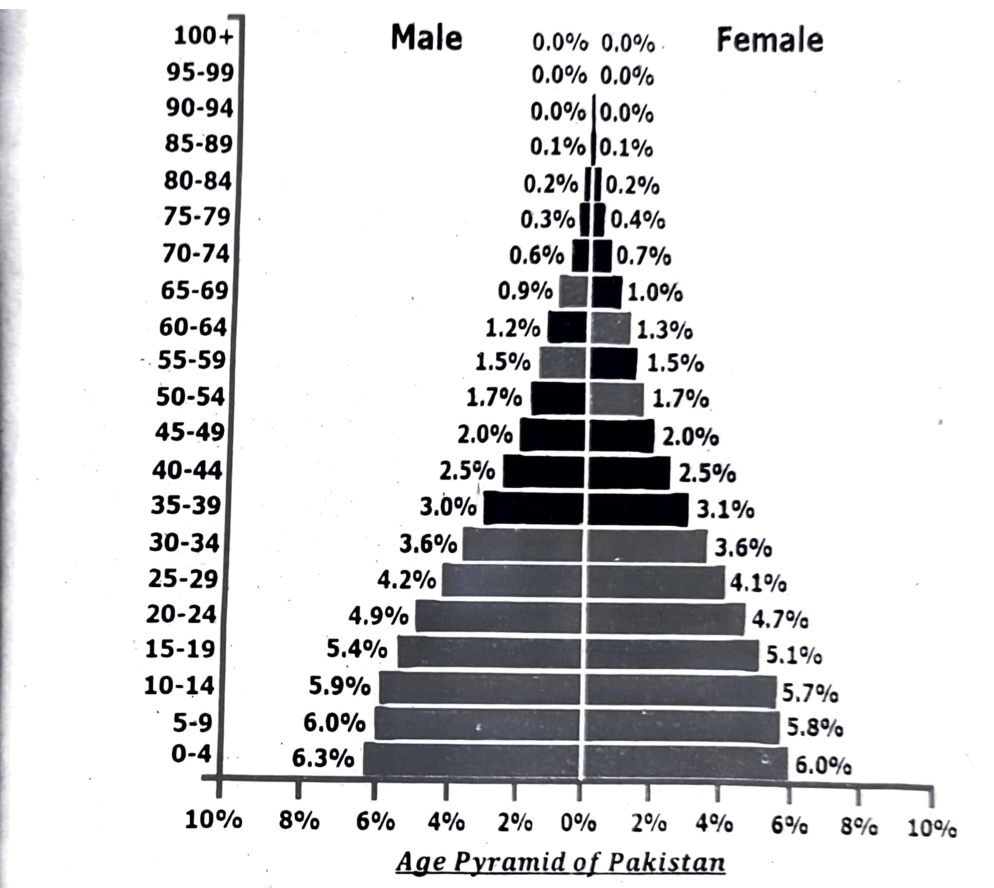
Above 60 years has been increasing demanding more healthcare better food and healthy lifestyle. Government and NGOs can plan for qualified old people may volunteer and counsel the younger generation.
Political stability is the dire need of the country. As without peace and stability, there can be no development of various projects, decreasing job opportunities in the country, leading to unemployment and migration.
Effects of Population Growth on the Economy and Development of Pakistan:
- Shortage of Basic Needs:
Rapid population growth increases demand for food, water, housing, and other basic necessities, putting pressure on available resources. - Pressure on Education and Health:
The government may struggle to provide sufficient quality education, skill-based training, hospitals, and healthcare facilities for the growing population. - Increase in Imports:
When domestic production cannot meet growing demand, Pakistan may need to increase imports of food, energy, and other essential goods, putting pressure on foreign exchange reserves. - Unemployment and Child Labour:
Rapid population growth increases the number of people entering the labour market. If enough jobs are not created, it can result in unemployment, underemployment, and child labour. - Inflation:
A growing population increases demand for goods and services. If supply does not increase accordingly, prices may rise, contributing to inflation. - Slow Development:
Limited government resources have to be distributed among a larger population. As a result, important development projects and infrastructure improvements may be delayed.
Rural-Urban and Seasonal Migration in Pakistan:
Migration is the movement of people from one place to another for economic, social, environmental, or other reasons. In Pakistan, both rural-urban migration and seasonal migration significantly influence population distribution and socio-economic development.
- Causes of Rural-Urban Migration:
People move from rural areas to cities mainly because of:
- Employment opportunities: Cities offer jobs in industries, construction, transport, trade, and services.
- Education: Better schools, colleges, and universities attract young people.
- Healthcare: Cities generally provide better hospitals and medical facilities.
- Better living standards: People seek improved housing, transport, electricity, and other services.
- Agricultural problems: Low agricultural income, water shortages, and limited farmland encourage people to leave rural areas.
- Causes of Seasonal Migration:
- Seasonal migration occurs when people move temporarily according to employment opportunities or environmental conditions.
- Agricultural workers may move during planting and harvesting seasons.
- Livestock herders may move between seasonal grazing areas.
- Construction workers may move to cities for temporary employment.
- Harsh weather, droughts, floods, and water shortages can also encourage temporary movement.
- Influence on Population Distribution:
Migration causes rapid population growth in urban areas, particularly major cities such as Karachi, Lahore, Islamabad, and Rawalpindi. Rural areas may experience a loss of young and economically active people.
- Geographic Impediments:
Rapid migration can create pressure on land, housing, transport, water, sanitation, and public services. Unplanned urban expansion may lead to overcrowding and the development of informal settlements.
- Socio-Economic Impacts:
Migration can provide families with employment and remittances, improving their standard of living. However, rapid urban migration can also increase unemployment, poverty, traffic congestion, pollution, and pressure on healthcare and education.
- Effects on Rural Areas:
The loss of working-age people may reduce the rural labour force and affect agricultural production. However, migrants may send remittances to their families, helping improve rural household incomes.
Urban-Rural Population in Pakistan:
- Rural-Urban Migration:
Rural-urban migration is the movement of people from villages and rural areas to cities. In Pakistan, this movement has increased since independence because of differences in resources, employment, and living standards.
- Pull Factors:
Cities attract people because they offer better:
- Employment and higher wages
- Education and healthcare
- Housing and sanitation
- Transport and infrastructure
- Recreation and other facilities
These are called pull factors because they attract people towards urban areas.
- Push Factors:
Rural areas may push people towards cities because of:
- Limited employment opportunities
- Large families and pressure on agricultural land
- Drought and overgrazing
- Low agricultural productivity
- Lack of modern technology and farming equipment
- Limited access to education, healthcare, and other services
- Growth of Urban Population:
Year Population (million) Urban Share (%) 1981 84.25 28.30 1998 132.35 32.52 2017 207.69 36.44 2023 241.49 38.82 - Effects of Urbanization
Increasing urban population can provide more workers, markets, industries, and economic opportunities. However, rapid urban growth can also cause overcrowding, unemployment, traffic congestion, housing shortages, pollution, and pressure on water, sanitation, education, and healthcare.
Pakistan is experiencing a gradual shift towards an increasingly urban population. Rural-urban migration is mainly caused by the pull factors of cities and push factors of rural areas. Proper urban planning and rural development are necessary to manage this growth sustainably.
Problems caused by urbanization:
Urbanisation attracts more people to cities as they provide better quality of life. This is leading to various serious economic, social and political problems. These are as follows:
- Lack of accommodation:
Migrating people are unable to get standard houses. There is a great decline in living conditions. They live in slums or kachi Abadis which have poor standard of living, shortage of safe drinking water, electricity, and natural gas leading to many hazards.
- Environmental issues:
Sanitation facilities are not enough to meet the unprecedented growing urban population. This leads to untreated domestic and industrial waste, which causes water and land pollution, resulting in health hazards (Malaria, Dengue, Typhoid etc.). Large number of vehicles causes air pollution since they release smoke and increase carbon emissions. Furthermore, this leads to traffic jams and many drivers do not follow the traffic rules resulting in frequent accidents. Industrial estates form around major cities contribute to very dense air pollution, for example there is now heavy smog in Lahore
- Degradation of resources:
People migrating from rural areas mostly settle in unplanned houses in the outskirt of cities where there is a great shortage of basic facilities of education, health, transport, and electricity which effects the main city life as well, this also leads to unemployment.
- Increase in crime rate:
Crime rate increase increases due to unemployment as well as inter mixing of people from different areas based on their lifestyle and culture. The great economic difference between the people of the planned city and rural people settled in the outskirts of these cities create a great economic difference leading to crime.
Urbanization is a critical factor in the development dynamics of Pakistan, with significant implications for economic growth, social transformation, and infrastructure development. Here’s why urbanization is important for Pakistan:
- Economic Growth:
Urban areas are generally more productive than rural areas due to higher levels of investment, better infrastructure, and more diverse economic activities. Cities are hubs of industrial activity, services, and trade, which contribute significantly to the national GDP. In Pakistan, urbanization can facilitate the transition from an agrarian economy to one dominated by manufacturing and services, which are key drivers of economic development.
- Job Creation:
Urban centers in Pakistan offer more diverse employment opportunities compared to rural areas. This includes jobs in manufacturing, retail, information technology, and services. Urbanization can help absorb the growing labor force and reduce unemployment by providing jobs that are not available in rural settings.
- Innovation and Productivity:
Cities are often centers of innovation due to the concentration of resources, educational institutions, and businesses. Urbanization promotes competitiveness and productivity through technological advancements and better business practices. For Pakistan, urbanization can enhance overall productivity by pooling talent and fostering innovation in various sectors.
- Improved Infrastructure:
Urbanization necessitates the development of infrastructure such as roads, public transport, electricity, water supply, and sanitation. Improving urban infrastructure in Pakistan can lead to better service delivery and quality of life for its urban residents, while also attracting more businesses and investments.
- Education and Healthcare Services:
Urban areas typically have better access to quality education and healthcare services. This access is crucial for improving human capital in Pakistan, where urban residents are more likely to benefit from higher education institutions and advanced medical facilities, thus improving the overall human development indices of the country.
- Social Mobility:
Urbanization provides opportunities for social mobility not typically available in rural areas. Residents of urban areas in Pakistan can benefit from more diverse social networks, exposure to new ideas and cultures, and better access to services and education, all of which contribute to social progress and individual advancement.
- Demographic Transition:
Urban areas have lower fertility rates due to lifestyle changes, better access to family planning, and the higher costs of raising children. This demographic transition can help manage population growth in Pakistan, which is crucial for sustainable development.
- Reduction of Rural Poverty:
By providing better economic opportunities, urbanization can help draw people out of subsistence agriculture and rural poverty. Migrants from rural areas can achieve higher incomes and improved living standards in urban centers.
Solutions to the Problems of Urbanization:
- Improve Transport System:
The government should improve roads, overhead bridges, underpasses, and public transport. Metro services, Orange Line, Green Line, and rapid bus systems should be expanded to meet the needs of the growing population and reduce traffic congestion.
- Conservation of Resources:
People should be educated about the proper use and conservation of electricity, gas, and water. This will help ensure the sustainable use of limited resources.
- Reduce Rural-Urban Migration:
Rural-urban migration can be reduced by providing quality education, electricity, safe drinking water, healthcare, and employment opportunities in rural areas. Small-scale industries should also be encouraged.
- Provide Affordable Housing:
The government and private sector should develop planned housing schemes for different income groups. Subsidized housing can help provide affordable accommodation and reduce the growth of slums and overcrowded settlements.
- Improve Urban Planning:
Cities should be developed through proper land-use planning, waste management, drainage, parks, and sanitation systems to improve living conditions.
Urbanization can be managed effectively through better transport, affordable housing, resource conservation, rural development, and proper urban planning. These measures can create more organized and sustainable cities.
Population Distribution According to Climate, Topography and Agriculture:
Pakistan’s population is unevenly distributed because climate, topography, availability of water, and agricultural opportunities vary greatly across the country.
- Effect of Climate:
Areas with extreme climates generally have low population density. The northern mountainous regions experience very cold temperatures, heavy snowfall, and frequent landslides, making settlement difficult. The dry and hot regions of Balochistan also have low population densities because of limited rainfall and water shortages.
- Effect of Topography:
Flat and level land is more suitable for settlement, transport, and construction. Therefore, the plains of Punjab and Sindh have higher population densities. In contrast, the Karakoram, Himalayas, and Hindu Kush have rugged terrain, steep slopes, and high altitudes, resulting in sparse populations.
- Effect of Agriculture:
Agriculture is an important factor influencing population distribution. Punjab and Sindh have fertile alluvial soils and reliable water from the Indus River, its tributaries, canals, and irrigation systems. These conditions support intensive agriculture and provide employment, attracting large populations.
- Low Population Density Areas:
Khyber Pakhtunkhwa's mountainous areas, Balochistan, and desert regions generally have lower population densities because of rugged terrain, low rainfall, limited water, poor transport links, and fewer employment opportunities.
- Urban Population Concentration:
Major cities have attracted people because of employment, education, healthcare, transport, housing, electricity, and recreational facilities. Cities such as Karachi, Lahore, and Faisalabad have therefore developed into major population centres.
Youth and Dependent Population in Pakistan:
Pakistan has a large young and dependent population. This can be a major advantage for economic development if young people receive proper education, skills, healthcare, and employment opportunities.
- Problems of Youth:
- Unemployment: Limited job opportunities can lead to poverty and economic dependency.
- Lack of skills: Many young people do not have the technical and vocational skills required by the modern job market.
- Limited quality education: Unequal access to quality education affects future employment opportunities.
- Health problems: Poor nutrition and limited healthcare can reduce productivity.
- Social issues: Unemployment and lack of opportunities may contribute to frustration, crime, and social instability.
- Problems of Dependent Population:
A dependent population includes children and elderly people who generally rely on the working-age population for support.
- A large number of dependents increases pressure on household incomes.
- Greater demand is placed on schools, hospitals, housing, and social services.
- Families may face increased financial pressure when there are fewer earners supporting more dependents.
- Role of Government:
The government can address these problems by:
- Improving education and vocational training.
- Creating employment through industrial and economic development.
- Supporting entrepreneurship and small businesses.
- Expanding healthcare and social protection.
- Providing technical training according to labour-market needs.
- Developing infrastructure and opportunities in less-developed regions.
- Role of NGOs:
NGOs can support government efforts by providing:
- Skills and vocational training.
- Education and literacy programmes.
- Healthcare and awareness campaigns.
- Support for women, children, and vulnerable communities.
- Microfinance and entrepreneurship programmes.
- Measures for Sustainable Human Resource Development:
For long-term development, Pakistan should:
- Invest in quality education and technical skills.
- Improve healthcare and nutrition.
- Promote youth employment and entrepreneurship.
- Develop digital and technological skills.
- Encourage participation of women in the workforce.
- Link education and training with the needs of industries.
- Strengthen cooperation between the government, NGOs, educational institutions, and private sector.
Factors Affecting Population Distribution:
Population distribution in Pakistan is influenced by physical, economic, social, and political factors. These factors determine where people choose to live and work.
- Physical Factors:
Relief, climate, water availability, and natural resources strongly influence population distribution. Flat and fertile areas with reliable water generally attract more people, while mountainous, dry, and difficult terrains have lower population densities.
- Example: The Northern Mountains have developed tourism because of their scenic beauty and pleasant summer climate. Improved roads, accommodation, and transport create employment for local people as tourist guides and service providers.
- Economic Factors
Employment and natural resources attract people to particular regions.
- Gwadar Port creates employment through port, trade, transport, and related activities.
- The Balochistan Plateau has valuable resources such as gold, copper, and coal, creating opportunities in mining and related industries.
- The Thar Coal project in Sindh provides employment and encourages the development of infrastructure and services.
These economic opportunities can attract people and reduce migration from less-developed areas.
- Social Factors:
Availability of education, healthcare, safe drinking water, housing, and recreational facilities affects where people prefer to live. Areas with better social services generally attract more population.