
Inheritance:
Inheritance is the process by which traits are passed from parents to offspring. These traits may base on the similarities between parent and their offspring (heredity) or difference between them (variation).
Genetics:
The study of heredity and variation is called genetics.
A chromosome is made up of DNA and proteins called histones. It has two arms—p and q—joined at a centromere. The ends of the chromosome are called telomeres. Each chromosome contains genetic material in the form of genes. These components help chromosomes function in cell division and inheritance.
The centromere is a constricted region that holds the two sister chromatids together. It plays a crucial role during cell division by attaching to spindle fibers. This ensures equal distribution of chromosomes to daughter cells. Without a centromere, chromosomes may not divide properly. Hence, it maintains genetic stability in organisms.
Understanding chromosome structure helps scientists identify abnormalities like missing or extra chromosomes. For example, Down syndrome is caused by an extra copy of chromosome 21. Structural defects like deletions or translocations can also be diagnosed. Karyotyping and genetic testing rely on this knowledge. Therefore, it is vital in medical genetics and early diagnosis.
- Genes:
Each characteristic and function of the body is controlled by factor called gene. The parental traits are passed to their offspring in the form of genes. Therefore, a gene is the unit of inheritance. Basically, a gene is a specific segment of DNA comprising a unique sequence of nucleotides that encodes the sequence of amino acid in a particular polypeptide. Mendel was the first person who proposed the idea of gene, he called them “factors” or “elementems” and used to represent the genes of different characteristics with alphabetical symbols. Each characteristic and function of the body is controlled by factor called gene. The parental traits are
passed to their offspring in the form of genes. Therefore, a gene is the unit of inheritance.
- Locus (Plural loci):
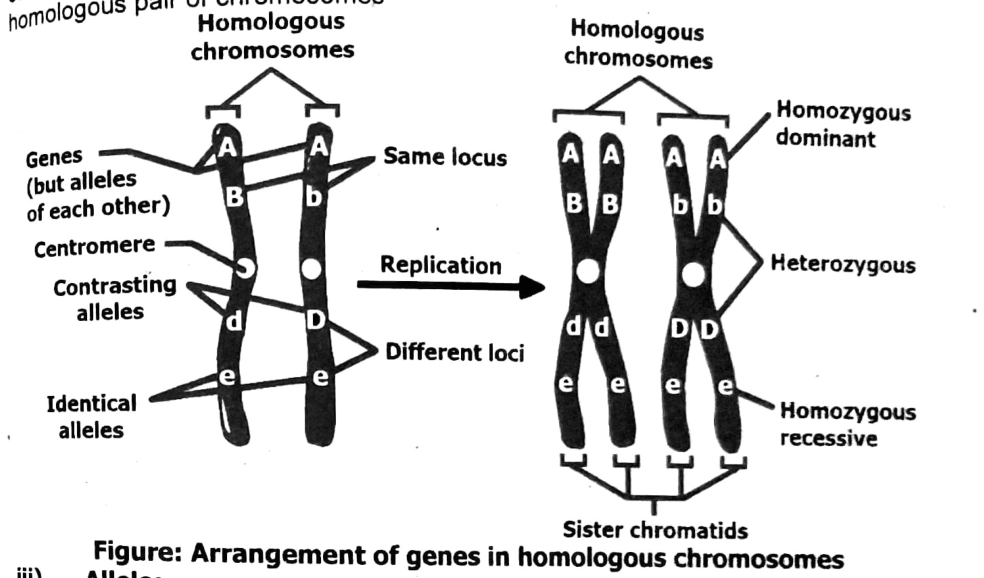
Now we know that the genes are found in chromosomes at specific positions called loci (singular locus). A locus is represented on both members of a homologous pair of chromosomes.
- Allele:
At each locus on a chromosome, a gene can exist in two or more forms. These different forms or variations of a gene are called alleles. Alleles are versions of the same gene that occupy the same position on a chromosome. For example, in humans, earlobes can either be free or attached. The gene for free earlobes is represented by “E” and the gene for attached earlobes is “e”. Both “E” and “e” are located at the same locus and are alleles of each other. Although “E” and “e” are different alleles, they are both considered genes as well.
Genome:
The complete set of an individual's genes is called the genome. The number of chromosomes that carry the entire genome is referred to as a set of chromosomes, represented by “n” or monoploid. A cell with two sets of chromosomes is called diploid or 2n. In humans, the full genome is spread across 23 chromosomes, which make up one set. The term haploid is used to represent a cell that contains half than the number of chromosomes of somatic cells (body cells other than gametes).
Cell Fertilization:
Self-fertilization is a type of reproduction where an organism's own sperm fertilizes its own eggs. This process commonly occurs in plants and some hermaphroditic animals. In self-fertilization, the offspring usually inherit genes from a single parent, leading to less genetic variation compared to cross-fertilization.
Genotype and Phenotypes:
- Genotype:
The genetic makeup of a trait at each locus is called the genotype. A genotype usually consists of a pair of genes or alleles. For example, the genotype for free earlobes can be represented as “EE” or “Ee,” while the genotype for attached earlobes is “ee.” If the genotype has two identical alleles (like “EE” or “ee”), it is called homozygous. If it has two different alleles (like “Ee”), it is called heterozygous. An individual with a homozygous genotype is considered a “true breed,” as it always produces offspring with the same trait when self-fertilized. In contrast, a heterozygous individual is “non-true breed” because it can produce offspring with either form of the trait when self-fertilized. For example, a true breed round seeded pea plant (RR) always produces round seeded offspring upon self-fertilization. Similarly, a non-true breed round seeded plant (Rr) can produce both round seeded and wrinkled seeded plants upon self-fertilization.
- Phenotype:
The physical appearance of a trait is called the phenotype, which is determined by the genotype. For example, when “EE” or “Ee” genotypes are expressed, they produce free earlobes and when “ee” is expressed, it produces attached earlobe. A phenotype that is visible even in the heterozygous state is called a dominant phenotype, while a phenotype that only appears in the homozygous state is called a recessive phenotype. The gene for a dominant phenotype is usually represented by a capital letter, while the gene for a recessive phenotype is represented by a lowercase letter.
Gene Pool:
A gene pool is the complete set of all the genes and their different alleles on specific locus present in all the individuals of a population. For example, total number of earlobe genes or alleles (“E” and “e”) in a population of 500 individuals is the gene pool of earlobe. Gene frequency, also known as allele frequency, refers to how often a particular allele appears in the gene pool. For example, total number of free earlobe genes (E) in the population is the dominant gene frequency and total number of attached earlobe genes (e) in the population is the recessive gene frequency. These frequencies reflect the genetic diversity of a population and can change over time due to factors like natural selection or mutation.
Mendelian Inheritance:
The field of genetics began in 1900 with the rediscovery of a paper published in 1866 by Gregor Johann Mendel, an Augustinian monk. Mendel was the first person who successfully explained mode of inheritance of traits from one generation to the next through his experiments on pea plants. The mode of inheritance according to the principle proposed by Mendel is known as Mendelian inheritance. Mendel's work laid the foundation for the science of inheritance, which is why he has been titled as the "Father of Genetics".
First, he developed true-breeding plants, which consistently produced offspring with the same traits after self-fertilization. This was achieved by repeated self-fertilization over successive generations. Mendel worked with seven pairs of contrasting traits, creating true-breeding plants for each.
Seven pairs of contrasting traits of pea plant:
| Trait | Dominant | Recessive |
|---|---|---|
| Seed shape | Round | Wrinkled |
| Seed colour | Yellow | Green |
| Pod/fruit shape | Inflated | Constricted |
| Pod/fruit colour | Green | Yellow |
| Flower colour | Purple | White |
| Flower position | Axial | Terminal |
| Stem length | Tall | Short |
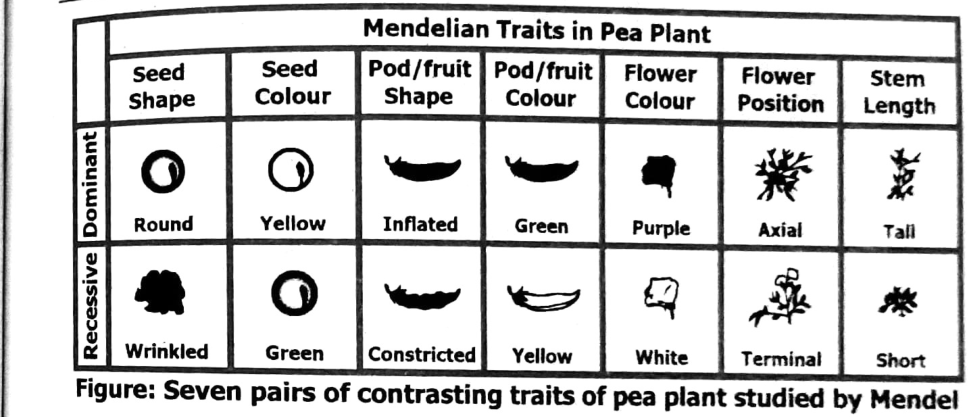
Mendel then carried out hybridization, where he cross-fertilized plants with different traits. For example, he crossed a round-seed plant with a wrinkled-seed plant to study a single trait (monohybrid cross) and a round, yellow-seed plant with a wrinkled, green-seed plant to study two traits (dihybrid cross). A monohybrid cross involves parents differing in one trait.
A dihybrid cross involves parents differing in two traits. Mendel ensured specific matings of different pea plants by removing the stamen of one plant and transferring pollen using a paintbrush.
Law of segregation:
Mendel's analysis in monohybrid cross while studying the inheritance of a single trait led to the formulation of the law of segregation, which states that co-existing alleles (occupy the same locus) segregate (separate) during gamete formation (Meiosis) and recombine randomly during fertilization.
Mendel's earlier experiments involved a single pair of contrasting traits i.e., he studied all seven traits one by one. One such experiment involved seed shape, which may be round or wrinkled. He selected true-breeding plant varieties of contrasting seed shapes. A true breeder produces offspring of its own type in successive generations if self-fertilization takes place.
Monohybrid:
He crossed a true-breeding round-seed plant with a true-breeding wrinkled-seed plant. All the offspring of the next generation produced round seeds. He called them monohybrid (hybrid in one trait) plants.
Hybrid:
Hybrid is a variety produced by crossing two contrasting true-breeding parents. Also, it showed dominance of round seed shape over wrinkled.
Parental Generation:
The parental generation is denoted as P1 generation. The offspring of P1 generation are first filial generation F1.
F1 Generation:
The cross in F1 generation produces F2 generation.
F2 Generation:
The wrinkled seed shape which, being recessive, failed to express in F1 generation, appeared again in F2 generation.
Phenotypic Ratio:
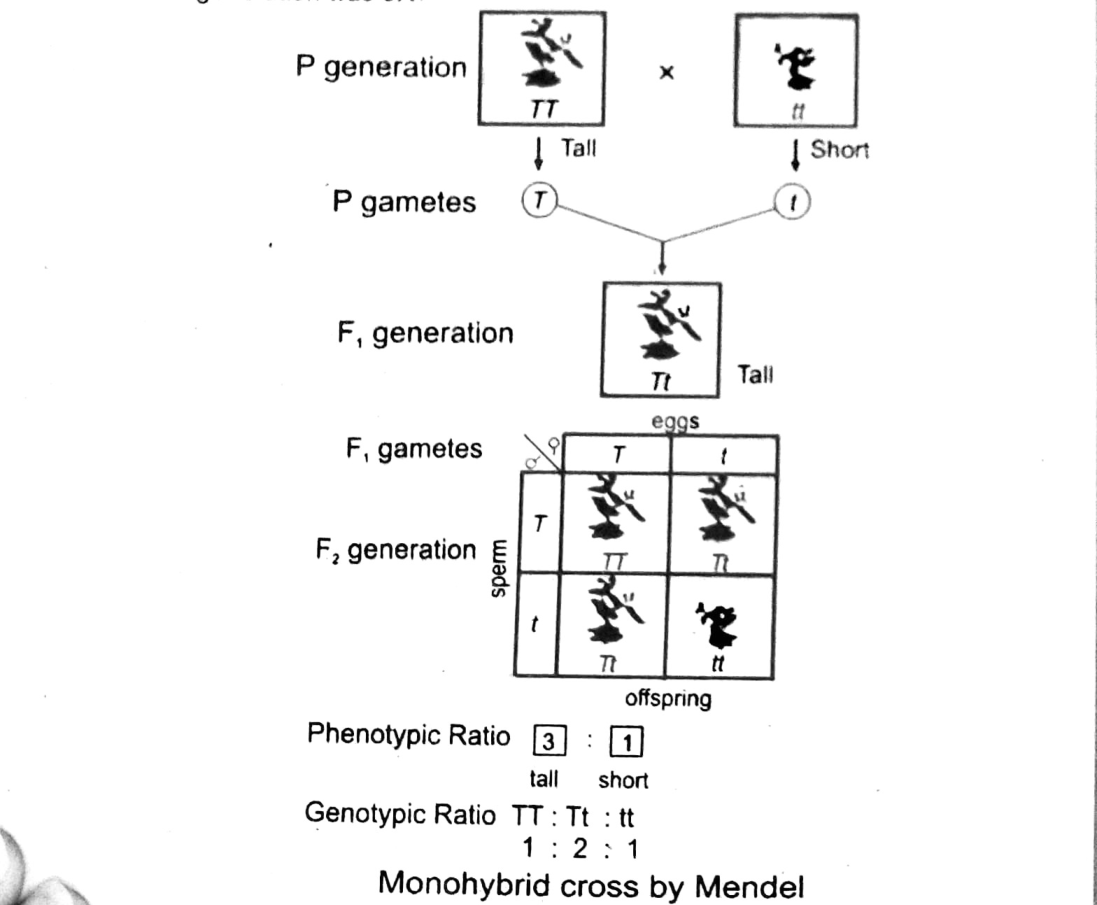
The phenotypic ratio between round and wrinkled-seeded offspring of F2 generation was 3:1.
In the monohybrid cross diagram, the P generation is TT (Tall) × tt (Short), producing P gametes T and t. The F1 generation is Tt (Tall). The F1 gametes are T and t; the F2 offspring genotypes shown are TT, Tt, Tt and tt. The phenotypic ratio is 3 tall : 1 short, and the genotypic ratio TT : Tt : tt is 1 : 2 : 1.
Mendel also made crosses using six other pairs of contrasting traits and found similar results. On the basis of these results, he concluded:
- True-breeding varieties possess two factors (alleles) for any given trait.
- The F1 generation possessed one allele from each parent, which is carried by gametes.
- The alleles retain their individuality in the F1 generation.
- Only the dominant allele shows its effect in the F1 generation, and the recessive factor reappears when in homozygous condition in the F2 generation.
Conclusions:
These conclusions were called the law of segregation, which states: Traits of organisms are determined by two alleles which separate in gametes and reunite again at fertilization.
Law of Independent Assortment:
Having established the outcome of breeding crosses involving a single pair of contrasting traits, Mendel turned his attention to the inheritance of two pairs of contrasting traits in the same cross. In one of his experiments he used seed shape and seed colour as the characteristics.
Statement:
This formed the basis of the law of independent assortment, which states that when two contrasting pairs of traits are followed in the same cross, their alleles assort in gametes independent of each other.
Dihybrid Crosses:
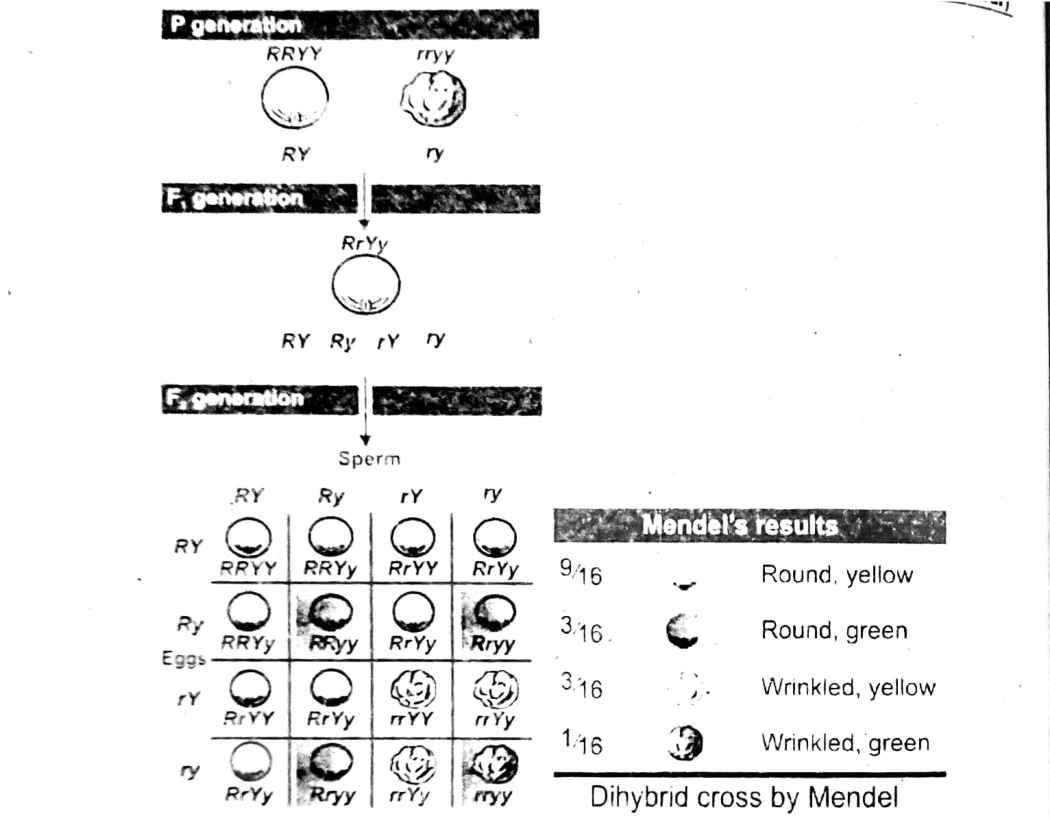
He crossed true-breeding plants having round and yellow seeds with true-breeding plants having wrinkled and green seeds.
F1 Generation Seeds:
The F1 generation seeds were round and yellow. Being hybrid in two traits, seed shape and seed colour, the F1 generation was called dihybrid. The round and yellow seeds of F1 plants were grown and allowed self-fertilization.
F2 Generation Seeds:
The F2 generation seeds produced from self-fertilization of the F1 generation appeared in four phenotypes.
Phenotypes:
These phenotypes included round yellow, round green, wrinkled yellow and wrinkled green with an approximated ratio of 9:3:3:1 respectively. This is known as the dihybrid ratio.
Along with parental combinations, two new phenotypes appeared in the F2 generation, i.e., round green and wrinkled yellow.
Results:
On the basis of these results, Mendel was able to state that two pairs of characteristics (seed shape and seed colour) separate and behave independently from one another in subsequent generations.
Heterozygous Interactions:
All the pea plant traits studied by Mendel show complete dominance. In this interaction, one allele completely suppresses the effects of the other allele. However, it is not the rule in all cases. Later it was found that alleles of some traits show different interactions between them.
STEAM ACTIVITY .7.1
EXPLORING MENDEL’S LAWS THROUGH A GENETIC SIMULATION
Objective:
To understand and apply Mendel’s Law of Segregation and Law of Independent Assortment using a hands-on simulation with colored beads.
Materials Needed:
- Two sets of colored beads (e.g., red and blue for one gene, yellow and green for another gene).
- Two small bowls or cups labeled Parent 1 and Parent 2
- A dice or coin (optional for independent assortment simulation)
- A data sheet for recording results
- Ziploc bags for storing beads
- Chart paper and markers (for visualizing results)
- Calculator (optional, for calculating probabilities)
Procedure:
PART 1: LAW OF SEGREGATION
- Setup:
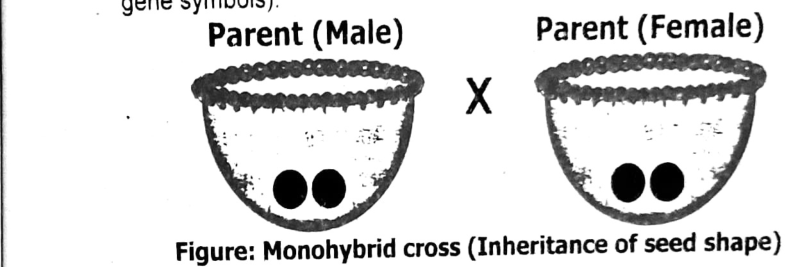
Assign colors to represent alleles for a single trait (e.g., R = Red, r = Blue). Alternatively, you can use circular plastic or cardboard discs and write gene symbols on them. Each parent (bowl) contains two alleles for the trait (e.g., Rr = one red bead and one blue bead or two cardboard discs labelled with gene symbols).
Figure: Monohybrid cross (Inheritance of seed shape)
- Simulation:
Students randomly draw one bead from each parent to simulate gamete formation. Combine the beads from both parents to form an offspring genotype (e.g., RR, Rr, or rr).
- Repeat/replication:
Perform the draw 50 times to simulate multiple offspring. Record the genotypes and phenotypes on a data sheet (sample is given below).
Repeats / Replicates Male Gamete Female Gamete Genotype of the offspring Phenotype of the offspring 1 R r Rr Round 2 r R Rr Round 3 … … … … And so, on up to 50 r r rr Wrinkled - Analysis:
Tally the frequency of each genotype and phenotype. Compare the results to the expected 1:2:1 genotypic ratio and 3:1 phenotypic ratio.
PART 2: LAW OF INDEPENDENT ASSORTMENT
- Setup:
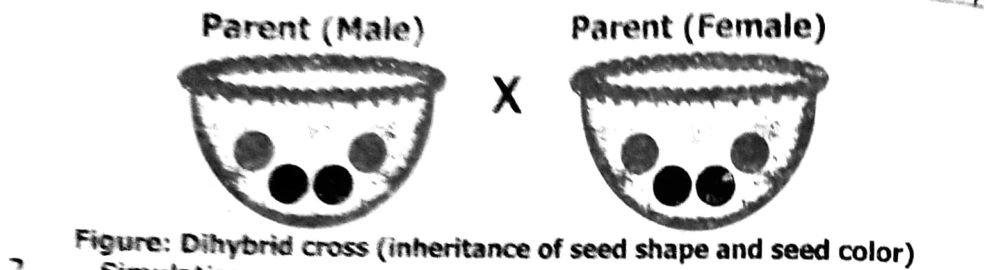
Add another trait to the simulation. Assign yellow and green beads to represent another gene (Y = Yellow, y = Green). Alternatively, you can use circular plastic or cardboard discs and write gene symbols on them. Each parent now contains four beads (e.g., RrYy = one red, one blue, one yellow, one green or four plastic or four cardboard discs labelled with gene symbols).
Figure: Dihybrid cross (inheritance of seed shape and seed color)
- Simulation:
Students randomly draw one bead for each gene (one for R/r and one for Y/y) from each parent. Combine the beads to determine the offspring's genotype (e.g., RrYy, rrYy, etc.).
- Repeat/Replicates:
Count 50 trials and record the offspring genotypes and phenotypes in datasheet (sample is given below).
Repeat/Replicates Male Gamete Female Gamete Genotype of the offspring Phenotype of the offspring 1 RY ry RrYy Round Yellow 2 rY RY RrYY Round Yellow 3 … … … … And so, on up to 50 yy rr rryy Wrinkled Green - Analysis:
The frequency of each genotype (e.g., RrYY, RRyy, etc.). Verify the 9:3:3:1 phenotypic ratio for dihybrid crosses.
Integration of Steam:
- Science involves understanding of Mendel's principles of heredity and exploring genetic variation and probability.
- Technology involves the use of spreadsheet software (e.g., Excel) to tabulate and analyze data.
- Engineering involves designing an efficient way to simulate large sample sizes using beads and tools.
- Art involves the creation of visual Punnett squares and frequency graphs to illustrate results.
- Mathematics involves the calculation of observed ratios and comparing them with theoretical ratios. It also involves the use of percentages and probabilities for analysis.
Follow-Up Discussion Questions
Your results may be close to 1:2:1 (segregation) or 9:3:3:1 (independent assortment), but small differences can happen. Deviations occur due to chance in random draw (like picking more R than r). A larger sample (e.g., 100 trials) reduces this error.
Random drawing shows how alleles separate (segregation) and combine independently (assortment), just like pea plant genes do during reproduction, as Mendel observed.
A large sample, like 50 offspring, gives more accurate ratios, reducing errors from chance and showing true genetic patterns.
Segregation separates alleles into gametes, while independent assortment mixes traits randomly, creating different combinations in offspring, like varied pea plant colors.
SUMMARY
Inheritance is the process through which traits are passed from parents to offspring, involving heredity (similarities) and variation (differences). The study of inheritance, or genetics, was pioneered by Gregor Mendel, whose experiments with pea plants laid the foundation for modern genetics. Mendel discovered that traits are controlled by genes, which can be dominant or recessive, and are inherited in predictable patterns across generations.
Chromosomes are thread-like structures in the cell nucleus made of DNA and proteins. They contain genetic information essential for development and reproduction. Each chromosome consists of chromatids, a centromere (the point where chromatids are joined) and telomeres (protective ends). DNA is coiled around histone proteins to form chromatin, which condenses during cell division to create chromosomes.
Chromosomes carry genes that direct the production of proteins, which determine traits and carry out essential cellular functions. The DNA in chromosomes is transcribed into mRNA, which is then translated into proteins. These proteins serve various functions, such as acting as enzymes, hormones, or structural components of the body.
A genotype refers to the genetic makeup of an organism, including the alleles inherited from both parents. Alleles are variations of a gene located at specific positions (loci) on chromosomes. A phenotype is the physical expression of a trait, determined by the genotype. Dominant traits are expressed even if only one dominant allele is present, while recessive traits require two recessive alleles to be expressed.
Mendel’s experiments revealed that traits are passed from one generation to the next through predictable patterns. His Law of Segregation states that alleles for a trait separate during gamete formation, ensuring offspring inherit one allele from each parent. His Law of Independent Assortment states that alleles for different traits are inherited independently of one another, explaining genetic variation in offspring.
Mendel used test crosses to determine the genotype of individuals expressing dominant traits by crossing them with recessive individuals. This allowed him to distinguish between homozygous and heterozygous individuals. His experiments confirmed his laws of segregation and independent assortment.