
Short Questions:
During cell division, chromosomes compact into thick chromatids to prevent tangling and damage, ensuring that the long strands of DNA are organized and protected. This compaction allows chromosomes to be moved accurately and efficiently by the spindle fibers, helping ensure each daughter cell receives a complete and identical set of genetic material. Without this compaction, the risk of errors during division would be much higher.
Telomeres are repetitive DNA sequences at the ends of chromosomes that act like protective caps. They prevent the loss of important genetic information during cell division by absorbing the shortening that naturally occurs when DNA is copied. This helps keep the essential genes intact and maintains chromosome stability.
Mendel’s experiments with pea plants showed that certain traits, like purple flowers, appeared in the first generation even when plants with white flowers were crossed in. This led him to conclude that some traits are dominant (like purple) and mask others that are recessive (like white), which only reappear when two recessive alleles are inherited. His consistent patterns across generations supported the idea of dominant and recessive inheritance.
Mendel used true-breeding plants to ensure that each parent consistently passed down the same traits to its offspring. This allowed him to clearly observe how traits were inherited across generations without unexpected variations, making it easier to identify patterns like dominance and segregation.
Two parents with free earlobes can have a child with attached earlobes if both parents carry a recessive allele for attached earlobes. Free earlobes are a dominant trait, so a person can have free earlobes with either one or two dominant alleles. If both parents are heterozygous (carrying one dominant and one recessive allele), there’s a 25% chance their child will inherit the recessive allele from each parent and have attached earlobes.
The law of segregation ensures genetic diversity by stating that during gamete formation, the two alleles for a gene separate so that each gamete receives only one allele. This means offspring inherit a random combination of alleles from each parent, creating many possible genetic combinations and increasing variation among individuals.
Mendel's dihybrid cross results differed from his monohybrid cross results because he was studying the inheritance of two traits simultaneously, rather than just one. In a monohybrid cross, he observed a 3:1 ratio of dominant to recessive traits, showing simple inheritance of a single gene. However, in a dihybrid cross, he found a 9:3:3:1 ratio, demonstrating that the two traits were inherited independently of each other. This supported his law of independent assortment, which states that alleles for different traits segregate independently during gamete formation, leading to greater genetic diversity.
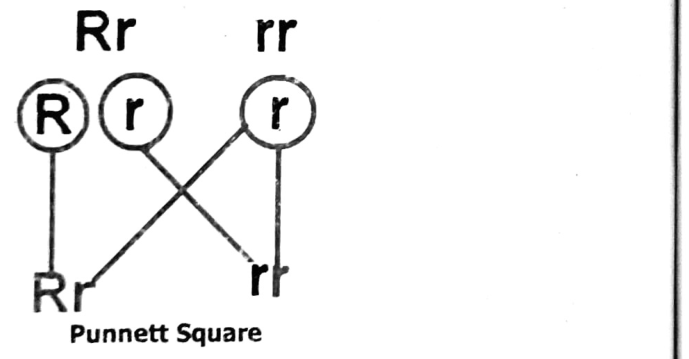
When a heterozygous round-seed plant (Rr) is crossed with a homozygous wrinkled-seed plant (rr), the possible offspring genotypes and phenotypes can be determined using a Punnett square.
Genotypic Ratio:
- Rr (heterozygous, round seeds): 1
- rr (homozygous, wrinkled seeds): 1
So, the genotypic ratio is 1 Rr : 1 rr.
Phenotypic Ratio:
- Round seeds (dominant trait, Rr): 1
- Wrinkled seeds (recessive trait, rr): 1
So the phenotypic ratio is 1 round : 1 wrinkled.
In conclusion, half of the offspring will have round seeds and half will have wrinkled seeds.
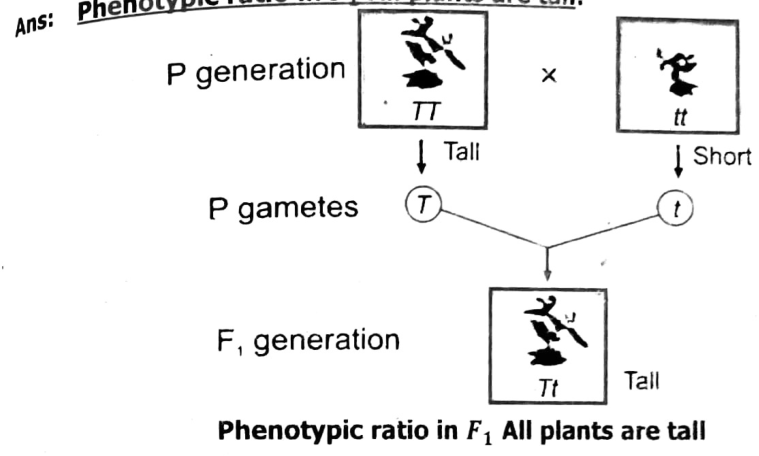
Phenotypic ratio in F1
All plants are tall.
The P generation cross is TT (tall) × tt (short). Their gametes are T and t, producing Tt offspring, which are tall.
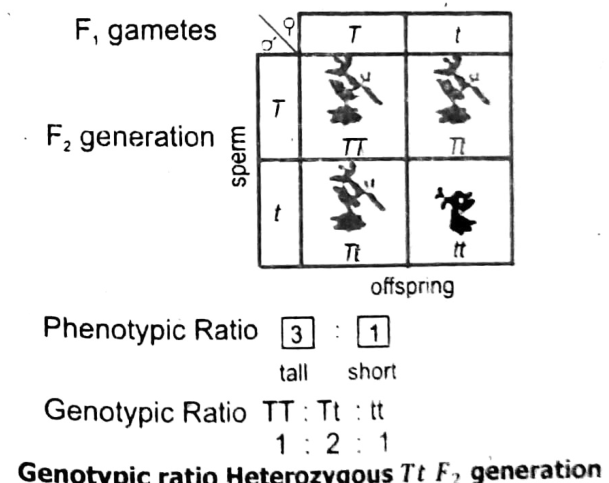
Genotypic ratio: heterozygous Tt F2 generation
When two F1 plants (Tt × Tt) are crossed, the F2 phenotypic ratio is 3 tall : 1 short.
The genotypic ratio is TT : Tt : tt = 1 : 2 : 1.
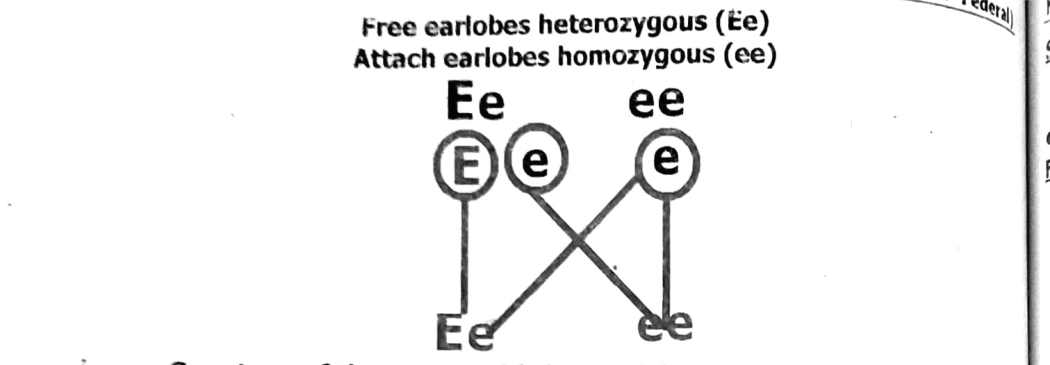
If a person with free earlobes has a child with attached earlobes, the parent with free earlobes must be heterozygous (Ee). This is because attached earlobes (ee) are a recessive trait, and the child must inherit one e allele from each parent.
The other parent has attached earlobes and is homozygous (ee).
- Genotype of the parent with free earlobes: Ee (heterozygous)
- Possible genotypes of the offspring:
- Ee (free earlobes)
- ee (attached earlobes)
So, the offspring could have either genotype, but only those with ee will show attached earlobes.
The parent plants are YYRR (yellow round) and yyrr (green wrinkled), so all F1 offspring are YyRr—they have one dominant and one recessive allele for each trait.
When two YyRr plants self-fertilize, each trait sorts independently (Mendel’s law of independent assortment). This results in four combinations of traits in the F2 generation:
- Yellow round (both dominant traits)
- Yellow wrinkled (dominant color, recessive shape)
- Green round (recessive color, dominant shape)
- Green wrinkled (both recessive traits)
These appear in a 9:3:3:1 ratio, a classic result of a dihybrid cross.
In a dihybrid cross where both parent pea plants have the genotype RrYy (heterozygous for seed shape and color), we want to find the probability that an offspring will have the genotype RRYY—homozygous dominant for both traits (round, yellow seeds).
- Step 1: Determine the probability for each trait separately.
- Trait 1: Seed shape (Rr × Rr)
- RR (homozygous dominant) = 1/4
- Trait 2: Seed color (Yy × Yy)
- YY (homozygous dominant) = 1/4
- Step 2: Multiply the probabilities: Since the traits assort independently (Mendel’s Law of Independent Assortment):
Probability of RRYY = (1/4) × (1/4) = 1/16
Final Answer:
The probability that an offspring will have round, yellow seeds with genotype RRYY is 1/16.
Long Questions:
Structure of Chromosome:
Chromosomes are thread-like structures found in the nucleus of cells, made up of DNA (Deoxyribonucleic Acid) and proteins. During interphase, the chromosomes are present in the form of a thin fibrous network called chromatin. The DNA in chromosomes carries the genetic information necessary for the development, functioning, and reproduction of organisms.
Parts of a Chromosome:
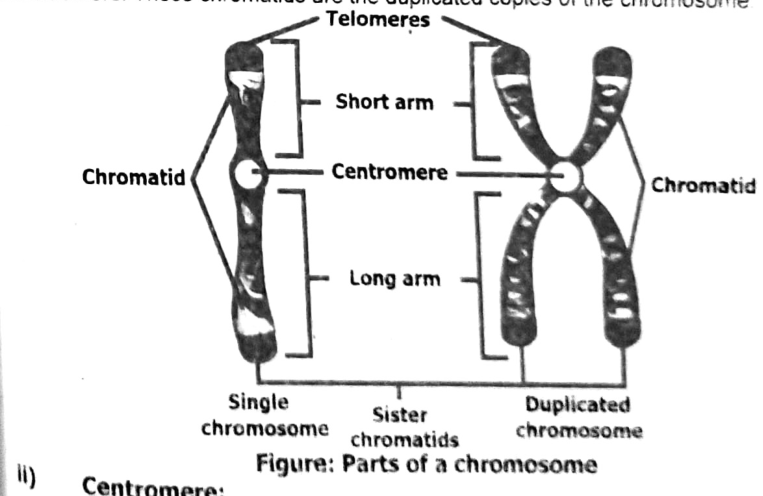
A chromosome consists of three main parts: chromatids, centromere and telomeres.
i) Chromatid: A single chromosome, before S-phase (DNA replication), consists of one thread-like structure called chromatid. After S-phase, a chromosome consists of two identical chromatids called sister chromatids that are attached together at centromere. These chromatids are the duplicated copies of the chromosome.
ii) Centromere: The centromere is the constricted region of a chromosome where the two chromatids are attached. The kinetochore is a protein complex in the centromere which serves as the attachment site for spindle fibers (microtubules) during mitosis and meiosis. The centromeres ensure that chromosomes are evenly distributed between the daughter cells.
iii) Telomeres: These are repetitive nucleotide sequences at the end of chromosomes, protecting them from degradation and preventing the loss of important genetic information during cell division.
Law of Independent Assortment:
Having established the outcome of breeding crosses involving a single pair of contrasting traits, Mendel turned his attention to the inheritance of two pairs of contrasting traits in the same cross. In one of his experiments he used seed shape and seed colour as the characteristics.
Dihybrid Crosses:
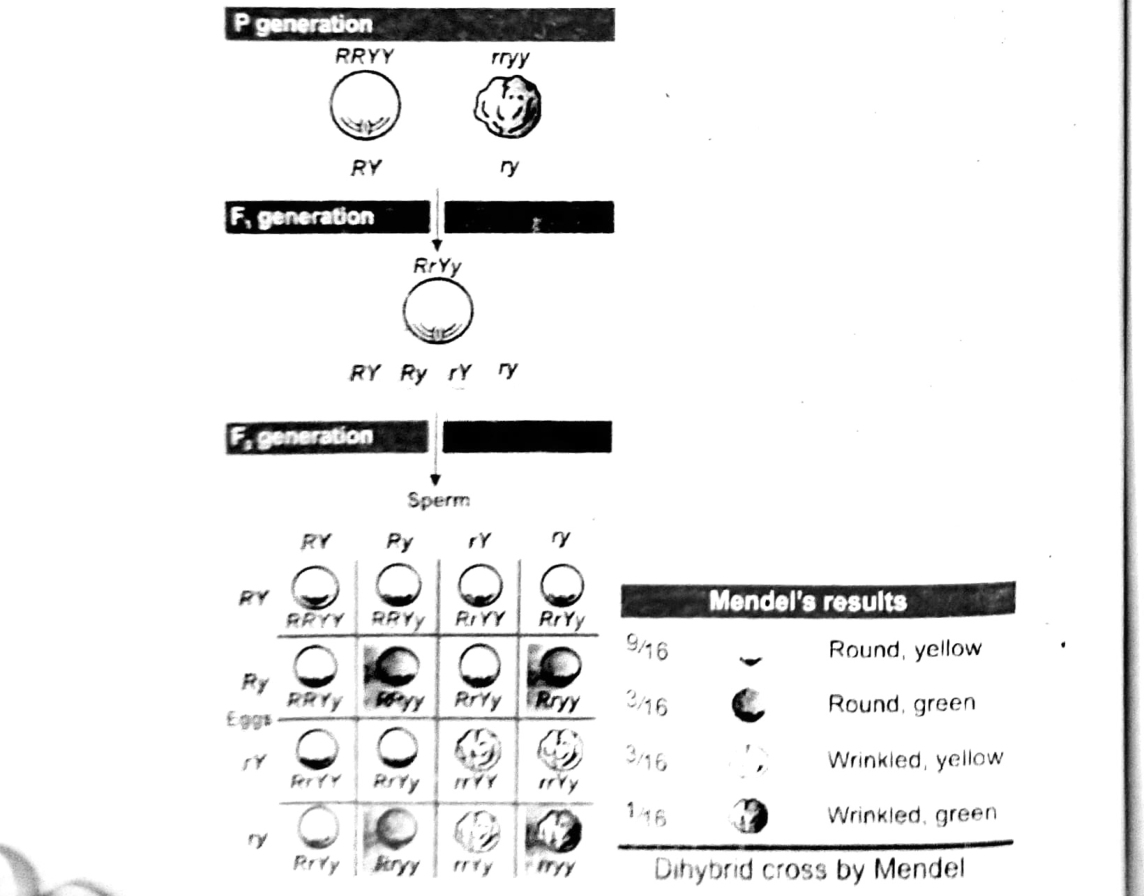
He crossed true breeding plants having round and yellow seeds with true breeding plants having wrinkled and green seeds.
F1 Generation Seeds:
The F1 generation seeds were round and yellow. Being hybrid in two traits, seed shape and seed colour, the F1 generation was called dihybrid. The round and yellow seeds of F1 plants were grown and allowed self-fertilization.
F2 Generation Seeds:
The F2 generation seeds produced from self-fertilization of F1 generation appeared in four phenotypes.
Phenotypes:
These phenotypes included round yellow, round green, wrinkled yellow and wrinkled green with an approximated ratio of 9:3:3:1 respectively. This is known as dihybrid ratio.
Along with parental combinations, two new phenotypes appeared in F2 generation i.e., round green and wrinkled yellow.
Results:
On the basis of these results, Mendel was able to state that two pairs of characteristics (seed shape and seed colour) separate and behave independently from one another in subsequent generations.
Statement:
This formed the basis of law of independent assortment which states that when two contrasting pairs of traits are followed in the same cross, there alleles assort in gametes independent of each other.
Heterozygous Interactions:
All the pea plant traits studied by Mendel show complete dominance. In this interaction one allele completely suppresses the effects of other allele. However it is not the rule in all cases. Later it was found that alleles of some traits show different interaction between them.
Mendel's Procedure and observations
He crossed a true-breeding round-seed plant with a true-breeding wrinkled-seed plant. In the first filial generation (F1), all offspring displayed the round seed trait (he designated this phenotype as dominant while other as recessive). However when these F1 plants self-fertilized, their offspring (F2) exhibited both round and wrinkled seeds in a 3:1 ratio. Further investigation revealed that 25% F2 generation were true breed round, 50% were non-true breed round and 25% were true breed wrinkled. So the genotypic ratio in F2 generation was 1:2:1. Similar results were obtained when he studied other pairs of contrasting traits.
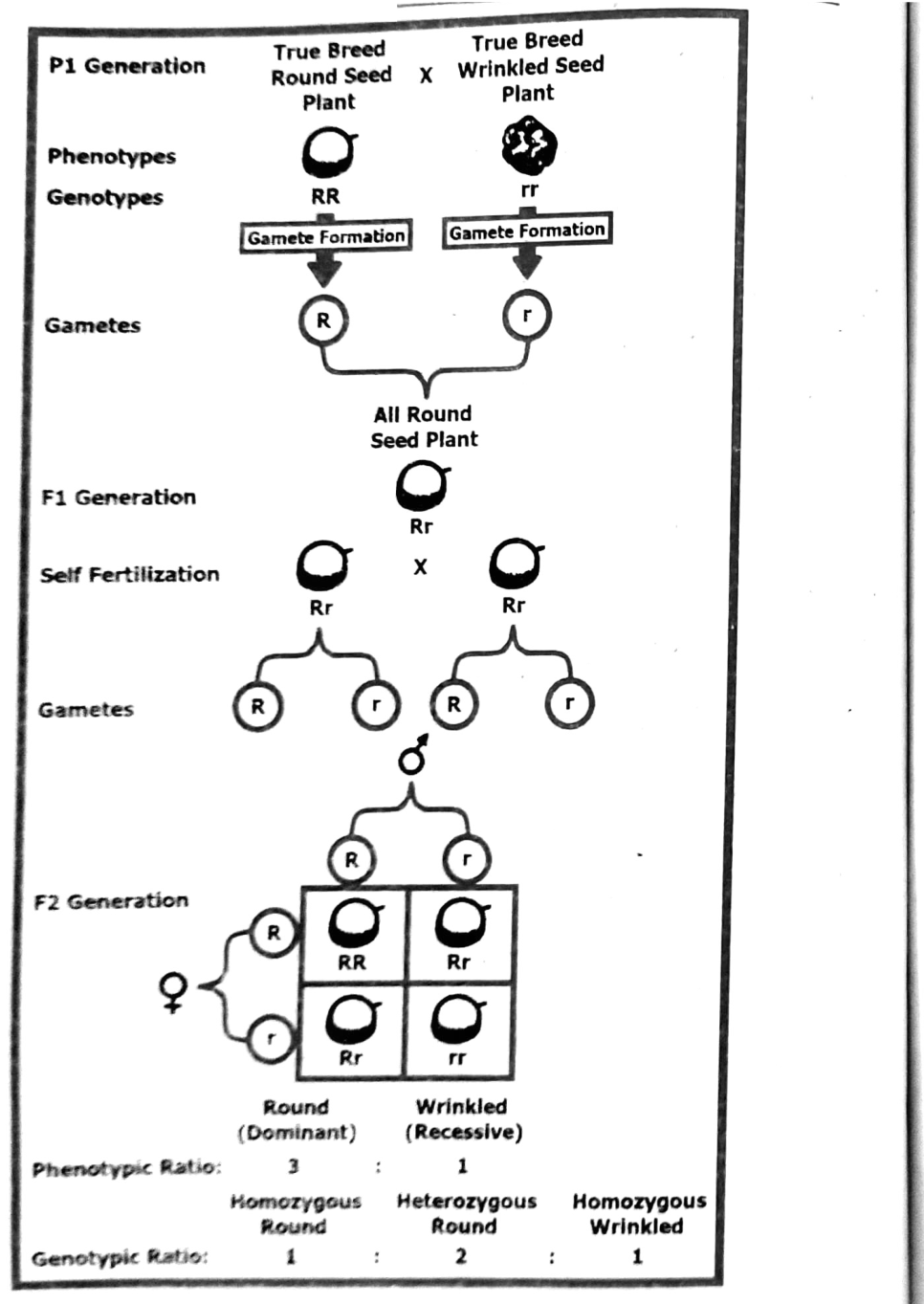
Figure: Outcome of F1 and F2 Generation in Monohybrid cross
A true-breeding round-seed plant (RR) crossed with a true-breeding wrinkled-seed plant (rr) produces gametes R and r. The F1 generation consists of all round-seed plants (Rr). When F1 plants self-fertilize (Rr × Rr), the F2 generation has genotypes RR, Rr, Rr and rr.
F2 phenotypic ratio: Round (Dominant) : Wrinkled (Recessive) = 3 : 1.
F2 genotypic ratio: Homozygous Round : Heterozygous Round : Homozygous Wrinkled = 1 : 2 : 1.
Conclusion/Interpretation of the results: Mendel concluded that:
- The traits are controlled by factors or elements (now called genes) passed from parents to offspring through gametes.
- Each plant carries two factors (alleles) for each trait—one from each parent.
- Dominant alleles, like “R” for round seeds, are expressed, while recessive alleles, like “r” for wrinkled seeds, are not expressed in F1, but reappear in F2 generation.
- During gamete formation both alleles of a gene pair segregate from each other and pass into different gamete.
- The gene pair is restored when gametes are fertilized to make the next generation.
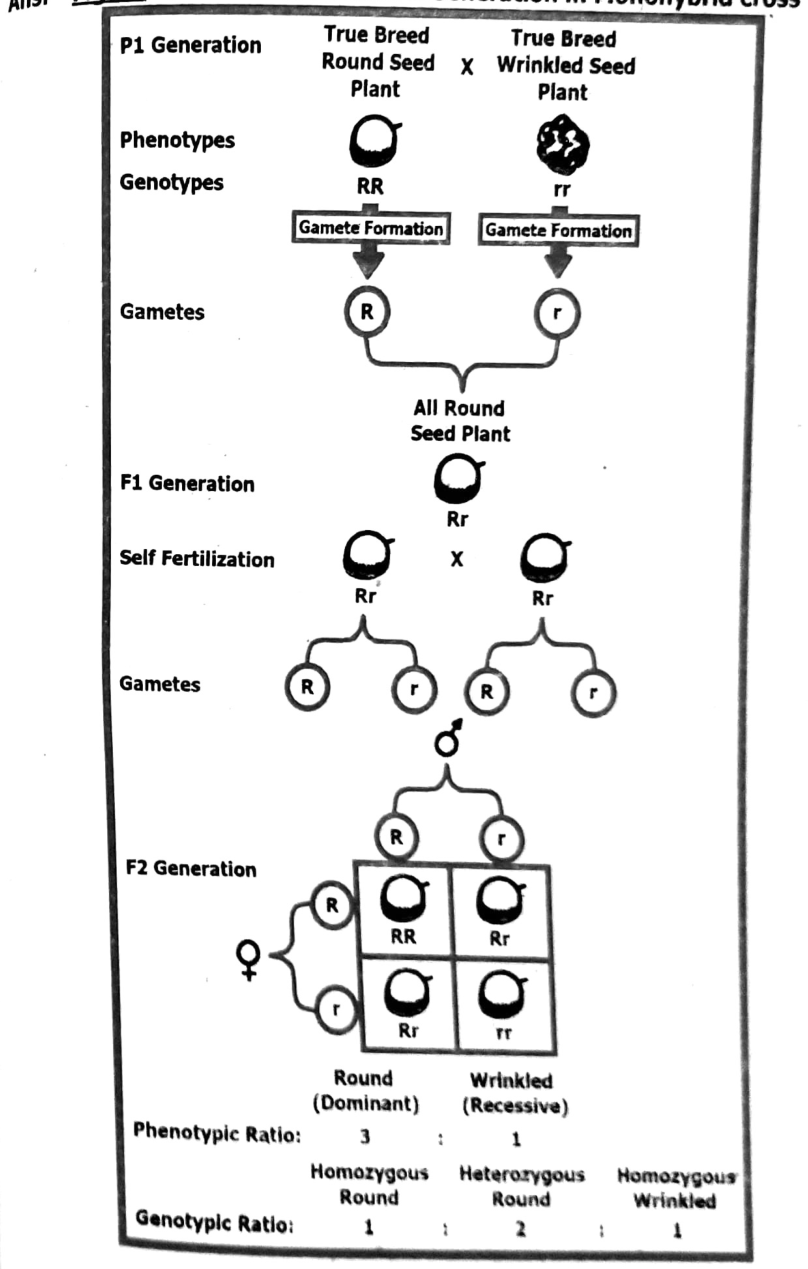
Genotype and Phenotype: Definitions with Examples
Genotype refers to the genetic makeup of an organism—the specific combination of alleles (versions of a gene) it inherits from its parents.
Phenotype is the observable trait or physical expression of that genotype, such as eye color, seed shape, or blood type.
Examples
Let’s consider pea seed shape, where:
- R = dominant allele for round seeds
- r = recessive allele for wrinkled seeds
- Homozygous Dominant (RR)
- Genotype: RR
- Phenotype: Round seeds
- Both alleles are dominant, so the trait shows clearly.
- Heterozygous (Rr)
- Genotype: Rr
- Phenotype: Round seeds
- One dominant allele is enough for the round seed trait to appear.
- Homozygous Recessive (rr)
- Genotype: rr
- Phenotype: Wrinkled seeds
- No dominant allele is present, so the recessive trait is expressed.
What is a Test Cross?
A test cross is a genetic cross used to determine whether an organism showing a dominant trait is homozygous dominant (AA) or heterozygous (Aa).
How It Works:
- The organism with the dominant trait is crossed with an organism that is homozygous recessive (aa) for the trait.
- The recessive parent can only pass on the recessive allele, so the offspring's traits will reveal the genotype of the dominant parent.
Example:
Suppose you have a pea plant with round seeds (dominant trait, genotype unknown: RR or Rr) and you cross it with a wrinkled-seed plant (rr):
- If the round-seed plant is RR (homozygous):
- All offspring will be Rr (round seeds).
- Result: 100% round seeds.
- If the round-seed plant is Rr (heterozygous):
- Half the offspring will be Rr (round) and half will be rr (wrinkled).
- Result: 50% round, 50% wrinkled seeds.
Purpose of a Test Cross:
It helps identify the true genotype of an organism showing a dominant trait by analyzing the phenotypes of its offspring.