
Short Questions:
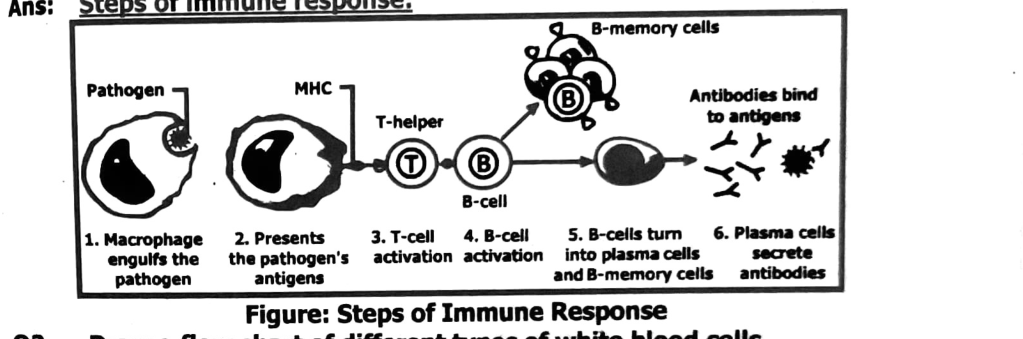
Steps of immune response:
- Macrophage engulfs the pathogen.
- Presents the pathogen's antigens.
- T-cell activation.
- B-cell activation.
- B-cells turn into plasma cells and B-memory cells.
- Plasma cells secrete antibodies.
The diagram also labels the pathogen, MHC, T-helper, B-cell, B-memory cells, and antibodies binding to antigens.
Flow chart of different types of white blood cells:
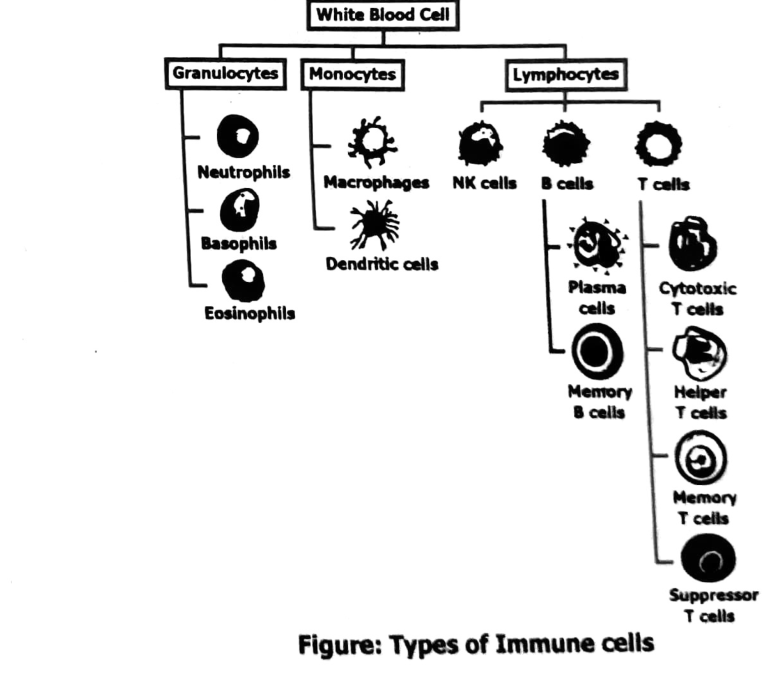
- White Blood Cell
- Granulocytes
- Neutrophils
- Basophils
- Eosinophils
- Monocytes
- Macrophages
- Dendritic cells
- Lymphocytes
- NK cells
- B cells
- Plasma cells
- Memory B cells
- T cells
- Cytotoxic T cells
- Helper T cells
- Memory T cells
- Suppressor T cells
- Granulocytes
Lymph nodes are small, bean-shaped organs that filter lymph fluid, which carries pathogens from tissues. Inside the lymph nodes, immune cells such as macrophages and lymphocytes detect and destroy these pathogens. This helps stop the infection from spreading to other parts of the body by triggering an immune response right where the pathogens are found.
Name of vaccines and the diseases they control:
- Influenza (Flu) Vaccine: The flu vaccine helps boost immunity against seasonal influenza viruses. It reduces the risk of illness, hospitalization, and death.
- MMR Vaccine: The measles, mumps, and rubella (MMR) vaccine boosts immunity against these three highly contagious diseases, it prevents serious complications and epidemics.
- DTaP Vaccine: The diphtheria, tetanus, and pertussis (DTaP) vaccine helps boost immunity against these three bacterial infections. It protects against severe illnesses and complications.
- COVID – 19 Vaccines: COVID – 19 vaccines have proven highly effective in boosting immunity against SARS – CoV – 2 virus. It reduces the risk of severe illness, hospitalization, and death from COVID – 19.
Types of Memory Cells:
- Memory B Cells:
- These are formed from activated B cells after an infection or vaccination.
- They “remember” the specific pathogen and can quickly produce antibodies if the body is exposed to it again.
- Memory T Cells:
- Formed from activated T cells, and there are two main types:
- Memory Helper T Cells (CD4+): Help activate other immune cells during a second infection.
- Memory Cytotoxic T Cells (CD8+): Kill infected cells faster upon re-exposure to the same pathogen.
Why They Are Important:
- Quick Response: Memory cells respond much faster and stronger than the first immune response.
- Long-term Protection: They provide long-lasting immunity, often for years or even a lifetime.
- Basis of Vaccination: Vaccines work by creating memory cells without causing disease.
Booster doses of vaccines are important because they:
- Strengthen Immunity: Over time, the immune response from the initial vaccine can weaken. A booster “reminds” the immune system and increases antibody levels.
- Enhance Memory Cells: Boosters improve the number and effectiveness of memory B and T cells, making the body more prepared to fight the disease.
- Protect Against Variants: Some boosters are updated to target new variants of a virus, helping maintain protection as the virus evolves.
In short, boosters help keep immunity strong and up-to-date.
Main symptoms of allergy:
- Sneezing
- Runny or stuffy nose
- Itchy or watery eyes
- Skin rash or hives
- Swelling
- Coughing or wheezing
- Shortness of breath
Different causes of allergy include:
- Pollen (from trees, grasses, and weeds)
- Dust mites
- Animal dander (skin flakes from pets)
- Certain foods (e.g., peanuts, eggs, milk, shellfish)
- Insect stings or bites
- Medicines (e.g., penicillin)
- Mold spores
- Latex
- Chemical substances (like detergents or perfumes)
The Substance that cause allergies are called allergens which include:
- Pollen (from trees, grasses, and weeds)
- Dust mites
- Animal dander (from pets like cats, dogs)
- Mold spores
- Foods (e.g., peanuts, eggs, milk, shellfish)
- Insect stings or bites (e.g., bee stings)
- Medications (e.g., antibiotics like penicillin)
- Latex
- Chemical substances (e.g., detergents, perfumes)
- Cockroach droppings
- Granulocytes and lymphocytes
- macrophages and dendritic cells
- allergy and allergen
- cytotoxic T cells and helper T cell
- plasma cells and memory B cells
a. Granulocytes and lymphocytes:
| Granulocytes | Lymphocytes |
|---|---|
| Type of white blood cell with visible granules. | Type of white blood cell with a single large nucleus. |
| Includes neutrophils, eosinophils, and basophils. | Includes T cells, B cells, and NK cells. |
| Primarily involved in inflammation and infection defense. | Primarily involved in adaptive immunity. |
| Act quickly during early stages of infection. | Respond more slowly, but with specificity to pathogens. |
b. Macrophages and dendritic cells:
| Macrophages | Dendritic Cells |
|---|---|
| Large immune cells that engulf and digest pathogens. | Act as antigen-presenting cells (APCs). |
| Found in tissues like lungs, liver, and spleen. | Found in skin, mucosal surfaces, and lymphoid organs. |
| Involved in both innate and adaptive immunity. | Primarily involved in activation of T cells. |
| Have longer lifespan and are phagocytic. | Have a shorter lifespan and are specialized for antigen presentation. |
c. Allergy and allergen:
| Allergy | Allergen |
|---|---|
| A sensitivity or overreaction of the immune system to harmless substances. | A substance that triggers an allergic reaction in a sensitive person. |
| Causes symptoms like sneezing, itching, and swelling. | Examples include pollen, dust mites, and peanuts. |
| Often results from an IgE-mediated immune response. | The substance that stimulates the immune system to react. |
d. Cytotoxic T cells and helper T cell:
| Cytotoxic T Cells | Helper T Cells |
|---|---|
| Also called CD8+ T cells, they destroy infected cells. | Also called CD4+ T cells, they activate other immune cells. |
| Recognize and kill virus-infected cells or tumor cells. | Help activate B cells, cytotoxic T cells, and macrophages. |
| Involved in cell-mediated immunity. | Involved in humoral immunity and immune regulation. |
e. Plasma cells and memory B cells:
| Plasma Cells | Memory B Cells |
|---|---|
| Secrete antibodies to neutralize pathogens. | Store immunological memory for faster response upon re-exposure. |
| Formed when B cells are activated by an antigen. | Formed after an initial infection or vaccination. |
| Short-lived, they rapidly produce antibodies. | Long-lived, they persist in the body to respond to future infections. |
f. Primary and secondary immune response:
| Primary Immune Response | Secondary Immune Response |
|---|---|
| The first exposure to an antigen. | Occurs upon subsequent exposures to the same antigen. |
| Involves slower antibody production. | Faster and stronger antibody production. |
| IgM antibodies are produced first, followed by IgG. | IgG antibodies are produced quickly and in higher quantities. |
| Memory cells are created during this response. | Memory cells allow for rapid immune activation. |
g. Innate immunity and acquired immunity:
| Innate Immunity | Acquired Immunity |
|---|---|
| The body's first line of defense, present at birth. | Develops over time after exposure to pathogens. |
| Non-specific, responds to a wide range of pathogens. | Specific to particular pathogens, based on memory. |
| Involves barriers like skin, mucus membranes, and cells like neutrophils. | Involves T cells, B cells, and antibodies. |
| Immediate response, no memory of past infections. | Delayed response, but long-lasting immunity and memory. |
Long Questions:
The immune system in the human body plays a crucial role in defending against harmful invaders, such as bacteria, viruses, fungi, and parasites, as well as abnormal cells like cancerous cells. It works in a highly coordinated way to protect the body and maintain health. Here's an overview of its main functions:
- Defense Against Pathogens:
The immune system detects and neutralizes harmful microorganisms (pathogens) that enter the body.
- Innate Immunity: The body's first line of defense, which includes physical barriers (skin, mucous membranes) and nonspecific immune responses (e.g., phagocytes like neutrophils and macrophages).
- Acquired (Adaptive) Immunity: If pathogens bypass the innate immunity, the adaptive immune system responds with specific attacks. This involves T cells and B cells, which target specific pathogens.
- Recognition of Foreign Substances: The immune system can distinguish between self (healthy body cells) and non-self (foreign invaders). This is achieved by recognizing molecules called antigens on the surface of pathogens.
- Activation of Immune Cells: When the immune system detects a threat, it activates various cells, such as:
- Macrophages and neutrophils (which engulf and digest pathogens).
- Helper T cells (which activate other immune cells).
- Cytotoxic T cells (which destroy infected cells).
- B cells (which produce antibodies to neutralize pathogens).
- Production of Antibodies: B cells produce antibodies (immunoglobulins) that bind to specific antigens on pathogens, marking them for destruction by other immune cells. Antibodies are a key part of humoral immunity.
- Memory and Long-Term Protection: After the immune system successfully fights an infection, it produces memory cells (memory B cells and memory T cells) that “remember” the pathogen. If the body encounters the same pathogen in the future, these memory cells allow the immune system to respond faster and stronger, preventing reinfection.
- Regulation and Tolerance: The immune system also has mechanisms to avoid attacking the body’s own cells (immune tolerance). It regulates its responses to ensure it only attacks harmful invaders, not the body’s own tissues.
- Inflammatory Response: When the body is injured or infected, the immune system triggers inflammation to increase blood flow and recruit immune cells to the site of infection or injury, helping to repair tissues and fight infection.
Immune System and Its Organs:
The immune system is the body's defense mechanism that protects against harmful substances like bacteria, viruses, fungi, parasites, and even abnormal cells (such as cancer cells). It is made up of a network of organs, tissues, cells, and proteins that work together to detect and eliminate threats.
Functions of the Immune System:
- Detects and fights pathogens
- Removes dead or damaged cells
- Prevents the spread of infection
- Remembers past infections to respond faster in the future (immunological memory)
Main Immune Cells:
- B Cells – Produce antibodies
- T Cells – Kill infected cells and help other immune cells
- Macrophages – Engulf and digest invaders
- Dendritic Cells – Present antigens to T cells
- Natural Killer (NK) Cells – Destroy infected or cancerous cells
The immune system is divided into:
- Innate Immunity (non-specific, immediate)
- First line of defense (skin, mucus, phagocytes)
- Responds quickly but not specifically
- Adaptive Immunity (specific, delayed)
- Involves T cells and B cells
- Builds memory for future protection
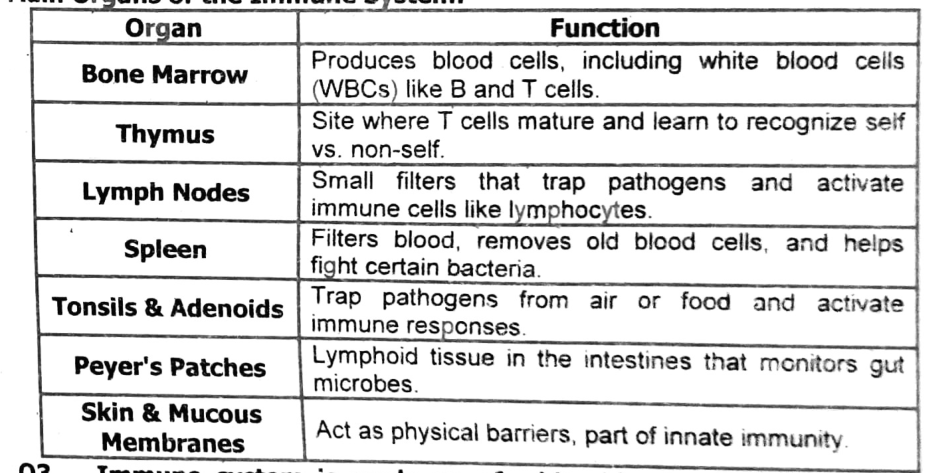
Main Organs of the Immune System:
| Organ | Function |
|---|---|
| Bone Marrow | Produces blood cells, including white blood cells (WBCs) like B and T cells. |
| Thymus | Site where T cells mature and learn to recognize self vs. non-self. |
| Lymph Nodes | Small filters that trap pathogens and activate immune cells like lymphocytes. |
| Spleen | Filters blood, removes old blood cells, and helps fight certain bacteria. |
| Tonsils & Adenoids | Trap pathogens from air or food and activate immune responses. |
| Peyer's Patches | Lymphoid tissue in the intestines that monitors gut microbes. |
| Skin & Mucous Membranes | Act as physical barriers, part of innate immunity. |
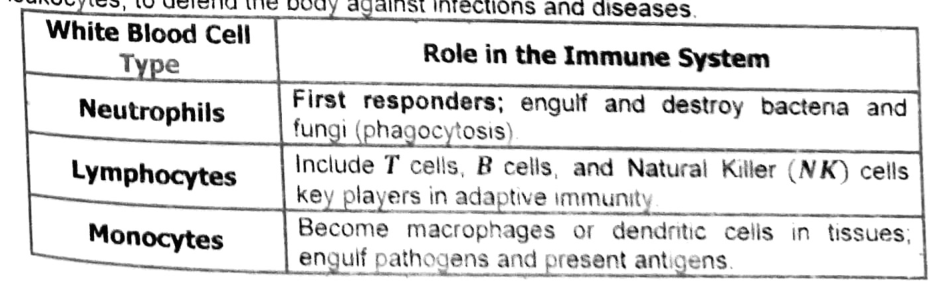
Immune system relies heavily on white blood cells (WBCs), also known as leukocytes, to defend the body against infections and diseases.
| White Blood Cell Type | Role in the Immune System |
|---|---|
| Neutrophils | First responders: engulf and destroy bacteria and fungi (phagocytosis). |
| Lymphocytes | Include T cells, B cells, and Natural Killer (NK) cells, key players in adaptive immunity. |
| Monocytes | Become macrophages or dendritic cells in tissues; engulf pathogens and present antigens. |
| Type | Function |
|---|---|
| Eosinophils | Fight parasites and are involved in allergic reactions. |
| Basophils | Release histamine during allergic responses; help in inflammation. |
Lymphocyte Subtypes and Their Roles:
| Type | Function |
|---|---|
| B cells | Produce antibodies to neutralize pathogens. |
| T cells | Helper T cells (CD4+): Activate other immune cells. Cytotoxic T cells (CD8+): Kill infected cells. |
| NK cells | Destroy virus-infected and cancerous cells without prior activation. |
Comparison innate and adaptive immunity:
| Feature | Innate Immunity | Adaptive Immunity |
|---|---|---|
| Definition | First line of defense, present from birth | Specific defense developed after exposure to pathogens |
| Speed of Response | Immediate (within minutes to hours) | Slower (takes days to develop) |
| Specificity | Non-specific (acts on all pathogens the same way) | Highly specific to a particular pathogen |
| Memory | No memory – does not improve with repeated exposure | Has memory – response is faster on second exposure |
| Main Components | Physical barriers (skin), phagocytes, NK cells, inflammation | B cells, T cells, antibodies |
| Types of Cells Involved | Neutrophils, macrophages, dendritic cells, NK cells | T cells (helper and cytotoxic), B cells |
| Function | Prevent entry and spread of infection | Eliminate specific pathogens and create memory |
| Response to Re-exposure | Same response every time | Stronger and quicker response after re-exposure |
Which type increases with age?
Adaptive immunity increases in most people as they grow into adulthood, due to exposure to various pathogens and vaccines. Over time, the body builds a library of memory cells that can recognize and respond to previously encountered threats more effectively.
The immune system protects the body through three lines of defence, each with different roles and components:
1st Line of Defence: Physical and Chemical Barriers (Innate Immunity)
Purpose: Prevent pathogens from entering the body.
Main Components:
- Skin: Acts as a physical barrier to block entry.
- Mucous membranes: Trap microbes in the respiratory, digestive, and urinary tracts.
- Tears, saliva, and mucus: Contain enzymes like lysozyme that break down bacteria.
- Stomach acid: Kills microbes swallowed with food.
- Hair and cilia: Trap dust and microbes in the nose and lungs.
2nd Line of Defence: Internal Non-Specific Response (Innate Immunity)
Purpose: Attack pathogens that enter the body.
Main Components:
- Phagocytes (like macrophages and neutrophils): Engulf and digest microbes.
- Natural Killer (NK) cells: Destroy virus-infected or abnormal cells.
- Inflammation: Increases blood flow and immune cells to infection site.
- Fever: Raises body temperature to slow down pathogen growth.
- Antimicrobial proteins: Help destroy or inhibit microbes (e.g., interferons, complement system).
3rd Line of Defence: Specific Immune Response (Adaptive Immunity)
Purpose: Specifically recognize and destroy pathogens; provides memory for future protection.
Main Components:
- B cells: Produce antibodies to neutralize pathogens.
- T cells
- Helper T cells (CD4+): Activate B cells and other immune cells.
- Cytotoxic T cells (CD8+): Kill infected cells.
- Memory cells: Remain in the body to provide long-lasting immunity.
Allergy:
An allergy is an overreaction of the immune system to a normally harmless substance called an allergen (like pollen, dust, or certain foods). In allergic individuals, the immune system mistakenly identifies these substances as threats and triggers a defensive response, often involving the release of histamine and other chemicals that cause symptoms like sneezing, itching, swelling, or even more serious reactions.
Types of Allergy:
| Type of Allergy | Description | Common Triggers |
|---|---|---|
| Respiratory Allergy | Affects the nose, sinuses, and lungs. | Pollen, dust mites, mold, animal dander. |
| Food Allergy | Reaction after eating certain foods. | Peanuts, eggs, milk, shellfish, wheat. |
| Skin Allergy | Causes skin irritation, rashes, or itching. | Latex, cosmetics, soaps, insect bites. |
| Drug Allergy | Reaction to certain medications. | Penicillin, sulfa drugs, aspirin. |
| Insect Sting Allergy | Allergic response to venom from insect stings. | Bee or wasp stings. |
| Anaphylaxis (Severe Allergy) | A life-threatening allergic reaction affecting the whole body. | Foods, medications, insect venom. |
Vaccination played a key role in eradicating smallpox, a deadly viral disease, by training the immune system to recognize and fight the virus without causing illness.
How It Worked:
- Immunity Without Illness
- The smallpox vaccine used a weakened virus (vaccinia virus) that did not cause disease but triggered the immune system to produce antibodies and memory cells.
- Mass Vaccination Campaigns
- The World Health Organization (WHO) launched global vaccination campaigns starting in the 1960s.
- People worldwide were vaccinated, breaking the chain of infection.
- Herd Immunity
- When most people became immune, the virus couldn’t spread easily, protecting even those who weren’t vaccinated.
- Surveillance and Containment
- Health workers quickly identified outbreaks and vaccinated people nearby to stop the spread (ring vaccination).
Result:
Smallpox was declared eradicated in 1980, the first disease in history to be completely wiped out by vaccination.