
Short Questions:
Role of urinary system:
- The role of the urinary system in the body is to remove waste products and excess substances from the blood, regulate fluid and electrolyte balance, and maintain proper pH levels.
- The kidneys filter the blood to form urine, which contains urea, salts, and water.
- Urine is then transported through the ureters to the bladder, where it's stored until it is excreted through the urethra.
- This system helps keep the body's internal environment stable and healthy.
Structures of urinary system:
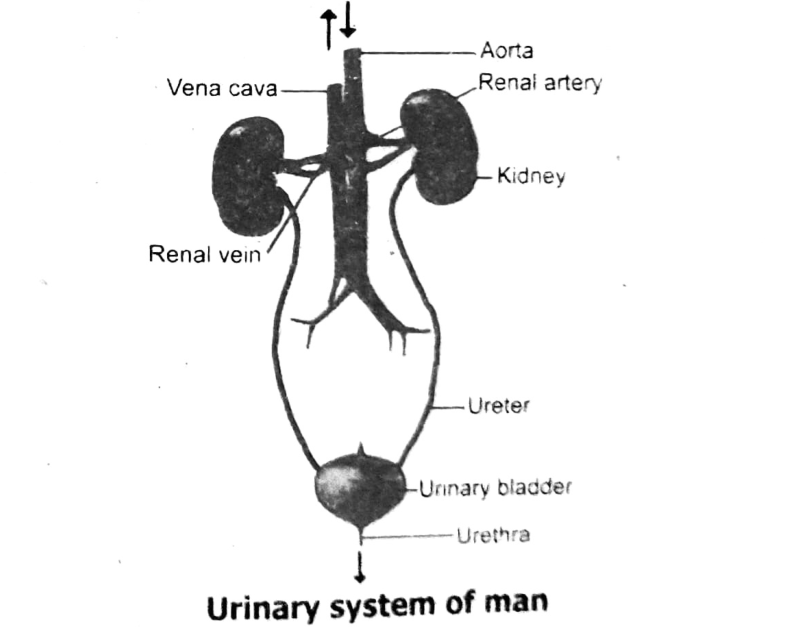
The urinary system of man consists of:
- A pair of kidneys
- A pair of ureters
- A urinary bladder
- A urethra
Functions:
| Structure / Process | Function |
|---|---|
| Kidney | Filters blood, removes waste and excess water, regulates blood pressure and electrolyte balance. |
| Ureter | Transports urine from the kidney to the urinary bladder. |
| Urinary Bladder | Stores urine until it is excreted from the body. |
| Urethra | Carries urine from the bladder to the outside of the body. |
| Pelvis of Kidney | Collects urine from nephrons and channels it into the ureter. |
| Capsule of Kidney | Protects the kidney from injury and infection. |
| Dialysis | Artificially removes waste and excess substances from the blood when kidneys fail. |
Materials returned to the blood during urine formation (mainly in the process of reabsorption) include:
- Water – to maintain fluid balance
- Glucose – for energy use
- Amino acids – for building proteins
- Salts (e.g., sodium, potassium) – to maintain electrolyte balance
- Some vitamins and minerals – as needed by the body
These useful substances are reabsorbed in the proximal convoluted tubule, loop of Henle, and distal convoluted tubule of the nephron.
Materials that leave the body in urine:
- Urea
- Creatinine
- Uric acid
- Excess salts
- Excess water
- Drugs and toxins
Disorders of kidney:
- Kidney Stones
- Kidney Failure
The causes of kidney stone are:
- Presence of high level of calcium in the blood because of other diseases.
- Presence of higher level of oxalate in the blood results in the formation of calcium oxalate stones.
- A decrease in water intake.
- Age and family history.
- Urea formation: Liver.
- Urine formation: Kidney.
- Filtration: Renal corpuscle.
- Re-absorption: Proximal convoluted tubule.
- Tubular secretion: The proximal part of the nephron and the descending limb of the loop of Henle.
- Temporary storage of urine: Urinary Bladder.
- Conduction of urine out of the body: Urethra.
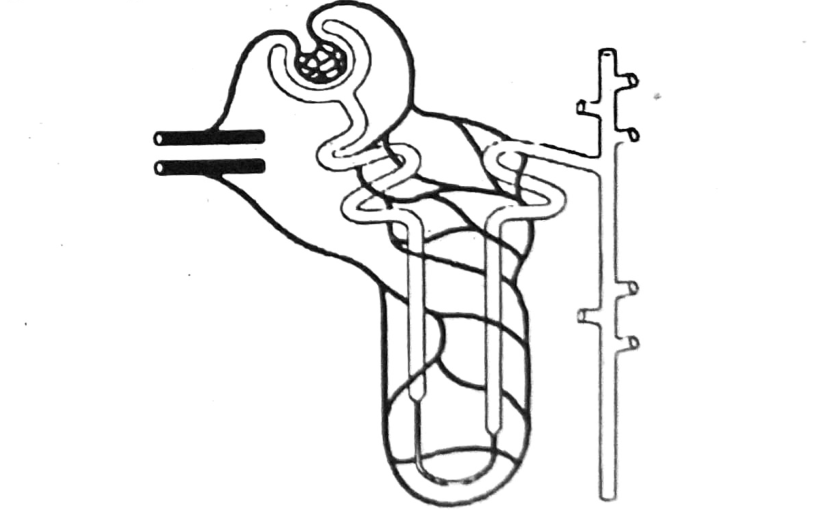
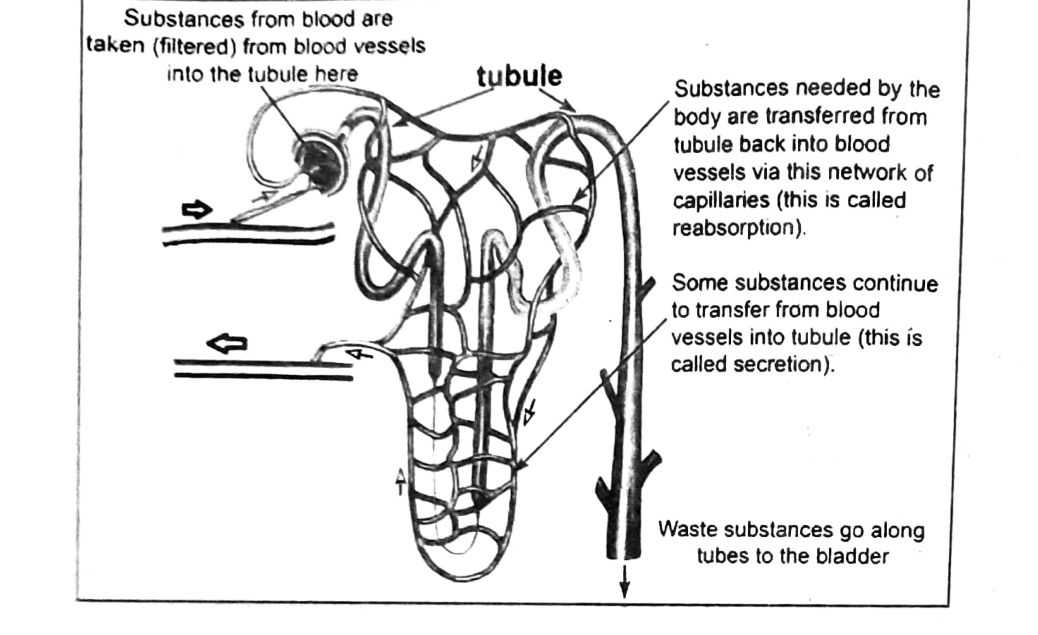
Substances from blood are taken (filtered) from blood vessels into the tubule here.
Substances needed by the body are transferred from the tubule back into blood vessels via this network of capillaries (this is called reabsorption).
Some substances continue to transfer from blood vessels into the tubule (this is called secretion).
Waste substances go along tubes to the bladder.
Kidney Transplant:
The kidney of a healthy person can be transplanted to a diseased one. The kidney may be donated by a donor. The tissue and blood chemistry of the donor should be similar to that of the patient. If the kidney is not matching 'tissue rejection' may occur and the patient's immune system destroys the donated kidney.
Kidney Failure:
Kidney failure is a condition where the kidneys lose their ability to filter waste, excess water, and toxins from the blood.
This can lead to the buildup of harmful substances in the body, which can be life-threatening if not treated.
Dialysis:
Dialysis is a medical treatment that performs the function of the kidneys when they fail.
It removes waste, extra fluid, and toxins from the blood using a dialysis machine or dialysis fluid.
Long Questions:
Urinary System of Man:
The products of metabolism which are not needed by the organism are called waste products. These are harmful if allowed to accumulate in the body. They must be either removed or deposited as harmless insoluble form. The waste products include urea, uric acid; toxic substances such as pesticides, drugs, food additives. Carbon dioxide and water vapour produced during respiration are also metabolic wastes.
Excretion:
The process by which metabolic waste products and toxic materials are removed from the body of an organism is called excretion.
Urinary System:
The urinary system of man consists of:
- A pair of kidneys
- A pair of ureters
- A urinary bladder
- A urethra
(a) Kidney:
The kidney is reddish brown in colour. It is bean shaped and enclosed in tough transparent membrane the capsule. Right kidney is slightly lower than the left kidney.
(b) Ureter:
From the kidney a thin tube ureter, comes out and extends downwards to join the urinary bladder.
(c) Urinary Bladder:
Urine from each kidney passes through the ureter to the urinary bladder. The bladder is an elastic muscular bag which stores urine.
(d) Urethra:
The urinary bladder has only one exit, a tube called urethra which leads out of the body.
The kidney is a vital excretory organ in the human body. Its structure is perfectly designed to carry out the functions of filtering blood, removing waste products, balancing body fluids, and producing urine. Each kidney has a bean-shaped structure and is divided into three main regions: the cortex, medulla, and renal pelvis.
The cortex, the outer part of the kidney, contains millions of filtering units called nephrons. Each nephron starts with a Bowman’s capsule, which surrounds a network of capillaries called the glomerulus. This is where the process of ultrafiltration takes place, as blood is filtered under pressure to remove waste products, water, and small molecules.
The medulla, the inner region of the kidney, contains the loop of Henle and collecting ducts of the nephrons. These structures play an important role in reabsorbing water, salts, and nutrients from the filtrate back into the blood. This ensures that only waste and excess substances are excreted, while useful materials are retained.
The renal pelvis is a funnel-shaped cavity that collects the urine formed by all nephrons. From here, urine passes into the ureter, then to the urinary bladder, and finally exits the body through the urethra.
The kidney is also richly supplied with blood through the renal artery, ensuring that a large volume of blood is continuously filtered. The renal vein carries the cleaned blood back to the body. This structure-function relationship allows the kidney to regulate blood pressure, maintain electrolyte balance, and support overall homeostasis.
Structure of Nephron:
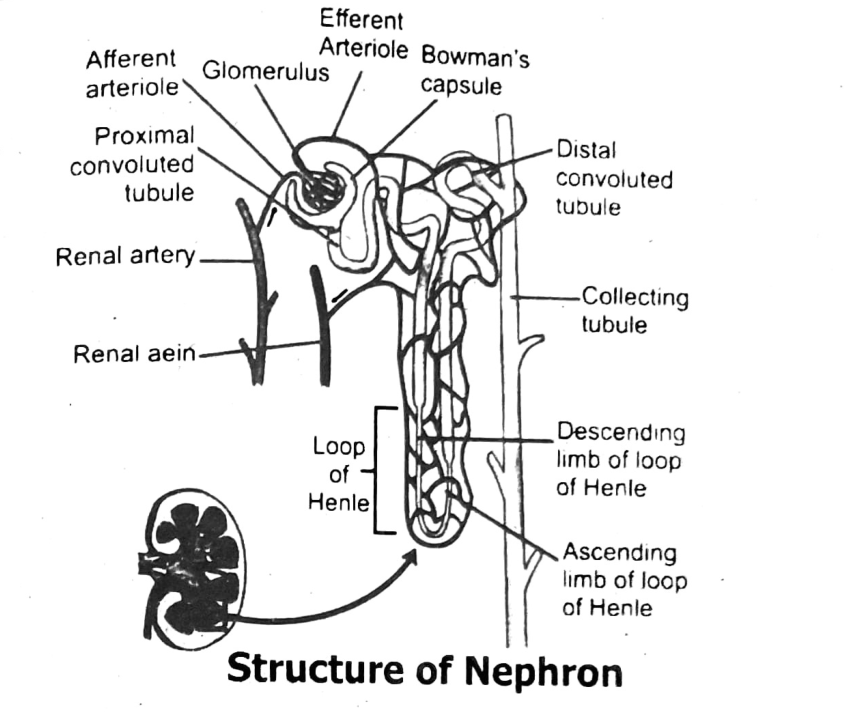
The nephron is the structural and functional unit of the kidney. Each kidney, in a human, contains about one million nephrons. The nephron consists of a long tubule. Each nephron is composed of renal corpuscle and renal tubule.
Renal Corpuscle:
Renal corpuscle consists of Bowman’s capsule and glomerulus of the Bowman’s capsule. The Bowman’s capsule is a double-walled hollow cup that surrounds a tuft of blood capillaries known as glomerulus.
Renal Tubule:
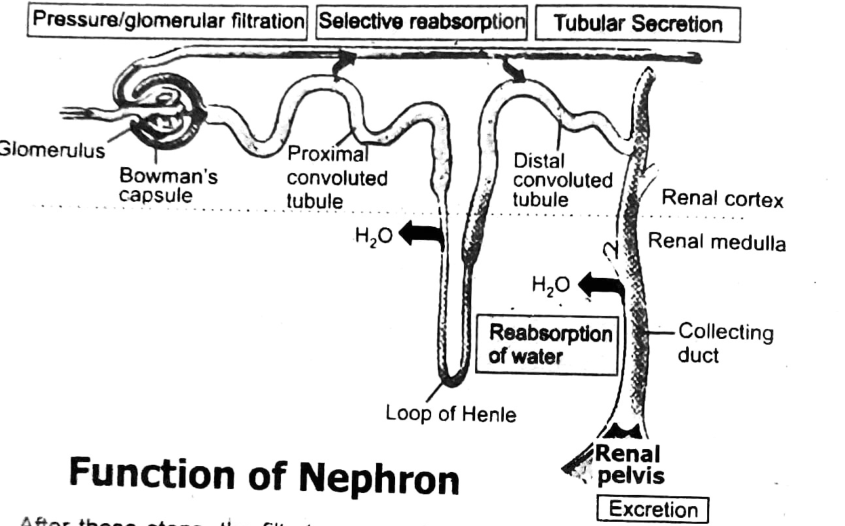
Renal Tubule has three parts. Proximal convoluted tubule begins from the Bowman’s capsule. The U-shaped structure is called loop of Henle. At the end of the loop, the nephron is highly coiled again to form distal convoluted tubule. The nephron finally merges into the collecting duct. The collecting ducts join with even larger ducts which open into the renal pelvis. Blood capillary after leaving glomerulus forms a network of capillaries around renal tubule.
Process of Urine Formation in Man (Functioning of Nephron):
Urea is the main nitrogenous waste material in the urine of man. Urea is formed in the liver and, is carried to the kidney. The function of the kidney is to remove urea and form urine. It involves three processes in the nephron pressure or glomerular filtration, tubular or selective reabsorption and tubular secretion.
Glomerular filtration:
It is the movement of small molecules across the glomerular wall as a result of blood pressure. When blood enters the glomerulus, blood pressure is sufficient to cause small molecules, such as water, nutrients, salts and wastes, to move from the glomerulus to the inside of the Bowman’s capsule. The fluid that leaves the blood is called glomerular filtrate. Blood proteins and blood cells are too large to be part of this filtrate, so they remain in the blood.
Selective reabsorption:
During reabsorption, about 99% of the water and the most of the solutes that enter the nephron are returned to the bloodstream, as the filtrate flows along the nephron. This reabsorption occurs through osmosis, diffusion and active transport. The substances needed by the body, particularly glucose and amino acids, are completely reabsorbed. Some water and most of the solutes are reabsorbed from the proximal convoluted tubule. The descending limb of loop of Henle allows the reabsorption of water while the ascending limb of loop of Henle allows the reabsorption of salts. The distal convoluted tubule again allows reabsorption of water in the blood.
Tubular secretion:
Some substances are actively transported from the blood capillaries into the nephron tubule by tubular secretion. These substances include K+ and H+ ions, drugs, uric acid and creatinine.
After these steps, the filtrate present in renal tubules is known as urine. It moves into collecting ducts and then into pelvis.
The movement of a molecule of urea from blood to urethra is as following:
Liver → Urea → Blood → Kidney → Nephron → Glomerulus → Bowman's capsule → Proximal Convoluted Tubule → Loop of Henle → Distal Convoluted Tubule → Collecting Duct → Ureter → Urinary bladder → Urethra → Urea given out of body in the form of urine
| Substance | Amount |
|---|---|
| Water | 95% |
| Urea | 9.3 g/L (g / L = grams per liter) |
| Chloride ions | 1.87 g/L |
| Sodium ions | 1.17 g/L |
| Potassium ions | 0.750 g/L |
| Other ions and compounds | Variable amounts |
Osmoregulatory Function of Kidney:
The kidneys are osmoregulatory organs which regulate the concentration of water and salts in the blood. If the blood is dilute i.e., contains too much water, less water is absorbed from the renal tubules, leaving more water to enter the bladder.
Thus, after drinking a lot, large volume of dilute urine is produced and the human body gets rid of extra water. If the blood is too concentrated more water is absorbed back into the blood from kidney tubule.
A rise in the blood concentration is thought to stimulate a thirst centre (hypothalamus) in the brain. The drinking which follows this stimulation restores the blood to its correct concentration. Besides excretion the kidneys help to maintain the pH, blood pressure and composition of the blood plasma.
Kidney Stones:
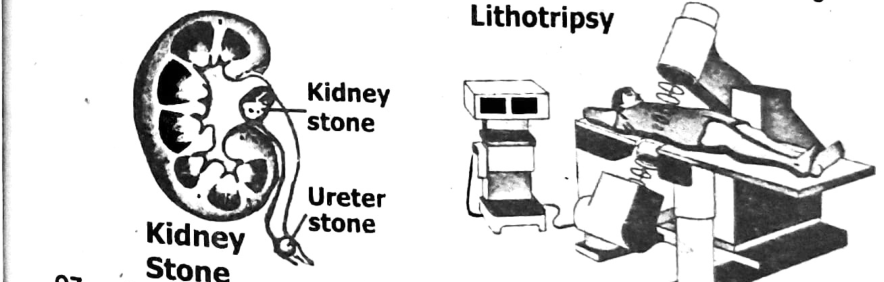
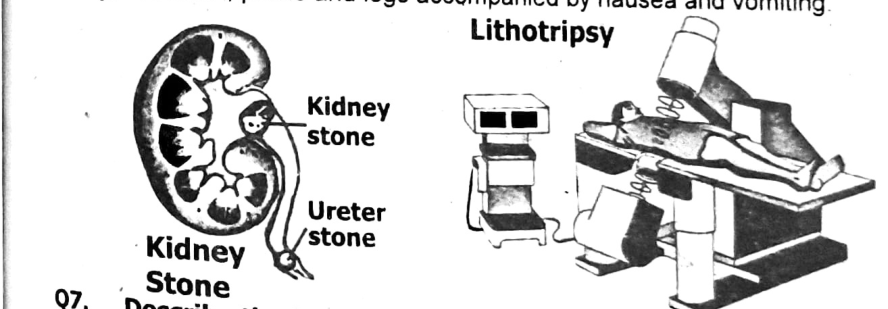
Stones may develop in any part of the urinary system. Kidney stones are usually composed of uric acid crystal or calcium oxalate etc.
Causes:
The causes of kidney stone are:
- Presence of high level of calcium in the blood because of other diseases.
- Presence of higher level of oxalate in the blood results in the formation of calcium oxalate stones.
- A decrease in water intake.
- Age and family history.
Treatment:
About 90% of all kidney stones can pass through the urinary system by drinking plenty of water. The kidney stone may be removed by surgery. There is a non-surgical method of stone removal called lithotripsy. It is a technique to breakup stones that form in the kidney, and ureter by shock waves targeted from outside the body. If a kidney stone passes into a ureter it may stimulate severe pain in the kidney, abdomen, pelvis and legs accompanied by nausea and vomiting.
There are two types of dialysis:
- Haemodialysis
- Peritoneal dialysis
(a) Haemodialysis:
In this process first a catheter is inserted into the vein, usually in the arm. The blood flows into the tube and then into the machine called dialyzer. Inside the machine the blood is pumped over the surface of a dialysis membrane (semi-permeable membrane).
This separates the patient's blood from the dialysis fluid. Urea diffuses out of the blood, across the dialysis membrane and into the dialysis fluid. The dialysis fluid already has sugar and salts in it.
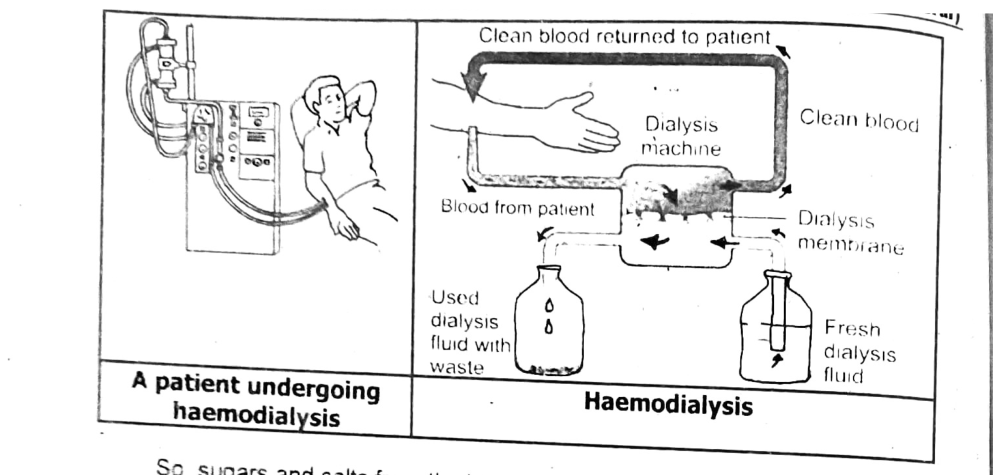
So sugars and salts from the blood will not diffuse across into the fluid. Urea and other wastes pass into the dialysis fluid. The patient’s cleaner blood passes back into the other vein of the arm through a second catheter. Fresh dialysis fluid enters the machine from one end. The used dialysis fluid with waste leaves the machine from the other end.
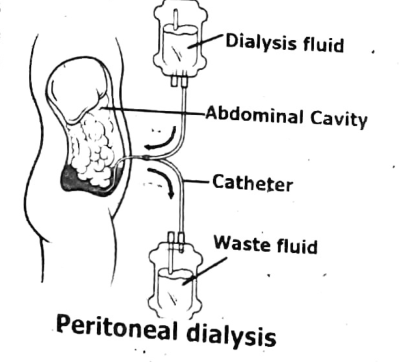
(b) Peritoneal Dialysis:
In this process, the dialysis fluid is pumped into the peritoneal cavity which is the space around gut. The peritoneum which lines the peritoneal cavity functions as the dialysis membrane. Dialysis fluid is added to the abdominal cavity through the tube. It is left for several hours before removal.
Exchange takes place between the dialysis fluid and the tissue fluid in the abdomen.
This type of dialysis can be performed at home. It must be done regularly, 3 or 4 times a day.
Causes of Kidney Failure:
- Diabetes: High blood sugar can damage the small blood vessels in the kidneys over time.
- High Blood Pressure: Causes strain and damage to kidney blood vessels.
- Glomerulonephritis: Inflammation of the kidney’s filtering units (glomeruli).
- Polycystic Kidney Disease: A genetic disorder that forms fluid-filled cysts in the kidneys.
- Repeated Infections or Obstructions: Such as kidney stones or urinary tract infections.
- Prolonged use of certain medicines: Like painkillers or antibiotics that harm the kidneys.
Treatment of Kidney Failure:
- Dialysis: A medical process that filters waste and extra fluids from the blood when kidneys cannot.
- Kidney Transplant: A surgical procedure where a healthy kidney from a donor replaces the failed kidney.
- Medications: To manage symptoms like high blood pressure and prevent further damage.
- Lifestyle Changes: Healthy diet, controlling diabetes and blood pressure, and avoiding harmful substances.