
Short Questions:
During the phase change from ice to water, the temperature remains constant because the energy supplied (heat) is used to break the bonds between the water molecules in the solid state (ice) rather than increasing the kinetic energy of the molecules. This energy is known as the latent heat of fusion. While the temperature stays the same, the ice is transitioning into liquid water, and the energy is being used to change the phase rather than increase the temperature.
The name given to phases change when a solid is converted directly to a gas is Sublimation.
Difference between evaporation and boiling:
| Evaporation | Boiling |
|---|---|
| It happens at any temperature. | It happens at a fixed temperature (boiling point). |
| It only takes place at the surface of the liquid. | It happens throughout the liquid. |
| No bubbles are produced. | Bubbles are formed. |
| It is a slow process. | It is a quick process. |
Heating curve for water:
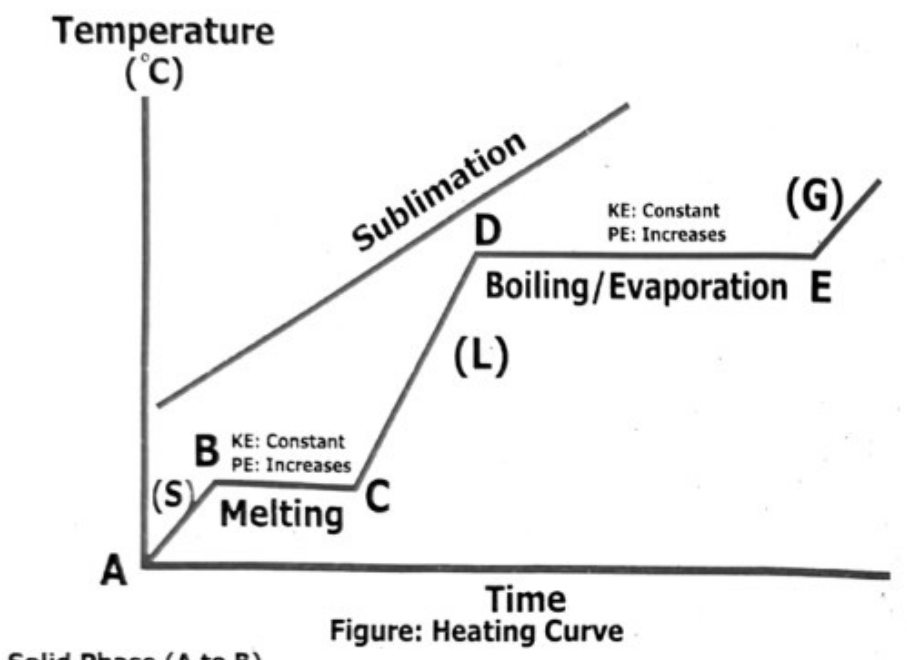
Solid Phase (A to B)
Segment A to B: The temperature of the solid increases as it absorbs heat.
Melting (B to C)
Segment B to C: The temperature remains constant as the solid melts into a liquid.
Liquid Phase (C to D)
Segment C to D: The temperature of the liquid increases as it continues to absorb heat.
Boiling (D to E)
Segment D to E: The temperature remains constant as the liquid changes into a gas.
Gas Phase (E onward)
Segment E onward: The temperature of the gas increases as it absorbs more heat. The kinetic energy of the gas particles increases, causing them to move even more rapidly.
When the temperature of a gas in a sealed container is increased, the pressure inside the container also rises, as long as the volume is kept constant. This happens because raising the temperature increases the average kinetic energy of the gas molecules, causing them to move faster. As the molecules speed up, they collide with the walls of the container more frequently and with greater force. Since pressure is the result of these collisions, the increased energy and frequency of collisions leads to an increase in pressure.
Increasing the external pressure raises the boiling point of a liquid. This is because the boiling point of a liquid is the temperature at which its vapor pressure equals the external pressure.
When the external pressure is increased, the liquid molecules need more energy (higher temperature) to overcome the greater atmospheric pressure and transition into the gas phase.
For example, in a pressure cooker, the external pressure is higher than atmospheric pressure, which raises the boiling point of water, allowing food to cook faster at higher temperatures.
Molecular Mass:
The rate of diffusion is inversely proportional to the square root of the molar mass of the gas particles.
Rate of diffusion: $$r \propto \frac{1}{\sqrt{m}} \quad \text{at constant } T \text{ and } P$$
Because lighter molecules move faster, they can travel greater distances in a given time than heavier molecules, resulting in a higher rate of diffusion.
OR (Second Answer)
The rate of diffusion is inversely related to molecular mass. Heavier molecules move more slowly, while lighter molecules move faster. This is because lighter molecules require less energy to move quickly, whereas heavier molecules have more inertia and move more slowly. According to Graham's Law of Diffusion, the rate of diffusion is proportional to the inverse square root of the molecular mass. Thus, substances with lower molecular masses diffuse more rapidly than those with higher molecular masses.
Sublimation:
Sublimation is the process in which molecules of a substance in the solid state go to the vapor state directly, without going through the liquid state. There are many substances that undergo sublimation. Carbon dioxide, camphor, and naphthalene are material that easily undergoes sublimation.
Application of Sublimation in our life
- The solid air fresheners we often use in our cars and homes rely solely on the magic of sublimation. The solid fragrance within slowly transforms into a delightful vapour, filling the entire space with an enticing aroma that lingers in the air.
- In the textile industry 3D printing uses a sublimation process. Dye sublimation printers are now widely used for the printing process for a reduced cost. Dye sublimation is used to print a variety of objects such as T-shirts, pens, coffee mugs, and bags.
The diffusion of gases is faster at higher temperatures because temperature increases the average kinetic energy of the gas molecules. As the temperature rises, the molecules move more quickly, which leads to more frequent and energetic collisions between them. These faster-moving molecules spread out and diffuse more rapidly, as their increased speed allows them to travel greater distances in a shorter amount of time. In short, higher temperatures cause gas molecules to move faster, which accelerates the rate of diffusion.
It states that for a gas at constant temperature and pressure, the volume of the gas is directly proportional to the number of moles of gas. $V \propto n$
When the number of gas particles (moles) increases, there are more particles colliding with the walls of the container. To keep the pressure constant, the volume of the container must increase to accommodate the additional particles and maintain the same number of collisions per unit area. Conversely, if the number of particles decreases, the volume must decrease to maintain constant pressure.
OR (Second Answer)
Avogadro's Law states that the volume of a gas is directly proportional to the number of moles of gas, provided temperature and pressure are constant. In simpler terms, if the number of gas molecules increases, the volume increases as well. Conversely, if the number of molecules decreases, the volume decreases. This relationship can be expressed as $V \propto n$. It emphasizes that the amount of gas directly impacts the space it occupies.
The Kinetic Particle Theory explains the behavior of matter in terms of the movement and interactions of particles (atoms, molecules, or ions). According to this theory, particles are constantly in motion, and their energy determines the state of the substance—solid, liquid, or gas. Here's how the Kinetic Particle Theory applies to the phase changes of melting, freezing, boiling, and condensation:
Melting (Solid to Liquid)
When a solid melts, it becomes a liquid. In a solid, the particles are tightly packed in a stable, well-ordered state and vibrate in fixed positions. When energy (usually heat) is added to the solid, it causes the particles to vibrate more strongly. When energy is added to a solid at the melting point, it increases its potential energy. This weakens the forces that hold the particles in place without increasing their kinetic energy, so the temperature stays the same. When the energy is strong enough to overcome the forces holding the particles in place, the solid melts into a liquid where the particles are in a stable state but can move freely around one another.
Freezing (Liquid to Solid)
When a liquid freezes, it turns into a solid.
According to the Kinetic Particle Theory in a liquid, particles have enough energy to move around each other. As the liquid loses energy, particle motion slows down, and the forces of attraction pull the particles into a fixed, orderly arrangement characteristic of a solid.
Energy is released during freezing, decreasing the potential energy of the particles. The temperature remains constant during this process as the energy released is used to form the solid structure.
Boiling (Liquid to Gas)
When a liquid boils, it turns into a gas.
According to the Kinetic Particle Theory in a liquid, particles are closely packed but can move past each other. As energy is added, particles move faster and eventually have enough energy to break free from the liquid's surface into the gas phase.
The added energy increases the potential energy of the particles, allowing them to overcome the attractive forces holding them in the liquid. This occurs at the boiling point, where the temperature remains constant as the liquid turns into gas.
Condensation (Gas to Liquid)
When a gas condenses, it turns into a liquid.
According to the Kinetic Particle Theory in a gas, particles move away rapidly and are far apart. As the gas loses energy, particle motion slows down, and attractive forces pull the particles closer together, forming a liquid.
Energy is released during condensation, reducing the potential energy of the particles. The temperature remains constant as the gas turns into a liquid.
Cooling Curve:
A cooling curve shows the reverse process as a substance is cooled. It consists of similar distinct regions, but in reverse order.
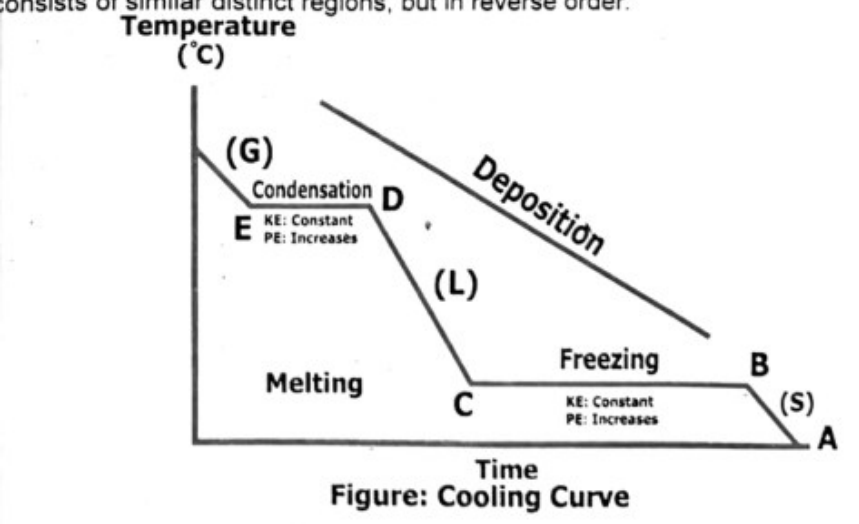
Gas Phase (Higher Temperature to E)
Segment higher temperature to E: The temperature of the gas decreases as it loses heat. The kinetic energy of the gas particles decreases, causing them to move less rapidly.
Condensation (E to D)
Segment E to D: The temperature remains constant as the gas condenses into a liquid. The lost heat energy is released as the intermolecular forces bring the particles closer together, resulting in the latent heat of vaporization being released.
Liquid Phase (D to C)
Segment D to C: The temperature of the liquid decreases as it loses more heat. The kinetic energy of the particles decreases, causing them to move more slowly.
Freezing (C to B)
Segment C to B: The temperature remains constant as the liquid freezes into a solid. The lost heat energy is released as the intermolecular forces arrange the particles into a solid structure, resulting in the latent heat of fusion being released.
Solid Phase (B to A and below)
Segment B to A and below: The temperature of the solid decreases as it continues to lose heat. The kinetic energy of the particles decreases, causing them to vibrate less.
Kinetic Theory Interpretation
Kinetic Energy and Temperature
In the regions where the temperature is changing (A to B, C to D, and E onward for heating) the kinetic energy and potential energy increase. E to D, C to B for cooling. KE of the particle is constant but PE is decreasing.
Potential Energy and Phase Changes
In the regions where the temperature remains constant (B to C and D to E for heating; D to C and B to A for cooling), the energy absorbed or released is used to change the phase of the substance. This involves changing the potential energy associated with intermolecular forces, rather than changing the kinetic energy of the particles.
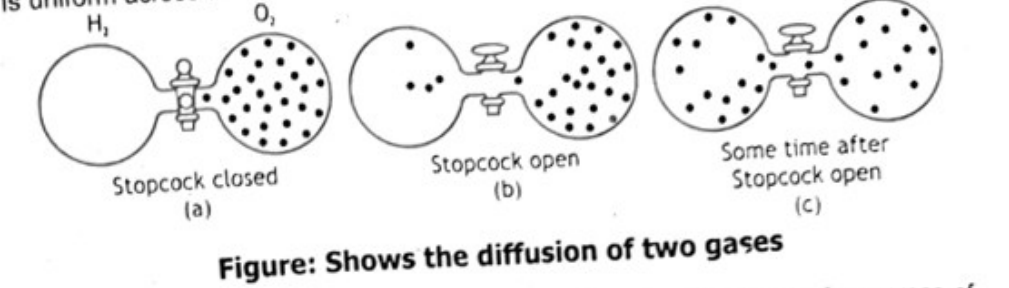
When two different gases come into contact, their particles begin to move together. Because of their kinetic energy, each type of a gas particle moves randomly in all directions. The random motion of these particles ensures that the particles from each of the two gases move into the other gas's space. This random and constant motion causes the gases to spread and mix up.
The gas particles change direction as they move and collide with each other. As they change direction, they spread out and move through the space available to them. As time goes on, this random motion causes the particles to spread out evenly across the space. Eventually, the concentration of both types of gas is uniform across the entire space, and equilibrium is achieved.
The rate of diffusion, the process by which molecules spread from areas of high concentration, is affected by several factors, including molecular weight and temperature.
Temperature
Diffusion rate increases with temperature. Higher temperatures give molecules more energy, which increases their kinetic energy. As the temperature increases, the average kinetic energy of the molecules increases. Since kinetic energy is proportional to the square of the velocity, this results in a higher molecular velocity. Higher molecular velocities at higher temperatures cause more frequent and energetic collisions between molecules, facilitating faster diffusion.
Long Questions:
The boiling point of water is significantly impacted by altitude, and this directly affects cooking times. To understand this impact, we need to consider the kinetic particle theory and the effect of external pressure (atmospheric pressure) on the boiling point.
Kinetic Particle Theory and Boiling Point
The boiling point of a liquid is the temperature at which its vapor pressure (the pressure exerted by the molecules of the liquid when they escape into the gas phase) equals the external pressure (the pressure exerted on the liquid from its surroundings, such as the atmosphere).
According to the kinetic particle theory, as the temperature of a liquid increases, the kinetic energy of its particles increases.
When a liquid reaches its boiling point:
- The particles move faster, and their kinetic energy becomes high enough for them to break the intermolecular forces holding them in the liquid state.
- The liquid transitions into a gas, and bubbles of vapor form within the liquid.
Impact of Altitude on Atmospheric Pressure:
At higher altitudes, the atmospheric pressure is lower because the air is less dense. Since the external pressure is lower at high altitudes, the vapor pressure required for boiling is reached at a lower temperature. In other words, the boiling point of water decreases as altitude increases.
Effect on the Boiling Point of Water:
At sea level, the boiling point of water is 100°C (212°F), where the vapor pressure of water equals the atmospheric pressure of 1 atmosphere (101.3 kPa). However, at higher altitudes:
- The atmospheric pressure is lower.
- As a result, water will boil at temperatures below 100°C (212°F).
For example:
- At 2,000 meters (about 6,561 feet) above sea level, the boiling point of water is around 93°C (199°F).
- At 4,000 meters (about 13,123 feet), the boiling point drops to around 86°C (187°F).
Effect on Cooking Times:
The lower boiling point at higher altitudes affects the cooking process because the temperature at which food is cooked is lower than at sea level. This means:
- Less heat is available to cook the food, which may result in longer cooking times.
For example:
- If you’re boiling pasta or cooking a stew, the water will boil at a lower temperature, so the food will take longer to cook because the heat is not as intense as it would be at sea level.
- The lower temperature also affects the rate of chemical reactions involved in cooking, such as denaturing proteins in meat or thickening sauces, which can further prolong cooking times.
Why Cooking Times Increase:
- Temperature and molecular motion:
According to the kinetic particle theory, molecules in a substance move faster at higher temperatures. At lower temperatures (due to lower boiling points), the molecular movement is slower, and reactions happen less quickly. - Reduced heat transfer:
Because the boiling point is lower, there is less thermal energy available in the water. Consequently, food takes longer to reach the desired level of doneness since it is being heated at a lower temperature.
Practical Solutions:
- Pressure cookers:
One solution to mitigate the longer cooking times at higher altitudes is the use of pressure cookers. These devices increase the pressure inside the cooking vessel, which raises the boiling point of water and allows food to cook at higher temperatures, reducing the impact of altitude on cooking times. - Adjusting cooking times:
Recipes often need to be adjusted for higher altitudes by increasing cooking time or using slightly higher temperatures to compensate for the lower boiling point of water.
In pharmaceutical development, diffusion rates refer to how quickly a drug moves from one place to another, like from the stomach into the bloodstream, or through tissues to reach its target.
This is important for several reasons:
- Absorption: When a drug is taken, it must diffuse across membranes (like the walls of the intestines) to enter the bloodstream. If the drug diffuses too slowly, it might not be absorbed properly, affecting how well the drug works.
- Controlled Release: For certain medications, it’s important to control how slowly or quickly the drug releases into the body. Understanding diffusion allows scientists to design extended-release medications, which release the drug gradually to maintain consistent levels in the body over time.
- Distribution: Once in the bloodstream, a drug must diffuse to the tissues or organs that need it. The rate at which this happens affects how quickly the drug works and how effectively it reaches its target.
- Safety and Effectiveness: If a drug diffuses too quickly or too slowly, it can lead to side effects or reduced effectiveness. By understanding diffusion, pharmaceutical companies can design drugs that release at the right rate, ensuring safety and maximum benefit.
Sublimation is the process by which a substance transitions directly from a solid to a gas without passing through a liquid phase. This unique phase change is utilized in several industries, including air fresheners and 3D printing. While sublimation offers various practical benefits, it also carries environmental and practical considerations that need to be evaluated.
- Air Fresheners (Sublimation of solid fragrance materials)
Benefits:
- Continuous Release:
Sublimation in air fresheners allows for a gradual and continuous release of fragrance without the need for liquids or aerosols, providing long-lasting effects without constant maintenance. - No Residue:
Unlike liquid air fresheners, sublimation doesn’t leave any wet residue or require refills, making it more convenient and potentially cleaner.
- Continuous Release:
- Eco-friendly:
Solid-state air fresheners can avoid the use of potentially harmful propellants and chemicals found in spray-based products, offering a more environmentally friendly option if made from natural materials.
Drawbacks:
- Limited Control over Release:
The rate of sublimation depends on temperature and airflow, which can make it difficult to control the intensity of the fragrance. Environmental factors such as humidity and room temperature can impact performance. - Resource Consumption:
Many air fresheners use synthetic chemicals, which may contain harmful volatile organic compounds (VOCs). Over time, the continuous release of these compounds can contribute to indoor air pollution. - Waste Generation:
If the air fresheners are not made from biodegradable materials, their disposal may add to waste in landfills.
- 3D Printing (Sublimation in materials used for printing):
Benefits:
- Improved Precision:
Sublimation in 3D printing, such as using materials that sublime directly into a gas, can offer more precise layering and resolution when creating intricate designs. - Material Efficiency:
Sublimation allows for the deposition of materials without the need for traditional melting, potentially reducing material waste since it avoids excess resin or filament. - Faster Printing:
The process can potentially reduce printing times, as the material can directly transition into a gas and then solidify, making it faster than traditional methods that involve heating and melting.
Drawbacks:
- Energy Consumption:
Sublimation requires controlled environmental conditions, such as a specific temperature and pressure, which can consume more energy in comparison to other 3D printing methods. - Material Limitations:
Not all materials can sublimate effectively, limiting the variety of substances that can be used in sublimation-based 3D printing. This might restrict design flexibility and application in certain industries. - Potential Environmental Impact of Materials:
If harmful chemicals or synthetic polymers are used in sublimation-based 3D printing, there is the potential for environmental harm during the production, use, or disposal of these materials. Proper recycling and disposal protocols would be essential.
- Improved Precision:
- General Environmental and Practical Implications of Sublimation:
Environmental Benefits:
- Reduced Waste:
Since sublimation involves the transition from solid to gas without passing through a liquid phase, it often results in less waste material and no leftover solvents or liquids. - Energy Efficiency:
When used effectively, sublimation can be energy-efficient, especially if it reduces the need for extra processing steps, such as heating or melting.
Environmental Drawbacks:
- Energy Use:
The need to maintain certain environmental conditions (like controlled heat or vacuum) can lead to higher energy consumption. If this energy is sourced from non-renewable resources, the overall environmental benefit of sublimation can be diminished. - Chemical Emissions:
In some cases, the sublimated materials (such as certain plastics or fragrances) may release volatile compounds into the air, which could contribute to pollution. For example, VOCs from sublimated air fresheners can impact indoor air quality.
Practical Considerations:
- Cost and Feasibility:
While sublimation offers certain efficiencies, the process can be complex and require specialized equipment, which may increase production costs for certain applications. - Health and Safety:
Sublimation processes in certain industries, like air fresheners, might release chemicals that could be harmful to human health if not properly controlled. In 3D printing, certain sublimated materials may release gases that could be toxic or hazardous.
- Reduced Waste: