
During melting, the particles of a solid gain energy, which causes them to vibrate more vigorously. As they gain enough energy, the attractive forces holding the particles in fixed positions weaken, allowing the particles to move past each other and transition into a liquid state.
The main factor is the amount of energy the particles have. In solids, particles have low energy and are closely packed. In liquids, particles have more energy and can move past each other. In gases, particles have high energy and move freely and rapidly.
During boiling, the heat energy is used to overcome the intermolecular forces between the particles in the liquid, rather than increasing the temperature. The temperature remains constant because all the added energy is being used to change the state from liquid to gas, not to increase the kinetic energy (temperature) of the particles.
When a gas is cooled, the particles lose energy, causing them to slow down and move closer together. The reduced kinetic energy means the particles no longer have enough energy to overcome the attractive forces between them, so they condense into a liquid. This explains condensation in terms of the kinetic particle theory, where a decrease in particle movement leads to a change of state from gas to liquid.
When the balloon is placed in the freezer, the temperature of the air inside the balloon drops. As the particles in the air lose energy, they move slower and become more tightly packed, causing the gas inside the balloon to contract. This results in the balloon shrinking due to the reduced kinetic energy and the decreased volume of the gas.
When the bottle of water is exposed to cold temperatures, the particles of water lose energy, causing them to slow down and move closer together. As the particles slow down, the attractive forces between them become stronger, and the water turns into ice (solid). This phase change from liquid to solid occurs because the particles no longer have enough energy to break free from their fixed positions in the solid state.
A state change (or phase transition) is the transition of matter from one state to another, such as a solid state to a liquid state, a liquid state to a gas state, or a state of matter directly between a solid state and a gas state. These transitions occur without a temperature change and can be understood through kinetic particle theory and the internal energy.
Sublimation (Solid to Gas)
When a solid sublimates, it turns directly into a gas without passing through the liquid phase. According to the Kinetic Particle Theory in a solid, particles are tightly packed in fixed positions.
When the solid gains enough energy, the particles gain sufficient energy to break free directly into the gas phase.
Energy is added, significantly increasing the potential energy of the particles to overcome the forces holding them in the solid structure. This occurs without a change in temperature during the sublimation process.
Deposition (Gas to Solid)
When a gas undergoes deposition, it turns directly into a solid without passing through the liquid phase.
According to the Kinetic Particle Theory in a gas, particles are far apart and move freely. When the gas loses energy, the particle motion slows significantly, and attractive forces pull the particles directly into a solid arrangement.
Energy is released, greatly reducing the potential energy of the particles. This happens without a change in temperature during the deposition process.
During the melting process, the particles gain kinetic energy and start vibrating more rapidly. However, this energy is used to overcome the intermolecular forces between particles, rather than increasing the temperature. Therefore, the temperature remains constant during melting.
During boiling, the heat energy is used to overcome the intermolecular forces between the liquid particles, allowing them to escape into the gas phase. This energy is not used to increase the temperature but to change the state of the substance. Therefore, the temperature remains constant at the boiling point.
As the gas cools, the particles lose kinetic energy and slow down. As the particles lose enough energy, they come closer together and form liquid bonds. During this process (condensation), the temperature remains constant because the energy released as the particles slow down and come closer together is not used to increase their kinetic energy, but rather to change the state from gas to liquid.
As a gas cools, the particles lose kinetic energy, causing them to move slower and become more closely packed. This slowing down of particles results in a decrease in temperature. The reduced energy means that the particles can form intermolecular bonds, transitioning from a gas to a liquid.
During the phase change from solid to liquid (melting), the temperature remains constant despite the addition of heat. This is because the energy is used to overcome the intermolecular forces between particles, not to increase their kinetic energy. As a result, the particles begin to move more freely, but the temperature does not rise until the phase change is complete.
As the water cools from its boiling point, the particles lose kinetic energy and slow down. The water vapor condenses into liquid droplets as the particles lose enough energy to overcome the forces keeping them apart. During this condensation process, the temperature of the water remains constant until all of the vapor has turned into liquid.
According to Boyle’s Law, when the volume of a gas decreases, its pressure increases, provided the temperature remains constant. This is because the particles are compressed into a smaller space, increasing the frequency and force of collisions with the container walls.
Avogadro's Law states that the volume of a gas is directly proportional to the number of gas particles (or moles) when the temperature and pressure are constant. As the number of particles increases, the volume of the gas increases.
The kinetic particle theory explains that when the volume of a gas decreases, the particles are confined to a smaller space. As a result, they collide with the walls of the container more frequently and with greater force, which increases the pressure, as pressure is the result of collisions between particles and the container walls.
According to kinetic particle theory, when a gas is heated, the kinetic energy of the particles increases, causing them to move faster. At constant pressure, the gas particles need more space to move around without increasing the frequency of collisions with the container walls. Therefore, the gas expands and its volume increases to accommodate the faster-moving particles.
According to Boyle's Law and the kinetic particle theory, when the temperature of the gas inside the balloon decreases, the kinetic energy of the particles decreases. As a result, the particles move more slowly and take up less space. If the pressure remains constant (e.g., the balloon is not sealed tightly), the volume of the gas decreases, causing the balloon to shrink.
According to Charles' Law, heating the gas increases its temperature, which increases the kinetic energy of the particles. As the particles move faster, they collide with the walls of the container more frequently and with greater force. If the volume of the container is fixed, these more frequent and forceful collisions result in an increase in pressure.
The key difference is that evaporation occurs gradually at the surface of the liquid at any temperature, while boiling occurs rapidly throughout the liquid when it reaches a specific boiling point.
Boiling occurs at the boiling point of the liquid, a specific temperature at a given pressure. It differs from evaporation because evaporation can happen at any temperature below the boiling point and only happens at the surface of the liquid.
Evaporation happens because some particles at the surface of a liquid have enough energy to overcome intermolecular forces and escape into the air. This can happen at any temperature. In contrast, boiling occurs only when the entire liquid reaches its boiling point, where the vapor pressure of the liquid equals the atmospheric pressure, causing bubbles to form and rapidly escape as gas.
Boiling occurs throughout the liquid because it involves the formation of bubbles that rise to the surface, with all the molecules gaining enough energy to escape. Evaporation, on the other hand, only occurs at the surface because only the surface molecules have enough energy to escape into the air, while the interior molecules are not exposed to the surrounding environment.
The water evaporates because evaporation occurs at all temperatures, not just at the boiling point. Molecules at the surface of the water gain enough energy to break free from the liquid and transition into the air, causing the puddle to gradually disappear.
To boil water, you must heat it to its boiling point because this is when the vapor pressure of the water equals the external pressure, allowing rapid formation of bubbles throughout the liquid. Simply increasing the temperature without reaching the boiling point won't result in boiling, as the water molecules won't have enough energy to transition rapidly from liquid to gas.
Concept of evaporation:
Evaporation is the process by which molecules at the surface of a liquid gain enough kinetic energy to escape into the gaseous phase. Only molecules at the liquid's surface participate in evaporation. These molecules must have sufficient kinetic energy to overcome intermolecular forces. Energy for evaporation comes from the surrounding environment. This absorption makes surroundings cooler than before. Evaporation can occur at any temperature below the liquid's boiling point. Higher temperatures increase the rate of evaporation since more molecules have sufficient energy to escape.
As high-energy molecules leave the liquid, the average kinetic energy of the remaining molecules decreases, leading to a cooling effect. This is why sweating helps cool the body.
Examples:
- Drying of clothes on a line.
- Evaporation of water from lakes and oceans contributing to the water cycle.
- Sweat evaporating from the skin, providing a cooling effect.
Concept of boiling:
Boiling is the process in which a liquid turns into vapor when it is heated to its boiling point, resulting in the formation of vapour bubbles within the liquid. Boiling occurs throughout the entire liquid, not just at the surface. Vapour bubbles form within the liquid, rise to the surface, and burst, releasing gas.
Boiling occurs at a specific temperature known as the boiling point. This temperature varies depending on the liquid and the external pressure. For water at sea level, the boiling point is 100°C (212°F).
Continuous heat input is required to maintain the liquid at its boiling point. The temperature of the liquid remains constant during boiling, as the added energy is used to convert the liquid into gas. Boiling is characterized by the vigorous formation of bubbles and steam, making it a highly visible process.
The boiling point changes with external pressure. Higher pressure increases the boiling point, while lower pressure decreases it. This is why water boils at lower temperatures at high altitudes.
External pressure increases the boiling point of a liquid. When the external pressure is higher, the liquid must be heated to a higher temperature for its vapor pressure to equal the external pressure, thus raising the boiling point.
High external pressure can decrease the rate of evaporation because the increased pressure forces more molecules back into the liquid, reducing the number of molecules that escape from the surface into the air.
At high altitudes, the external pressure is lower than at sea level. As a result, the vapor pressure of the liquid can equal the external pressure at a lower temperature, causing the liquid to boil at a lower temperature.
Evaporation is influenced less by external pressure than boiling. While increased external pressure can slow down evaporation by pushing more molecules back into the liquid, boiling is directly linked to the vapor pressure reaching the external pressure, which means changes in external pressure have a more noticeable effect on the boiling point.
In a pressure cooker, the external pressure is higher, which raises the boiling point of water. This allows the temperature of the water and steam to increase, speeding up cooking because the food cooks at a higher temperature than it would at normal atmospheric pressure.
At higher altitudes, the external pressure is lower, which slightly increases the rate of evaporation. With reduced external pressure, fewer air molecules push against the surface of the liquid, allowing more water molecules to escape into the air, thereby speeding up the evaporation process.
The effect of pressure on evaporation and boiling is primarily related to how it influences the rate at which molecules escape from the liquid's surface into the gas phase. Here are the key points regarding the effect of pressure on evaporation:
Effect of Lower Pressure:
At lower atmospheric pressures, the rate of evaporation increases. This is because there is less external pressure exerted on the liquid surface, making it easier for molecules to escape into the vapor phase.
For example, water will evaporate more quickly at high altitudes where the atmospheric pressure is lower than at sea level.
Lower pressure reduces the boiling point of a liquid, which means the liquid can transition to the gas phase at a lower temperature. This indirectly affects evaporation by facilitating the conditions under which it can occur more readily.
Effect of Higher Pressure:
At higher atmospheric pressures, the rate of evaporation decreases. The increased external pressure on the liquid surface makes it more difficult for molecules to escape into the vapour phase.
For example, in a pressure cooker, the high pressure suppresses evaporation until a higher temperature is reached, allowing food to cook faster.
Higher pressure increases the boiling point of a liquid, which means the liquid requires a higher temperature to transition into the gas phase. This indirectly affects evaporation by making the conditions less favorable for it to occur.
For example, in a pressure cooker, the high pressure suppresses boiling until a higher temperature is reached, allowing water to boil at a higher temperature. This allows food to cook faster.
Evaporation is a gradual process occurring at any temperature below the boiling point and at the surface of a liquid, while boiling is a rapid, vigorous process that occurs throughout the liquid at a specific boiling point.
Statement:
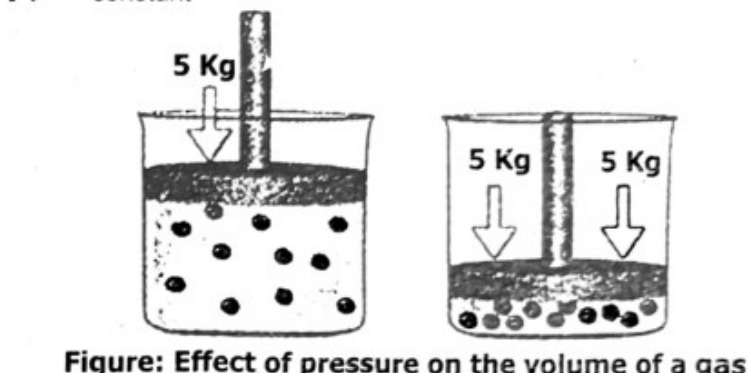
It states that for a fixed amount of gas at a constant temperature, the volume of a gas is inversely proportional to its pressure.
Mathematically,
$V \propto \frac{1}{P}$
$V = k\frac{1}{P}$
$PV = \text{constant}$
Kinetic Particle Theory Interpretation
Effect of Volume on Pressure:
When the volume of a gas decreases, the gas particles have less space to move around. This results in more frequent collisions with the walls of the container, thereby increasing the pressure.
Conversely, if the volume increases, the particles collide with the walls less often, decreasing the pressure.
Constant Temperature:
The average kinetic energy of the particles remains constant since the temperature does not change. The speed of the particles does not change, but the frequency of collisions with the container walls changes due to the volume change.
Statement:
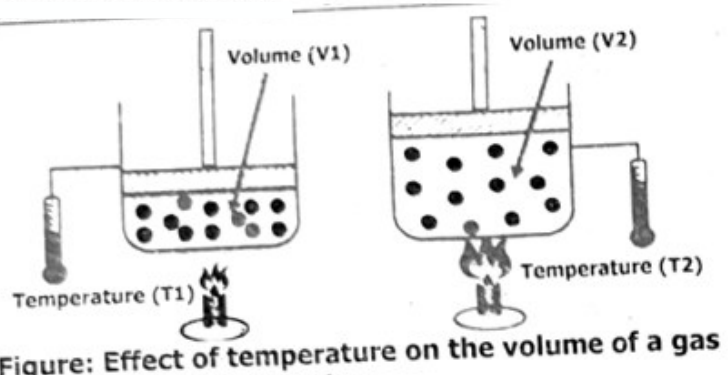
It states that for a fixed amount of gas at constant pressure, the volume of a gas is directly proportional to its absolute temperature.
Mathematically,
$V \propto T$
$V = kT$
$\frac{V}{T} = k$
$PV = \text{constant}$
Kinetic Particle Theory Interpretation
Effect of Temperature on Volume
When the temperature of a gas increases, the kinetic energy of the gas particles increases. This means the particles move faster. To maintain constant pressure, the volume of the container must increase to allow the particles to travel further between collisions with the container walls, thus keeping the pressure constant.
Conversely, if the temperature decreases, the kinetic energy of the particles decreases, the particles move slower, and the volume must decrease to maintain constant pressure.
Constant Pressure
The volume changes to balance the increased or decreased frequency and force of collisions due to temperature changes, maintaining constant pressure.
Statement
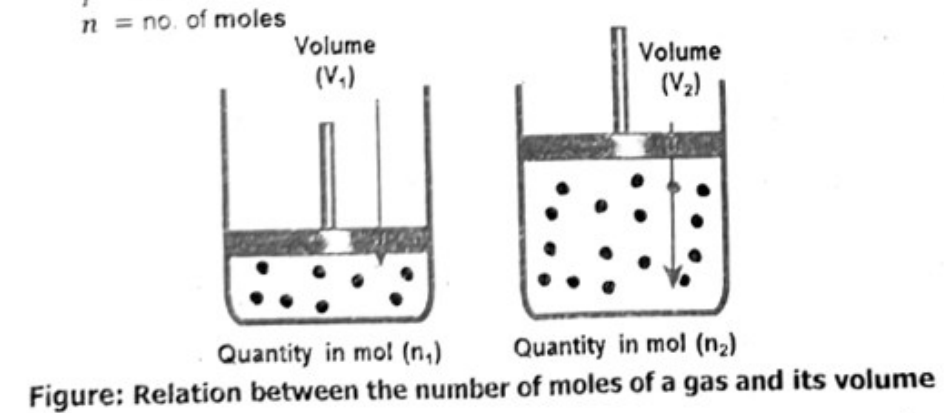
It states that for a gas at constant temperature and pressure, the volume of the gas is directly proportional to the number of moles of gas.
Mathematically,
$V \propto n$
$V = kn$, where $k$ and $n$ are constant
$\frac{V}{n} = \text{constant}$
$n = \text{no. of moles}$
Constant Temperature and Pressure
The temperature ensures the kinetic energy of each particle remains the same, and the pressure remains constant by adjusting the volume according to the number of particles.
Gas particles diffuse from high concentration to low concentration because they are in constant random motion, and collisions between the particles cause them to spread out evenly. This movement continues until the particles are uniformly distributed.
Increasing the temperature causes gas particles to move faster because they gain more kinetic energy. As a result, the diffusion rate increases, as the particles spread out more quickly and collide more frequently.
According to the kinetic particle theory, lighter gas molecules (such as hydrogen) move faster than heavier gas molecules (such as oxygen) because they have more kinetic energy relative to their mass. Therefore, lighter molecules diffuse faster than heavier molecules.
A steeper concentration gradient means there is a larger difference in concentration between the areas. This results in more frequent collisions between particles from the high-concentration area and those in the low-concentration area, leading to a faster rate of diffusion as the particles spread out more quickly.
When perfume is sprayed, the fragrance molecules are released into the air and begin to diffuse. According to the kinetic particle theory, the perfume molecules are in constant random motion, and collisions between molecules cause them to spread out from the high-concentration area (where the perfume was sprayed) to areas of lower concentration, rapidly filling the room.
According to the kinetic particle theory, the gas with the lighter molecular mass will diffuse faster than the heavier gas. This is because lighter particles move faster, having more kinetic energy per unit mass, which results in a higher rate of diffusion compared to heavier particles.
Diffusion of gases
One of the simplest examples of diffusion in everyday use is when perfume is sprayed and dispersed across a room. At first, perfume molecules are concentrated in the sprayer and dispersed across the room. However, as the perfume particles travel and collide, they disperse across the room, allowing the perfume to be detected even at a distance from the source.
Gases with lighter molecular masses diffuse faster than gases with heavier molecular masses. This is because lighter molecules move faster, due to having more kinetic energy per unit mass, which leads to a higher rate of diffusion.
When the temperature of a gas is increased, the rate of diffusion increases. This is because heating the gas increases the kinetic energy of the particles, causing them to move faster and spread out more quickly.
According to the kinetic particle theory, lighter molecules move faster than heavier molecules because they have less mass for the same amount of kinetic energy. This faster motion allows lighter molecules to collide more frequently and spread out more quickly, increasing their rate of diffusion.
Increasing the temperature increases the kinetic energy of the gas particles, making them move faster. Faster-moving particles collide more often and with greater energy, which increases the rate of diffusion as particles spread out more rapidly to equalize concentration.
The lighter gas will diffuse faster because it has a lower molecular mass. According to the kinetic particle theory, lighter particles move faster than heavier particles, leading to a higher rate of diffusion for the lighter gas.
Heating up the room will increase the kinetic energy of the perfume molecules, causing them to move faster. As a result, the perfume will diffuse more quickly throughout the room, reaching all corners faster. This is because the rate of diffusion increases with temperature.
Concept Assessment Exercise 2.1 — Explain why?
Yes, when you apply perfume to your palm (or any other skin area), you might feel a cooling sensation. This happens because alcohol, which is a common base ingredient in many perfumes, evaporates quickly when exposed to air. As the alcohol evaporates, it draws heat from your skin, causing a temporary cooling effect.
It's a similar sensation to when you apply hand sanitizer or rubbing alcohol to your skin—the evaporation of the alcohol creates a feeling of coolness.
Sweat is your body's natural cooling mechanism. When your body temperature rises, whether due to heat or physical activity, your sweat glands produce sweat, which is mostly water. As sweat evaporates from your skin, it absorbs heat from your body, leading to a cooling effect. This helps regulate your body temperature and prevent overheating.
Sublimation is the process in which a solid directly changes into a gas without first becoming a liquid. This differs from melting (solid to liquid) and boiling (liquid to gas), as sublimation bypasses the liquid phase altogether.
Two common examples of sublimation in everyday life are solid air fresheners and freeze-dried foods. In both cases, solids directly turn into gases or vapors without passing through the liquid state.
Solid air fresheners contain substances like naphthalene or camphor that sublimate slowly at room temperature. As the solid directly turns into gas, it spreads the fragrance in the air, keeping the environment fresh without needing liquid or spray.
In 3D printing, some printers use materials like polyvinyl alcohol (PVA), which can sublimate away when exposed to heat or air. This allows for easy removal of support structures from printed objects, which is essential for creating complex shapes.
In freeze-drying, the food is frozen, and then the water in it is removed by sublimation under low pressure. This process allows the food to retain its shape, flavor, and nutrients while removing moisture, making it lightweight and easier to store.
Sublimation can be applied in vacuum packing or cold storage systems to remove moisture from products. By freezing the product and reducing the pressure, water in the form of ice can sublimate directly into vapor, preserving the product without introducing liquid water, which could damage the texture or quality.
Sublimation:
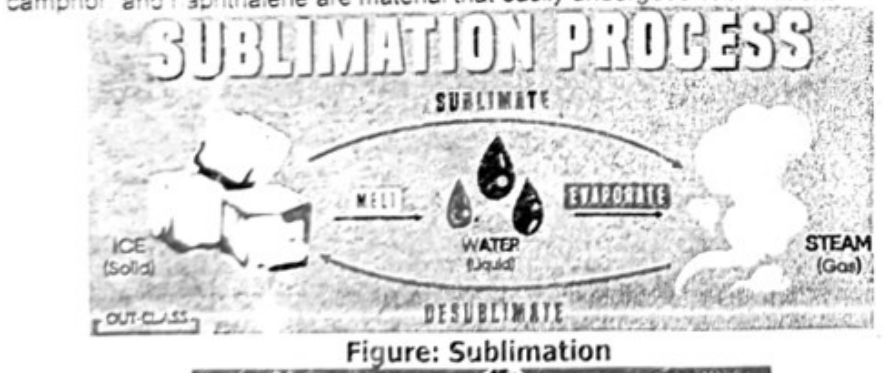
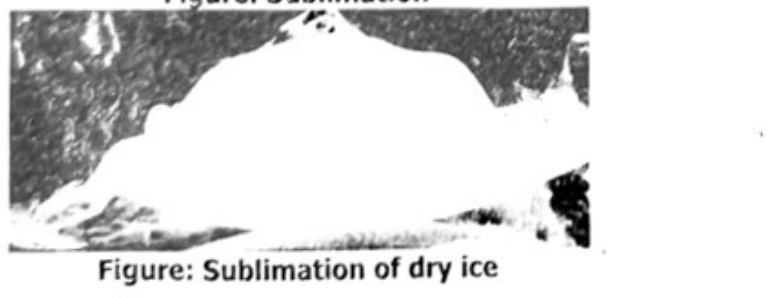
Sublimation is the process in which molecules of a substance in the solid state go to the vapor state directly, without going through the liquid state. According to the kinetic molecular theory, we know that molecules are in constant random motion, even when the substance is below the melting point. We also know that the average speed of the molecules (kinetic energy) is directly proportional to the absolute temperature.
If the molecules are below the melting point and are kept in the solid state by relatively weak intermolecular forces (compared to the strength of the covalent bonds within the molecule), then sometimes a molecule will have enough energy to break these intermolecular bonds and go into the vapour state.
Example:
There are many substances that undergo sublimation. Carbon dioxide, camphor and naphthalene are material that easily undergoes sublimation.
Application of Sublimation in our life
- The solid air fresheners we often use in our cars and homes rely solely on the magic of sublimation. The solid fragrance within slowly transforms into a delightful vapour, filling the entire space with an enticing aroma that lingers in the air.
- In the textile industry 3D printing uses a sublimation process. Dye sublimation printers are now widely used for the printing process for a reduced cost. Dye sublimation is used to print a variety of objects such as T-shirts, pens, coffee mugs, and bags.
- In the food industry, freeze-drying food items for preservation for a longer duration is due to the process of sublimation.
Simple examples of deposition in daily life.
- The formation process of snow from water vapour.
- Black Soot inside a Vehicle Exhaust.
- The Making Process of Dry Ice Using Carbon Dioxide.
The concentration gradient is the difference in concentration between two regions. In the case of medicine in the body, a higher concentration of the medicine in one area (like the stomach or bloodstream) compared to another area leads to faster diffusion. A larger concentration gradient causes molecules to move more rapidly from high to low concentration, allowing the medicine to spread quickly throughout the body.
The molecular size of a medicine affects its ability to diffuse through cell membranes. Smaller molecules diffuse more easily and rapidly across membranes because they experience less resistance. Larger molecules, due to their greater size, have more difficulty diffusing through cell membranes, leading to slower rates of absorption and distribution in the body.
Temperature affects the kinetic energy of molecules. As the temperature increases, the molecules of both the medicine and the body's cells move faster. This increased movement enhances the rate at which the medicine molecules diffuse across cell membranes and spread through the body. A higher body temperature, such as during a fever, can therefore accelerate the diffusion of medicines.
The surface area of the lungs, particularly the alveoli, is large and provides more space for gases and medicines to diffuse. This large surface area facilitates a faster and more efficient diffusion of inhaled medicines into the bloodstream. The more area available for diffusion, the quicker the medicine reaches the circulatory system and begins to take effect.
The rate of diffusion is crucial in intravenous painkillers because the faster the medicine diffuses into the bloodstream, the quicker it can reach the site of pain. Since intravenous injection bypasses the digestive system and goes directly into the blood, the medicine quickly spreads throughout the body, leading to rapid pain relief. A faster diffusion rate ensures immediate therapeutic effects.
Controlled release medications are designed to diffuse slowly over time. By controlling the diffusion rate, these medicines provide a steady and sustained release of active ingredients into the bloodstream. This ensures that the medication maintains a consistent therapeutic effect over a longer period, reducing the need for frequent doses and improving patient compliance and comfort.
Importance of diffusion rates in medicines:
Kinetic particle theory is one of the most important theories for understanding drug distribution rates in the human body. When you take a drug, whether it's taken by mouth or injected, it needs to diffuse from the injection site into your bloodstream. The diffusion rate determines how quickly a drug reaches its target area in your body. Drug molecules need to spread through different tissues and organs to reach your body's cells where they do their work. Higher levels of diffusion usually mean your drug will work faster.
For example, a fast-acting drug like a pain relievers needs to dissolve quickly to provide immediate pain relief. Kinetic particles theory explains that drug diffusion rates are affected by a concentration gradient between your drug and your surrounding tissues. If your drug is at a high concentration at the time of administration, and your surrounding tissues are at a low concentration, then your drug diffusion rate will be faster.
The rate of diffusion also depends on the composition of the drug (e.g. liquid, gel, tablet). Generally, liquid drugs move more quickly than solid drugs, as their particles have already dispersed. Controlled-release formulations are used to control the rate of drug diffusion so that the therapeutic effect remains consistent over time.
KEY POINTS
- Solids, liquids and gases change state when they are heated or cooled.
- A state change (or phase transition) is the transition of matter from one state of matter to another.
- A heating curve typically shows temperature change over time as a substance is heated.
- The temperature remains constant as the solid melts into a liquid.
- The temperature remains constant as the liquid changes into a gas.
- The temperature remains constant as the gas condenses into a liquid.
- Evaporation is the process by which molecules at the surface of a liquid gain enough kinetic energy to escape into the gaseous phase.
- Boiling is the process in which a liquid turns into vapor when it is heated to its boiling point.
- Boyle's Law: It states that for a fixed amount of gas at a constant temperature, the volume of a gas is inversely proportional to its pressure.
- Charles's Law: It states that for a fixed amount of gas at constant pressure, the volume of a gas is directly proportional to its absolute temperature.
- Avogadro's Law: It states that for a gas at constant temperature and pressure, the volume of the gas is directly proportional to the number of moles of gas.
- Graham's law of diffusion: The rate of diffusion is inversely proportional to the square root of the molar mass of the gas particles.
- Sublimation is the process in which molecules of a substance in the solid state go to the vapor state directly, without going through the liquid state.