
Short Questions:
Pakistan's trade routes are of significant importance in the context of international trade due to several reasons:
Geographical Location:
Pakistan serves as a crucial bridge between South Asia, Central Asia, the Middle East, and China, making it a key transit route for trade between these regions.
Access to Seaports:
Pakistan's strategic location along the Arabian Sea provides access to important seaports such as Karachi Port and Gwadar Port, facilitating maritime trade with countries in the Indian Ocean region and beyond.
Trade Corridors:
Pakistan is part of several major trade corridors, including the China-Pakistan Economic Corridor (CPEC), which enhances connectivity and trade between China, Pakistan, and other countries in the region.
Transit Trade:
Pakistan's land routes serve as vital transit corridors for landlocked countries such as Afghanistan and Central Asian nations, providing them with access to seaports and global markets.
Economic Integration:
Pakistan's trade routes promote economic integration and cooperation among neighboring countries, fostering regional trade agreements and initiatives aimed at boosting trade and investment.
Topography is a detailed map of the surface features of land. It includes the mountains, hills, creeks, and other bumps and lumps on a particular hunk of earth.
For example, topographic maps often tie in administrative boundaries, cities, hydrography, parks, landmarks, transportation, and buildings.
Main Features of Topography:
- Mountains and hills
- Valleys and plains
- Rivers and streams
- Land elevation and slopes
Dry Ports:
Inland ports or terminals are known as dry ports.
In Pakistan's urban areas, they are essential for the transportation of goods for export. These facilities are given in key areas of the country. Highways, railroads, and even airplanes are some of the modes of transportation that connect dry ports to seaports. They enhance the efficiency of the export process and reduce dependency on traditional seaports.
Names of some dry ports of Pakistan:
- Lahore Dry Port
- Rawalpindi Dry Port
- Peshawar Dry Port
- Sialkot Dry Port
- Quetta Dry Port
Role of Dry Ports in Reducing Dependence on Sea Ports:
Inland Cargo Handling:
Dry ports provide inland facilities for loading, unloading and storage of goods, reducing pressure on coastal ports.
Customs Clearance:
They provide customs clearance facilities inland, allowing goods to be processed before reaching or after leaving sea ports.
Reduce Congestion:
Dry ports help reduce congestion and delays at conventional sea ports by handling cargo away from the coast.
Multimodal Transportation:
They connect road and railway networks with sea ports, making the movement of goods faster and more efficient.
Expand Trade Connectivity:
Dry ports provide trade facilities to landlocked and inland regions, increasing accessibility to international markets and reducing reliance on coastal locations.
CPEC stands for China-Pakistan Economic Corridor. It is a major economic and infrastructure project connecting Pakistan and China, including roads, railways, energy projects and Gwadar Port.
Air Transport Considered the Most Expensive:
High Fuel Costs:
Aircraft consume large amounts of aviation fuel, which makes air transport expensive.
High Maintenance Costs:
Aircraft require regular inspection, maintenance, and repairs to ensure safety.
Expensive Infrastructure:
Airports, runways, navigation systems, and air traffic control require large investments.
Security Costs:
Strict security checks and safety measures increase operating expenses.
Skilled Labour:
Air transport requires highly trained pilots, engineers, air traffic controllers, and other staff, resulting in higher labour costs.
Limited Carrying Capacity:
Aircraft generally carry less bulky cargo than ships and trains, making the cost per unit of goods higher.
Ways to Increase Pakistan’s Share in International Trade:
Improve Trade Infrastructure:
Invest in upgrading ports, roads, and customs facilities to enhance trade efficiency and reduce transit times.
Diversify Export Base:
Promote diversification of exports by developing new industries and products to cater to a wider range of international markets.
Trade Agreements:
Negotiate and implement trade agreements with key trading partners to reduce tariffs, streamline customs procedures, and facilitate market access.
Enhance Trade Facilitation:
Simplify trade procedures, reduce bureaucratic hurdles, and invest in technology to streamline customs clearance and logistics processes.
Market Access:
Increase market access by participating in trade fairs, conducting marketing campaigns, and leveraging digital platforms to showcase Pakistani products to international buyers.
Long Questions:
Advantages and Disadvantages of Different Modes of Transportation:
Every nation's infrastructure must include transportation as it affects economic growth, accessibility, and general quality of life. In Pakistan, both goods and people are transported by using a variety of transport methods. Each mode has advantages and problems of its own. We'll contrast and analyze different modes in this section based on things like speed, price, dependability, and environmental impact.
i. Road Transport:
Advantages:
Speed:
Since most areas of Pakistan can be reached by road, small distances can be traveled by road quite quickly.
Cost:
Compared to other infrastructure, the building and maintaining of roads is less expensive.
Flexibility:
Road transportation is appropriate for both urban and rural areas because it can reach distant locations.
Reliability:
Road transportation is often dependable for short-distance and local travel.
Disadvantages:
Traffic jamming:
Major cities like Karachi and Lahore see heavy traffic, which causes delays.
Safety:
Poor road conditions and high accident rates, especially in mountainous areas, can be risky.
Pollution:
Road traffic contributes to pollution and road degradation, which has an effect on the environment.
ii. Rail Transportation:
Advantages:
Speed:
Trains are more suitable for large distances, especially for huge cargo.
Cost:
For long distances and huge volumes of cargo, rail transportation is the most economical option.
Efficiency:
It uses less energy and has a lower environmental effect.
Disadvantages:
Reliability:
Because of Pakistan's old rail infrastructure and poor maintenance, delays are common.
Limited Connectivity:
Basically, rail networks connect big cities and ignore the rural areas.
Passenger Services:
Due to reduced speeds and old-fashioned infrastructure, passenger trains are less popular.
iii. Air Travel:
Advantages:
Speed:
Air travel is the quickest option to link with remote areas of Pakistan. Airports in major cities like Islamabad, Lahore, and Karachi are well connected.
Reliability:
In terms of schedules, flights are typically dependable.
Disadvantages:
Price:
Air travel can be costly, which limits its accessibility for many individuals.
Limited Cargo:
Since air transportation is expensive, it is typically reserved for expensive and urgent commodities.
Environmental Impact:
Aviation discharges play a significant role in the production of greenhouse gases.
iv. Water Transportation:
Advantages:
Cost:
For international trade, water transport via ports like Karachi and Gwadar can be economical.
Bulk Goods:
Especially, goods in huge quantity can be import and export by water transportation.
iii. Low Environmental Impact:
Compared to other modes, ships have a lower carbon impact on environment.
Disadvantages:
Speed:
When it comes to inland travel, water transport is slower than other options.
Limited Reach:
Access to some areas is hampered by Pakistan's underdeveloped interior waterways.
Infrastructure:
Ports and waterways need a lot of repair and investment.
Environmental Effect:
Due to emissions of greenhouse gases and pollutants, road and air transportation tend to have higher environmental impacts rather than rail and water transport, which have lower emissions and generally are considered more environmentally friendly.
In Pakistan, the choice of transportation mode depends on different factors such as the needs of passengers, distance, accessibility and environmental concerns. Each mode has its positive and negative impacts.
OR (Second Answer)
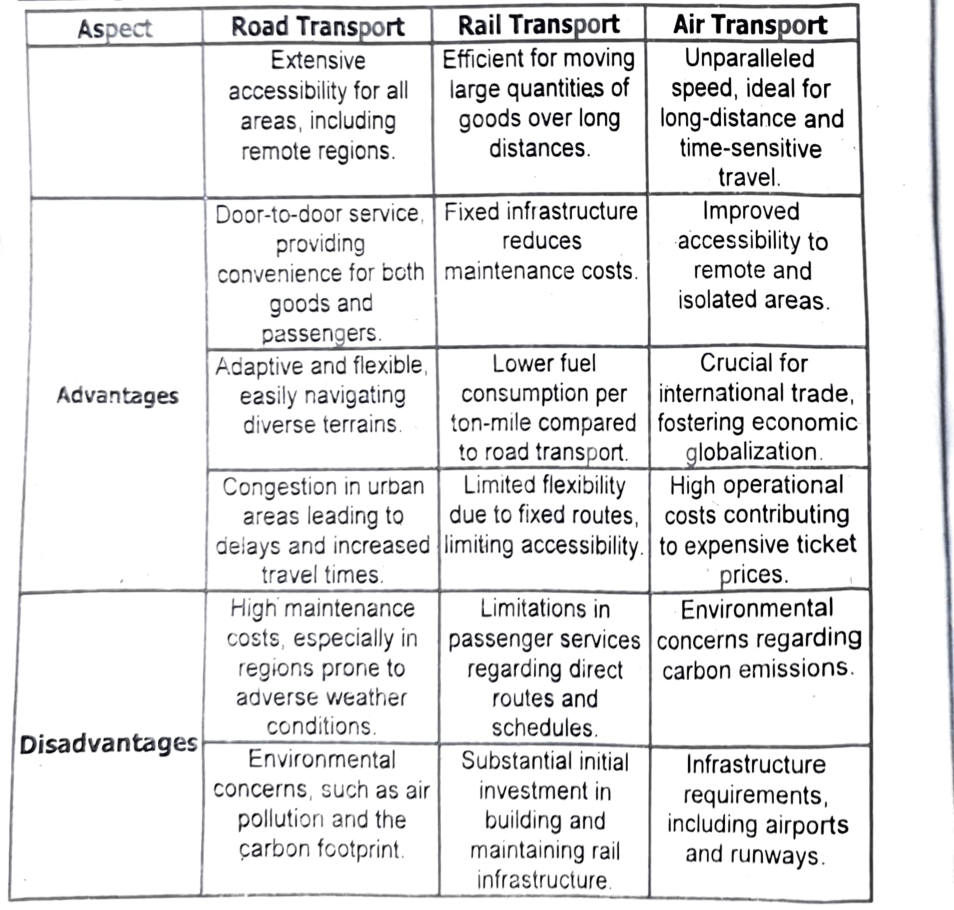
Advantages and Disadvantages of Different Modes of Transportation:
| Aspect | Road Transport | Rail Transport | Air Transport |
|---|---|---|---|
| Advantages | Extensive accessibility for all areas, including remote regions. | Efficient for moving large quantities of goods over long distances. | Unparalleled speed, ideal for long-distance and time-sensitive travel. |
| Door-to-door service, providing convenience for both goods and passengers. | Fixed infrastructure reduces maintenance costs. | Improved accessibility to remote and isolated areas. | |
| Adaptive and flexible, easily navigating diverse terrains. | Lower fuel consumption per ton-mile compared to road transport. | Crucial for international trade, fostering economic globalization. | |
| Disadvantages | Congestion in urban areas leading to delays and increased travel times. | Limited flexibility due to fixed routes, limiting accessibility. | High operational costs contributing to expensive ticket prices. |
| High maintenance costs, especially in regions prone to adverse weather conditions. | Limitations in passenger services regarding direct routes and schedules. | Environmental concerns regarding carbon emissions. | |
| Environmental concerns, such as air pollution and the carbon footprint. | Substantial initial investment in building and maintaining rail infrastructure. | Infrastructure requirements, including airports and runways. |
Importance of dry ports in trade:
Reduced Traffic:
Major traffic jams are common in Pakistan's urban areas. They can delay the transportation of goods to and from seaports. Dry ports help in reducing road blocking and pollution both by diverting a large amount of traffic away from urban areas.
Savings:
By using dry ports, we can significantly reduce the cost of delivering goods to seaports. Long-distance trucking, which transports commodities from a point to the seaport, saves both time and money. In global market, businesses are trying to save transportation expenses. China's Belt and Road Initiative is an ample example of it.
Better Logistics:
Dry ports serve as logistical centers by providing locations for the distribution and storage of goods. This helps exporters manage their supply chains efficiently by streamlining cargo transportation.
Accessibility:
Dry ports are placed in close to the cities which are considered production and industrial hubs. So, it becomes quick and easy for exporters and manufacturers to reach there. As a result, businesses can rapidly deliver their goods to the dry port where they can be prepared for shipment. Travel time is reduced, and the overall effectiveness of the supply chain is increased.
Customs clearance and paperwork:
Dry ports frequently include customs facilities, which helps hasten the export clearance process. When customs officials are present, any issues may be handled quickly. It helps to reduce delays and assures simpler exports.
Economic Development:
The construction of dry ports in urban areas can stimulate economic growth by growing new businesses, creating job opportunities, and promoting trade. These locations can serve as a center for value-added services like packing, labeling, and quality control.
Having customs officials on-site can help resolve any issues quickly. It helps not only in reducing delays but ensuring smoother exports also.
Reduced Dependence on Seaports:
Pakistan's significant dependence on seaports has frequently caused blockages and delays in international trade. Dry ports assist in reducing this dependence.
Security and safety:
Better safety measures are often used at dry ports. These measures lower the danger of cargo damage and theft. This is especially crucial for expensive or delicate goods.
Role of trade in Pakistan's trade economy:
Trade plays a significant role in Pakistan's economy, contributing to economic growth, employment generation, poverty reduction, and foreign exchange earnings:
Contribution to GDP:
Trade, both exports, and imports, accounts for a substantial portion of Pakistan's Gross Domestic Product (GDP). The combined value of exports and imports represents a significant share of the country's economic output.
Foreign Exchange Earnings:
Exports generate foreign exchange earnings for Pakistan, which are crucial for financing imports, servicing external debt, and maintaining currency stability. Key export sectors include textiles, garments, leather products, rice, fruits, and seafood.
Employment Generation:
The trade sector provides employment opportunities to a large segment of the population, including exporters, importers, traders, transporters, customs agents, and workers in related industries such as manufacturing and logistics.
Industrial Development:
Trade stimulates industrial development by providing access to international markets for Pakistani goods and raw materials. Export-oriented industries such as textiles, garments, and leather products contribute significantly to industrial output and employment.
Market Access:
Trade agreements and preferential trade arrangements with various countries provide market access for Pakistani products, enhancing export opportunities and competitiveness. Bilateral and multilateral trade agreements help to reduce tariffs, eliminate trade barriers, and facilitate cross-border trade.
Revenue Generation:
Trade-related taxes and duties, including customs duties, sales tax, and excise duties, contribute to government revenue. Customs duties on imports are a significant source of revenue for the government and are used to finance public expenditure on infrastructure, social services, and development programs.
Balance of Payments:
The balance of trade, which measures the difference between exports and imports, impacts Pakistan's balance of payments. A trade surplus (exports > imports) results in a positive balance of payments, while a trade deficit (imports > exports) leads to a negative balance of payments, requiring foreign exchange reserves to finance the gap.
Foreign Direct Investment (FDI):
A conducive trade environment attracts foreign investment in Pakistan, particularly in export-oriented sectors. Foreign investors are attracted to Pakistan's large consumer market, skilled labor force, and strategic location as a gateway to regional markets.
Economic Growth:
Trade contributes to economic growth by promoting specialization, efficiency, and productivity gains. Increased trade leads to economies of scale, technological transfer, and enhanced competitiveness, driving overall economic expansion and development.
Importance of Pakistan’s Trade Routes:
Gwadar Port:
Gwadar Port is located on the Arabian Sea at an important position near major international shipping routes. It provides a potential trade gateway for China, Afghanistan and the landlocked countries of Central Asia. It is an important component of CPEC and can promote regional trade, transit activities and investment in Pakistan.
Karachi Port:
Karachi Port is one of Pakistan’s major seaports and handles a significant share of the country’s international trade. It facilitates the import and export of goods such as machinery, petroleum products, food items and manufactured goods. Its connection with road and railway networks makes it an important centre of trade and commerce.
Regional Connectivity:
Pakistan’s trade routes connect the country with South Asia, Central Asia, China and the Middle East. This geographical position allows Pakistan to act as a transit route for the movement of goods between neighbouring regions.
Promotion of Trade and Industry:
Efficient trade routes and ports reduce transportation time and costs, making imports and exports easier. They also support industries by providing better access to raw materials and international markets.
Foreign Exchange and Economic Growth:
International trade through Gwadar and Karachi ports helps Pakistan earn foreign exchange, creates employment and encourages investment. Consequently, these trade routes contribute to economic growth and strengthen Pakistan’s position in international trade.
Some Sustainable Solutions for increasing Trade in Pakistan:
Developing countries are frequently facing internal challenges when it comes to increasing their share in international. So, Pakistan is also facing a variety of domestic problems. These difficulties may have several sides and be connected to one another. They need long-term remedies that deal with the root causes. The following is an analysis of several internal issues and possible solutions:
Infrastructure shortcomings:
Obstacle:
Poor energy, logistics, and transportation infrastructure can make trade more expensive and time-consuming.
Solution:
Invest in infrastructure development through public-private partnerships, encourage foreign direct investment (FDI) in infrastructure projects, and improve maintenance and administration of existing assets.
Administrative Red Tape:
Obstacle:
Difficult and dragging bureaucratic procedures, such as regulatory and customs hurdles, can suppress trade and raise the cost of conducting business.
Solution:
It is important to cut back on pointless rules to promote trade. Ensure to make open and effective customs rules.
Weak Institutions for Trade Facilitation and Promotion:
Obstacle:
Trade Facilitation Centers may have limited abilities so efforts to promote exports and expand markets may be hindered.
Solution:
It is important to strengthen Trade Facilitation Center and train their staff members.
Develop a thorough export marketing plan. Implement strategies to aid trade finance.
Training and Competencies Challenge:
Challenge:
A nation's capacity to engage in global trade can be limited by a shortage of skilled workforce and low levels of education.
Solution:
Investment requires in educational and vocational training programs so that skilled workers can be prepared. These programs should be matched to the demands of the labor market and new sectors.
Terrible Regulatory Framework:
Challenge:
Poorly applied regulations might discourage international investment and trade.
Solution:
Implementation of the rules is important to establish a business-friendly climate. By improving enforcement of regulations, international norms and agreements can be followed properly.
Access to affordable loans:
Challenge:
Financing is a big challenge that can limit the expansion of businesses, particularly small and medium-sized enterprises.
Solution:
Create and extend the loans limits for small and middle businesses, promote the growth of microfinance organizations.
Political and Policy Stability:
Challenge:
Constant political instability and policy changes can reduce investor confidence and cause trade disruptions.
Solution:
Encourage political stability by implementing comprehensive policymaking and democratic governance. Create long-term economic plans that are independent of political cycles.
Corruption and Transparency:
Challenge:
Corruption can make it more expensive to conduct business and can tilt the playing field.
Solution:
Anti-corruption measures should be strengthened, openness should be improved, and good governance should be promoted. Reduce corruption by putting technology-driven solutions.
Access to Technology and Creativity:
Challenge:
Lack of originality and restricted access to technology might make it difficult to be competitive
Solution:
Promote technology transfer through collaborations with developed nations and international organizations, invest in research and development, and encourage creativity through financial incentives.
OR (Second Answer)
Increasing international trade for Pakistan involves a multifaceted approach that addresses various economic, infrastructural, and policy challenges. Here are some suggestions:
Diversification of Exports:
Pakistan heavily relies on a few key exports like textiles and agriculture. Diversifying export products can help in tapping into new markets and reducing dependence on specific sectors. Encouraging industries like IT, pharmaceuticals, and engineering goods can be beneficial.
Trade Agreements and Partnerships:
Pakistan should actively pursue bilateral and multilateral trade agreements with other countries and regional blocs. This can reduce trade barriers, enhance market access, and promote trade facilitation. Strengthening ties with emerging economies like China, India, and ASEAN nations can be particularly advantageous.
Improving Trade Infrastructure:
Enhancing ports, roads, and logistics infrastructure is crucial for facilitating trade. Investments in ports such as Gwadar can improve connectivity with Central Asia and the Middle East. Efficient customs procedures and streamlined trade processes can reduce transaction costs and enhance competitiveness.
Trade Facilitation and Ease of Doing Business:
Simplifying trade procedures, reducing bureaucratic hurdles, and enhancing
Investment in Human Capital and Technology:
Investing in education and skill development programs can enhance the workforce's productivity and competitiveness. Embracing technological advancements like digital platforms for trade documentation, e-commerce platforms, and automation in manufacturing processes can boost efficiency and quality.
Promotion of SMEs and Entrepreneurship:
Supporting small and medium-sized enterprises (SMEs) and fostering entrepreneurship can spur innovation and economic growth. Providing access to finance, technical assistance, and market linkages can empower SMEs to participate more actively in international trade.
Quality Standards and Certifications:
Ensuring compliance with international quality standards and certifications is essential for accessing global markets. Investing in quality assurance infrastructure, providing training on compliance requirements, and promoting a culture of quality consciousness among producers can enhance product competitiveness.
Focus on Services Sector:
While goods trade is essential, Pakistan can also leverage its services sector, including IT services, tourism, and healthcare, to increase exports. Developing specialized skills, promoting tourism destinations, and improving healthcare infrastructure can attract foreign exchange through services exports.
Strengthening Institutional Framework:
Establishing dedicated trade promotion agencies, enhancing coordination between relevant government departments, and providing policy support and incentives for exporters can create an enabling environment for international trade.
Political Stability and Regional Peace:
Political stability and peaceful relations with neighboring countries are crucial for fostering an environment conducive to trade and investment. Resolving regional conflicts and enhancing diplomatic ties can create opportunities for cross-border trade and economic cooperation.
Implementing these suggestions requires concerted efforts from the government, private sector, and other stakeholders. A comprehensive and coordinated strategy addressing these aspects can significantly enhance Pakistan's international trade performance and contribute to sustainable economic development.