
Modes of Transportation in Pakistan:
Transportation is essential for the movement of people, goods, raw materials, and services. The transport network of Pakistan varies from region to region because of differences in topography, population, and economic activity.
- Road Transportation:
Road transport is the most widely used mode of transportation in Pakistan.
Purpose:
- Transport passengers and goods.
- Connect villages, towns, and cities.
- Carry agricultural products to markets.
- Support trade and industries.
Distribution:
Road networks are densest in the Punjab and Sindh plains because of their flat terrain, high population, and intensive agriculture. They are less developed in the mountainous areas of northern Pakistan and Balochistan because of rugged terrain and low population density.
- Railway Transportation:
Railways are mainly used for long-distance movement of passengers and heavy goods.
Purpose:
- Transport agricultural and industrial goods.
- Connect major cities and commercial centres.
- Provide relatively inexpensive long-distance travel.
Distribution:
The railway network is concentrated mainly in the Indus Plain, particularly Punjab and Sindh, where the flat terrain, large population, agriculture, and industries provide greater demand. Mountainous and sparsely populated regions have fewer railway connections.
- Air Transportation:
Air transport is mainly used for fast movement of passengers and high-value or time-sensitive goods over long distances.
Purpose:
- Domestic and international passenger travel.
- Transport urgent and high-value goods.
- Connect remote regions with major cities.
- Support tourism and international business.
Distribution:
Major airports are located near large cities and economic centres such as Karachi, Lahore, Islamabad, Peshawar, and Quetta. Air transport is particularly useful for mountainous and remote regions where road and rail connections are difficult.
Regional Differences:
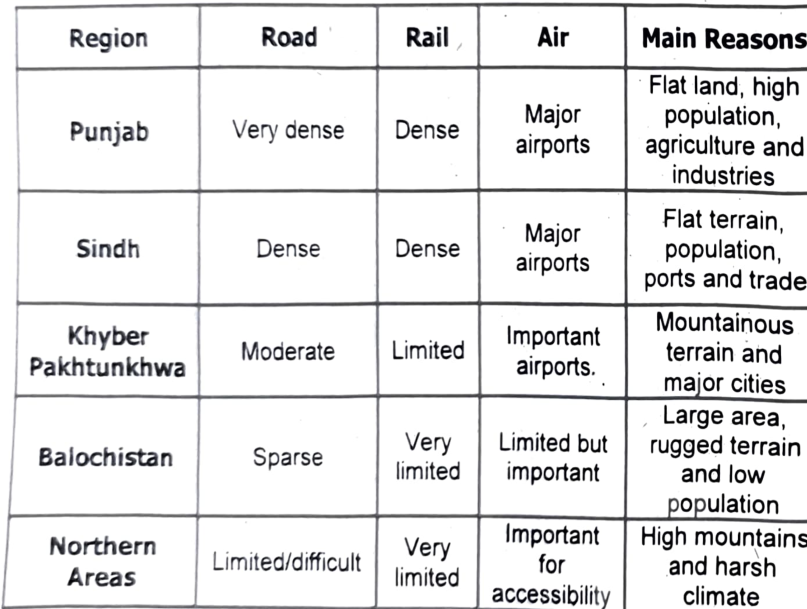
Region Road Rail Air Main Reasons Punjab Very dense Dense Major airports Flat land, high population, agriculture and industries Sindh Dense Dense Major airports Flat terrain, population, ports and trade Khyber Pakhtunkhwa Moderate Limited Important airports Mountainous terrain and major cities Balochistan Sparse Very limited Limited but important Large area, rugged terrain and low population Northern Areas Limited/difficult Very limited Important for accessibility High mountains and harsh climate
Factors Affecting Transport Distribution:
- Topography: Flat plains allow roads and railways to be built more easily, while mountains increase construction costs and make routes difficult.
- Population: Densely populated areas require more transport services because of greater demand for travel and movement of goods.
- Economic Activity: Agricultural, industrial, commercial, and port areas require well-developed transport networks to move products and raw materials.
Pakistan’s transport system includes roads, railways, and airways, each serving different purposes. The networks are most concentrated in the populated and economically active plains of Punjab and Sindh, while mountainous and sparsely populated areas have fewer connections. Topography, population density, and economic activity are therefore major factors controlling the distribution and arrangement of transportation networks.
There are four main modes of transportation in Pakistan:
- Road Transportation
- Rail Transportation
- Air Transportation
- Water Transportation
Transportation in Pakistan can be categorized into a number of modes. It can be included air travel, rail travel, and road travel. All kind of transportation has many purposes.
- Road Transportation:
- Purpose:
In Pakistan, intercity travel and the movement of cargo by road are the two purposes of this transportation that are most frequently used.
- Regional Differences:
- Northern Areas:
In mountainous areas like Gilgit-Baltistan and Khyber Pakhtunkhwa, road networks are primarily built to connect remote areas and tourism destinations.
- Urban areas:
Densely populated urban areas like Karachi, Lahore, and Islamabad have extensive road networks to handle the huge volume of traffic.
- Rural areas:
Connectivity might be challenging in rural areas with less developed roads.
- Northern Areas:
- Purpose:
- Transportation by Rail:
- Purpose:
The main purposes of rail transportation in Pakistan are long-distance passenger travel and goods transportation. It includes coal, cement, and agricultural products.
- Regional Differences:
- Main Trunk Lines:
By connecting significant cities like Peshawar, Lahore, Rawalpindi, and Karachi, these lines facilitate trade between these areas.
- Hilly Areas:
In remote and steep areas, rail networks are less extensive due to topographical challenges.
- Main Trunk Lines:
- Purpose:
- Air Transportation:
- Purpose:
Air travel is mostly used for long-distance travel and international connections. It makes it easier for the transfer of both passengers and cargo.
- Regional Differences:
- Important Airports:
Important cities like Karachi, Lahore, and Islamabad are home to significant international airports that provide travel locally and internationally.
- Important Airports:
- Purpose:
- Regional Airports:
In cities like Quetta, Peshawar, Sialkot, and Faisalabad, there are smaller regional airports that facilitate domestic flights and regional connectivity.
- Water Transportation:
- Purpose:
Water transportation in Pakistan primarily facilitates trade and cargo movement. Ports like Karachi and Gwadar are vital in handling international imports and exports. These ports contribute significantly to the country's economy, support the fishing industry, and provide shipping facilities for goods like oil, machinery, and agricultural products.
- Regional Differences:
- Ports:
Regionally, Karachi, as the largest port city, accommodates the majority of sea trade, while Gwadar is emerging as a hub under the China-Pakistan Economic Corridor (CPEC).
- Coastal Regions:
Coastal regions in Sindh and Balochistan benefit from access to water transport, whereas inland areas rely more on other transportation modes due to limited waterways. The development of regional ports in areas like Pasni and Ormara could enhance connectivity and trade opportunities in the future.
- Ports:
- Purpose:
Factors Affecting Regional Variations:
- Topography:
Northern mountainous areas make it difficult to expand the road and rail networks. It leads to limited connectivity in these areas.
- In Coastal areas:
Connectivity is far better due to their generally flat topography and support for road and rail networks.
- Population Distribution:
Densely populated cities need extensive road systems in order to manage traffic. Due to lower population density in rural areas they have fewer transit options.
- Economic Activity:
In the cities like Karachi, Lahore, Faisalabad and Sialkot which are considered major industrial and economic hubs of Pakistan, well-developed transit networks encourage their trade and commerce. They get great benefits from it. Agricultural regions rely on road and rail networks for the movement of goods and crops.
- Government Policies:
Rules and Regulations with the government's spending influence the creation of transportation infrastructure. In some areas, the connectivity of roads and rail has improved because of the China-Pakistan Economic Corridor (CPEC).
Advantages and Disadvantages of Different Transport Modes in Pakistan:
Pakistan uses roads, railways, airways, and waterways to transport people and goods. Each mode has different advantages and disadvantages in terms of speed, cost, reliability, and environmental impact.
- Road Transport:
Advantages:
- Provides door-to-door transportation.
- Suitable for both passengers and goods.
- Flexible routes and destinations.
- Useful for short and medium distances.
- Easily connects villages with towns and cities.
Disadvantages:
- Traffic congestion can cause delays.
- Fuel costs can be high.
- Road accidents are a risk.
- Produces air pollution and greenhouse gases.
- Heavy goods vehicles can damage roads.
- Railway Transport:
Advantages:
- Suitable for transporting large quantities of goods and passengers.
- Generally cheaper than air transport for long distances.
- More fuel-efficient than road transport for bulk goods.
- Produces relatively lower emissions per passenger or tonne of goods.
Disadvantages:
- Routes are fixed and cannot provide door-to-door service.
- Requires expensive infrastructure and maintenance.
- Delays can occur because of damaged tracks or operational problems.
- Railway coverage is limited in some regions of Pakistan.
iii. Air Transport:
Advantages:
- The fastest mode of transportation.
- Very useful for long-distance passenger travel.
- Connects remote areas and international destinations.
- Suitable for urgent and high-value goods.
Disadvantages:
- Very expensive compared with road and rail.
- Limited capacity for heavy and bulky goods.
- Flights may be affected by bad weather.
- Produces relatively high carbon emissions per passenger or unit of freight.
iv. Water Transport:
Advantages:
- Can transport large quantities of heavy and bulky goods.
- Relatively low transportation cost for bulk cargo.
- More fuel-efficient for large-scale freight movement.
- Important for international trade through Pakistan’s seaports.
Disadvantages:
- Slower than road, rail, and air transport.
- Limited to areas with suitable waterways or ports.
- Loading and unloading can take considerable time.
- Marine transport can contribute to water pollution and environmental damage.
Role of Trade in Pakistan's Economy:
Trade is an important part of Pakistan's economy. It involves the exchange of goods and services within the country and with other countries. International trade provides Pakistan with foreign markets, investment opportunities, and access to goods that are not sufficiently produced domestically.
- Access to Global Markets:
International trade allows Pakistani businesses to sell products in international markets. Major exports include textiles, rice, leather products, sports goods, surgical instruments, and agricultural products.
- Foreign Exchange Earnings:
Exports generate foreign exchange, which Pakistan uses to pay for imports such as oil, machinery, chemicals, technology, and industrial raw materials.
- Increased Competitiveness:
International competition encourages Pakistani industries to improve product quality, efficiency, technology, and productivity. This can make local businesses more competitive in global markets.
- Employment Opportunities:
Trade creates jobs in manufacturing, agriculture, transport, banking, shipping, logistics, retail, and export-related industries.
- Industrial Development:
Demand for exports encourages the growth of industries such as textiles, food processing, leather, sports goods, and surgical instruments. Imports of machinery and technology can also help industries modernize.
- Access to Goods and Technology:
Imports provide consumers and industries with products that may be unavailable or expensive to produce locally. Imported machinery, technology, raw materials, and energy resources can support economic development.
- Regional and International Links:
Trade strengthens Pakistan’s economic relationships with countries in Asia, the Middle East, Europe, and other regions. Improved trade links can encourage investment and regional connectivity.
- Challenges of Trade:
Pakistan can face problems when imports are much greater than exports, creating a trade deficit. Dependence on imported energy and raw materials can also increase pressure on foreign exchange reserves.
Trade contributes to Pakistan’s economy by providing access to global markets, foreign exchange, employment, industrial growth, technology, and increased competitiveness. Improving export quality, diversifying products and markets, and developing efficient transport and trade infrastructure can increase the benefits of international trade.
Trade:
An action of buying and selling of goods and services is called trade. Trade is necessary to Pakistan's economy. It offers a variety of advantages. Here, we'll examine how trade affects Pakistan's economy.
Economic Development and Growth:
Trade is making a huge economic contribution to Pakistan. A significant amount of the nation's GDP is made up of exports and imports of commodities and services. Pakistan can contact to a larger client base through international trade and can promote its economic growth through greater output and consumption.
- Export expansion:
Trade assists Pakistan to expand its exports beyond agriculture and textiles. Trade reduces dependence on a limited number of products and helps to alleviate the risks.
- Competitiveness:
Participation in international trade increases the competitiveness of Pakistani industries. Businesses must increase their productivity and quality if they want to succeed in international markets. Better productivity, innovation, and cost-effectiveness can result from increased competitiveness.
- Access to Technology and Skills:
Trade exposes Pakistani businesses to foreign best practices and innovations. Importing machinery and other high-tech commodities can raise domestic productivity. Knowledge transfer and skill development can be facilitated by collaboration with overseas partners.
- Foreign Exchange:
Exports produce foreign exchange profits, which Pakistan needs in order to pay its debts abroad and keep the rupee stable. Pakistan's economic stability depends on a strong foreign exchange market and a stable currency.
- Job Creation:
Trade-related activities generate employment across a range of industries, including marketing, banking, and manufacturing. This may lessen poverty and unemployment.
- Availability of raw materials:
It is crucial to access the raw materials and ideas through trade, which may not be affordable or available locally. It is essential for maintaining sectors like textiles and manufacturing.
- Access to the world market:
Pakistan receives special access to international markets through trade agreements and membership in organizations like the World Trade Organization (WTO). These agreements can lower trade obstacles and tariffs and increasing the competitiveness of Pakistani goods in foreign markets.
- Consumer Welfare and Choice:
Consumers in Pakistan have access to a greater range of goods through international trade, which raises their level of living. More competition can result in higher-quality goods with lower pricing.
- Financial Stability:
Trade can promote economic stability by attracting foreign investment, encouraging savings and investment in the economy. It also helps in expanding revenue streams to reduce dependence on a particular industry or market.
Pakistan’s Trade Routes and International Trade:
Pakistan has a strategically important location between China, Central Asia, and the Middle East. Its ports and trade corridors provide routes for the movement of goods and can strengthen Pakistan’s role in regional and global trade.
- Gwadar Port:
Gwadar Port is located on the Arabian Sea in Balochistan. Its position provides access to important sea routes and can facilitate trade between China, Pakistan, the Middle East, and Central Asia.
Importance:
- Provides a deep-sea port for international trade.
- Can reduce transportation distances for some regional trade.
- Creates opportunities for shipping, logistics, industry, and investment.
- Supports the development of Balochistan.
- China-Pakistan Economic Corridor (CPEC):
CPEC connects China’s western region with Pakistan through roads, railways, pipelines, and other infrastructure.
Importance:
- Improves connectivity between China and the Arabian Sea.
- Supports trade and investment.
- Develops transport and energy infrastructure.
- Creates employment and industrial opportunities.
- Can strengthen Pakistan’s position as a regional trade and transit hub.
- Karachi Port:
Karachi Port is one of Pakistan’s major international ports and handles a large volume of imports and exports.
Importance:
- Connects Pakistan with Middle Eastern, Asian, African, and European markets.
- Handles containers, bulk cargo, and other goods.
- Supports industries and businesses across Pakistan.
- Generates employment and contributes to government revenue.
- Trade with China:
China is an important trading partner of Pakistan. Improved road, rail, and port connections through CPEC and Gwadar can facilitate the movement of goods between the two countries.
- Trade with Central Asia:
Pakistan's location provides Central Asian countries with potential access to the Arabian Sea. Better road and rail connections through Pakistan can support the movement of goods between Central Asia and international markets.
- Trade with the Middle East:
Pakistan's Arabian Sea ports provide direct maritime connections with the Middle East. This is important for the import and export of energy, food, manufactured goods, and other products.
- Trade Agreements:
Trade agreements can reduce restrictions and encourage the exchange of goods between countries. They can increase market access and investment.
- Tariffs:
Tariffs are taxes imposed on imported goods. High tariffs can make products more expensive and reduce trade, while lower tariffs can encourage international trade.
- Transportation Costs:
Efficient ports, roads, railways, and logistics systems can reduce transportation costs and make Pakistani exports more competitive.
- Political Stability:
Political stability and security are important for attracting investment and ensuring the smooth movement of goods. Political uncertainty can increase risks and transportation costs.
Factors impacting the Global Trades:
- Trade Agreements:
The China-Pakistan Economic Corridor (CPEC) is an important bilateral deal between the two nations. It connects Pakistan's Gwadar Port with China's northwest area. This trade corridor encourages the exchange of products and services and lowers the economic barriers between China and Pakistan.
- Taxes:
One of the main advantages of CPEC is the lowering of trade restrictions and tariffs between China and Pakistan. As a result, trade between the two countries becomes more efficient and encourages imports and exports. The largest and busiest seaport in Pakistan is Karachi Port. It has favorable tax structures and it can impact on the cost of trade with various nations.
- Transportation Costs:
Gwadar Port helps to keep transportation costs for commodities going to Central Asia and the Middle East to a minimum level. It becomes easy because of its beneficial location close to important shipping lanes. Trade expenses can be significantly impacted by effective management.
- Stability in politics:
Pakistan's political stability is important for preserving and extending trade networks. Trade flows can be interrupted by political chaos or instability, which can leave multinational firms concerned.
- Market Demand:
The demand for goods and services in China, Central Asia, and the Middle East is heavily impacted through these routes. For firms wishing to trade internationally, understanding market dynamics, consumer preferences, and growing industries is crucial.
- Infrastructure Development:
Projects related to Gwadar Port and CPECs infrastructure, such as the road, rail, and energy sectors, improve connectivity and cut down on transit times. It resulted in boosting the effectiveness of commerce.
- Security Issues:
Trade activity may be troubled by security issues in some areas along the trade routes. Cargo and employee safety must be guaranteed for these routes to continue to be reliable.
- Geopolitical Factors:
Trade agreements and partnerships using these routes may be impacted by geopolitical factors in the region, including the participation of other nations like India, the United States, and Russia.
- Environmental Considerations:
When trade increases, the environmental pollution increases too.
Internal Challenges Affecting Pakistan's Share of International Trade:
Developing countries such as Pakistan face several internal economic, social, political, and infrastructural challenges that can limit their ability to maintain or increase their share of international trade.
- Poor Infrastructure:
Inadequate roads, railways, ports, storage facilities, and electricity supply can increase transportation and production costs, making exports less competitive.
- Limited Industrial Development:
Many industries use outdated machinery and technology, resulting in lower productivity, inconsistent quality, and difficulty competing in international markets.
- High Production Costs:
High costs of energy, fuel, raw materials, and transportation can make Pakistani products more expensive than those of competitors.
- Political and Economic Instability:
Political uncertainty, inflation, changing policies, and economic instability can discourage foreign investment and negatively affect international trade.
- Limited Export Diversification:
Pakistan relies heavily on a limited number of products, particularly textiles and agricultural goods. A fall in global demand or prices for these products can reduce export earnings.
- Low Quality and Lack of Value Addition:
Some products may not meet international quality, safety, packaging, and environmental standards. Limited processing and value addition also reduces their potential export value.
- Water and Energy Shortages:
Water shortages affect agricultural production, while unreliable or expensive energy supplies increase the costs of manufacturing and processing.
- Lack of Skilled Labour:
A shortage of workers with technical, digital, and specialized skills can reduce productivity and limit the development of high-value export industries.
- Improve Infrastructure:
Invest in modern ports, roads, railways, electricity, digital networks, and storage facilities to reduce trade and transportation costs.
- Promote Modern Technology:
Industries should adopt modern machinery, automation, digital technology, and research and development to improve productivity and product quality.
Importance of CPEC for Pakistan:
- Economic Growth:
CPEC can promote economic growth by improving infrastructure, energy supply, and industrial development.
- Trade and Connectivity:
It connects China with Gwadar Port and provides better access to regional and international markets through improved roads and railways.
- Employment Opportunities:
CPEC creates jobs through construction, transport, energy projects, industries and related businesses.